
Mediterranean Southwest Europe (1708–1719 CE): War's Resolution …
Years: 1708 - 1719
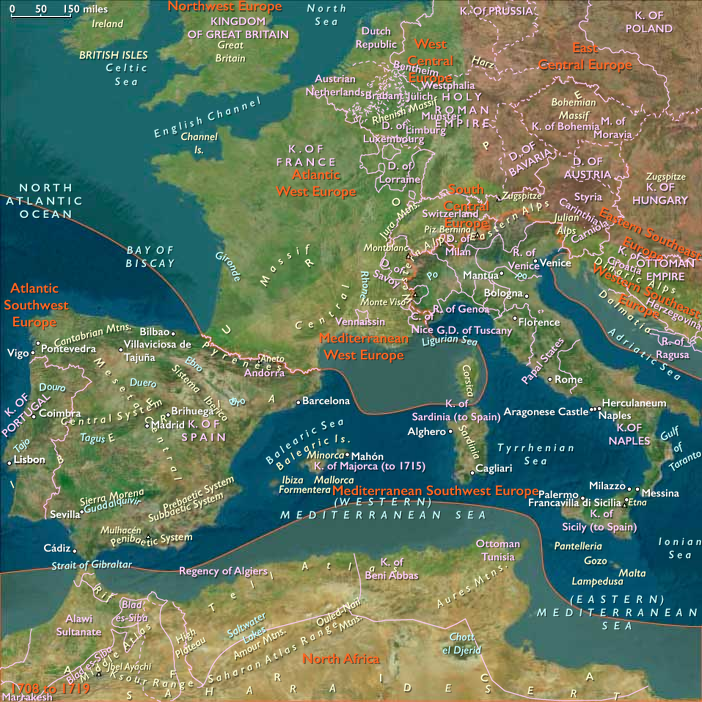
Mediterranean Southwest Europe (1708–1719 CE): War's Resolution and Territorial Realignments
The era 1708–1719 CE in Mediterranean Southwest Europe is characterized by the conclusion of the significant War of the Spanish Succession, territorial realignments, and the reshaping of political and cultural landscapes across the region.
Spain: Resolution and New Realities
The War of the Spanish Succession (1702–1714), initially triggered by the accession of the Bourbon Philip V to the Spanish throne, reaches a decisive conclusion. Despite British and Austrian support for the Habsburg claimant, Archduke Charles of Austria, Philip V's position in Castile remains solid. However, fierce resistance continues in Catalonia, which steadfastly defends its traditional liberties (fueros) against centralizing Bourbon policies. The prolonged and devastating Siege of Barcelona (1713–1714) ultimately forces Catalonia into submission, significantly altering its autonomy and integrating it more directly into a centralized Spanish state.
The Treaty of Utrecht (1713) formally ends the broader European conflict, confirming the Bourbon succession in Spain under the condition that the French and Spanish crowns never unite. This treaty profoundly impacts Spain’s international standing, as it loses substantial European territories: the Spanish Netherlands (subsequently known as the Austrian Netherlands) and its significant Italian possessions revert to Austrian Habsburg control. Britain solidifies its Mediterranean presence by retaining Gibraltar and Menorca, gaining crucial trade concessions in Spanish America. Although Spain maintains internal cohesion and its vast overseas empire, its role in European power dynamics diminishes considerably.
Italy: Shifting Influence and Cultural Continuity
In Italy, territorial shifts reshape the peninsula’s political landscape. Following the Treaty of Utrecht, significant territories such as Naples, Milan, and Sardinia come under Austrian rule. These changes reinforce Austrian influence over Italy, altering power dynamics among Italian states, which increasingly become strategic pawns in broader European diplomacy.
Despite political upheaval, Italy continues to flourish culturally. Cities like Venice and Rome sustain vibrant artistic and intellectual environments, where opera, painting, and architecture thrive amid international political shifts. Intellectual circles increasingly reflect early Enlightenment ideals, encouraging reason, scientific inquiry, and social reform, laying foundations for significant future cultural movements.
Malta: Strategic Consolidation and Stability
Malta remains a crucial Mediterranean stronghold under the governance of the Knights Hospitaller. The fortification of Valletta is further enhanced, strengthening the island’s strategic value amid shifting European alliances. Maltese medical institutions, notably the Sacra Infermeria, gain further prominence for their advanced healthcare standards, continuing Malta’s legacy as a medical leader in Europe.
Broader Regional Implications
Across Mediterranean Southwest Europe, the aftermath of the War of the Spanish Succession reshapes political alliances, territorial boundaries, and strategic priorities. Britain emerges as a significant Mediterranean maritime power, while Austria extends its influence into formerly Spanish territories. These realignments establish a new balance of power, significantly affecting regional stability and setting the stage for future geopolitical developments.
Conclusion: Foundations of a New Order
The era 1708–1719 CE marks a turning point for Mediterranean Southwest Europe, characterized by the resolution of the War of the Spanish Succession, significant territorial changes, and continuing cultural vibrancy. These developments decisively shape the political and cultural trajectory of the region, laying critical groundwork for subsequent eighteenth-century transformations.
People
- Bartolomeo Cristofori
- Charles II of Spain
- Charles VI, Holy Roman Emperor, King of the Romans (King of Germany)
- Louis XIV of France
- Philip V of Spain
- Pope Clement XI
- Pope Innocent XII
Groups
- Papal States (Republic of St. Peter)
- Malta
- Italy, Kingdom of (Holy Roman Empire)
- Genoa, (Most Serene) Republic of
- Christians, Roman Catholic
- Venice, (Most Serene) Republic of
- Austria, Archduchy of
- Gibraltar (United Kingdom overseas territory, claimed by Spain)
- Aragon, Crown of
- Menorca
- Sardinia, Kingdom of
- Holy Roman Empire
- Milan, Duchy of
- Ottoman Empire
- Naples, Kingdom of
- Spain, Habsburg Kingdom of
- Knights of Malta, Sovereign and Military Order of the
- Netherlands, Southern (Spanish)
- Habsburg Monarchy, or Empire
- Britain, Kingdom of Great
- Netherlands, Southern (Austrian)
Topics
Commodoties
Subjects
Regions
Subregions

Years: 1708 - 1719
People
- Bartolomeo Cristofori
- Charles II of Spain
- Charles VI, Holy Roman Emperor, King of the Romans (King of Germany)
- Louis XIV of France
- Philip V of Spain
- Pope Clement XI
- Pope Innocent XII
Groups
- Papal States (Republic of St. Peter)
- Malta
- Italy, Kingdom of (Holy Roman Empire)
- Genoa, (Most Serene) Republic of
- Christians, Roman Catholic
- Venice, (Most Serene) Republic of
- Austria, Archduchy of
- Gibraltar (United Kingdom overseas territory, claimed by Spain)
- Aragon, Crown of
- Menorca
- Sardinia, Kingdom of
- Holy Roman Empire
- Milan, Duchy of
- Ottoman Empire
- Naples, Kingdom of
- Spain, Habsburg Kingdom of
- Knights of Malta, Sovereign and Military Order of the
- Netherlands, Southern (Spanish)
- Habsburg Monarchy, or Empire
- Britain, Kingdom of Great
- Netherlands, Southern (Austrian)
Topics
Commodoties
Subjects
Regions
Subregions