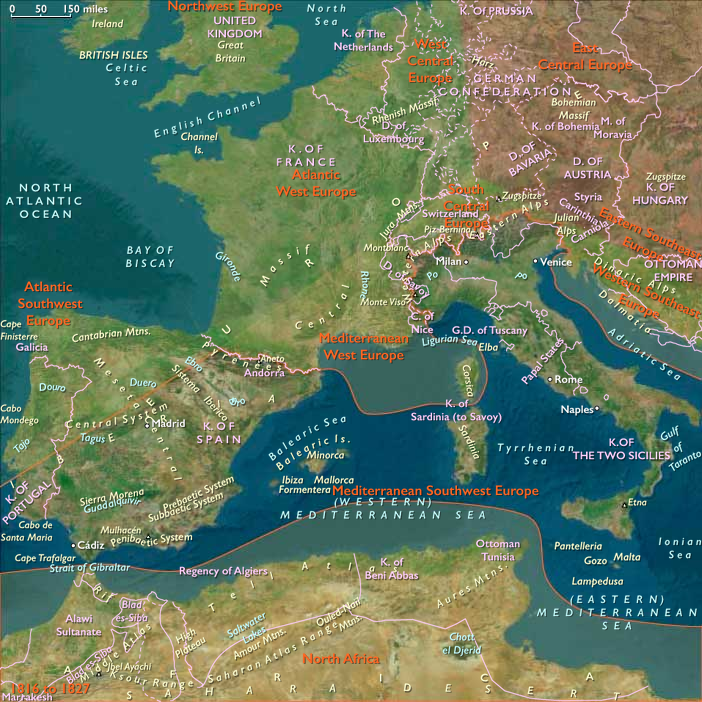
Mediterranean Southwest Europe (1816–1827 CE): Revolutions, Liberalism,…
1816 CE to 1827 CE
Mediterranean Southwest Europe (1816–1827 CE): Revolutions, Liberalism, and the Crisis of Empire
The era 1816–1827 CE in Mediterranean Southwest Europe is characterized by ongoing political instability, revolutionary fervor, and the collapse of Spanish authority in its American colonies, reshaping political landscapes across the region.
Turmoil and Revolution in Spain
In Spain, King Ferdinand VII struggles to maintain control following the upheavals of the Napoleonic Wars. The restoration of his absolute monarchy after 1814 faces significant resistance, exacerbated by attempts to reconquer rebellious American colonies. Efforts to maintain an inflated wartime army and finance costly military expeditions lead to severe economic strain and widespread discontent.
In 1820, dissatisfaction culminates in a military uprising led by Major Rafael de Riego, who issues a pronunciamiento—a revolutionary declaration demanding reinstatement of the liberal Constitution of 1812. Riego’s revolt gains widespread military support, forcing Ferdinand to accept constitutional rule, thus beginning the Constitutional Triennium (1820–1823). The pronunciamiento sets a lasting precedent in Spanish politics, where military consensus often determines political power.
The Liberal Experiment and its Collapse
Under the liberal government of the Constitutional Triennium, significant reforms seek to modernize Spain. These include measures to ensure equality before the law, a centralized administration, and greater freedoms in economic affairs. However, the reforms trigger fierce opposition from conservative sectors and the restored monarch.
In 1823, a French army, invited by Ferdinand VII and backed by conservative European powers, invades Spain to restore royal absolutism, quickly ending the brief liberal experiment. The liberals and their reforms are suppressed, reinstating Ferdinand's absolute rule and marking a return to authoritarian governance.
Loss of the Spanish American Colonies
While Spain struggles domestically, its American colonies decisively break away. By 1825, nearly all former colonies in Spanish America have declared independence and established republican governments, leaving only Cuba and Puerto Rico under Spanish rule. Spain’s efforts to reclaim these territories strain its resources and exacerbate internal tensions, highlighting its diminished status as a global power.
Continued Transformations in Italy and Andorra
In Italy, regions once under Napoleonic control are adjusting to new political realities following the Congress of Vienna. Genoa’s incorporation into the Kingdom of Sardinia marks a permanent shift away from its historic independence, reshaping regional power dynamics.
Andorra continues to enjoy relative stability, having regained its traditional autonomy in 1814. The small principality maintains its distinctive governance, largely unaffected by broader revolutionary movements sweeping through Spain and Italy.
Conclusion: A Region at the Crossroads
The period 1816–1827 CE highlights the profound challenges and transformative forces reshaping Mediterranean Southwest Europe. Revolution, liberal aspirations, and the decline of colonial empires fundamentally alter the political, social, and economic landscape, setting the stage for further turmoil and the long-term struggle between conservative and liberal ideologies in the region.
Groups
Topics
Regions
Southwest Europe
View →Subregions