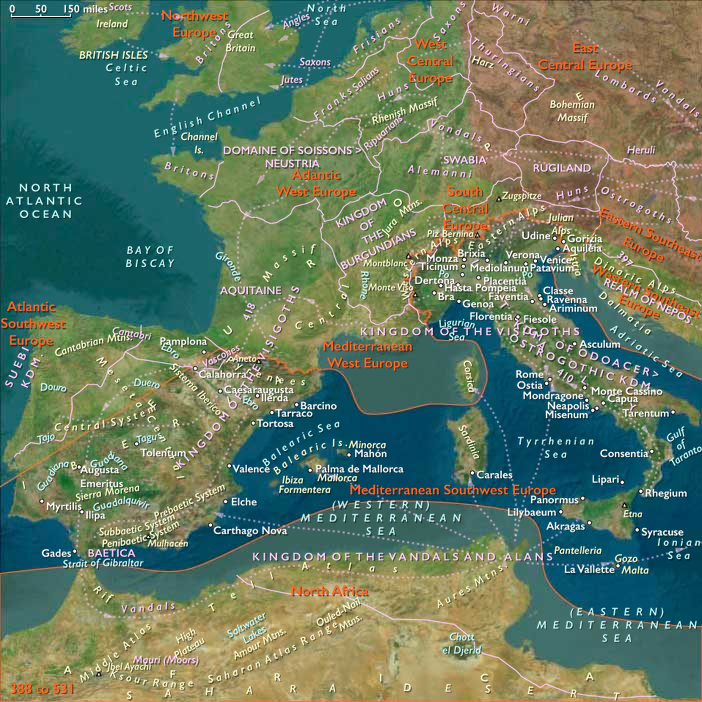
Mediterranean Southwest Europe (388–399 CE): Theodosius's Consolidation …
Years: 388 - 399
Mediterranean Southwest Europe (388–399 CE): Theodosius's Consolidation and Religious Orthodoxy
The era 388–399 CE in Mediterranean Southwest Europe is defined by the firm consolidation of imperial authority under Theodosius I, the deepening integration of Christianity as the state religion, and evolving cultural dynamics amid persistent external threats.
Imperial Consolidation under Theodosius I
After successfully defeating the usurper Magnus Maximus in 388 CE, Theodosius I unifies the Roman Empire for the last time under single imperial authority. His leadership stabilizes the empire temporarily, reasserting central control and solidifying political cohesion across Mediterranean Southwest Europe.
The Edicts Against Paganism
Theodosius intensifies his religious policies, promoting Christianity through a series of edicts targeting traditional Roman paganism. Notably, between 391 and 392 CE, he issues edicts prohibiting pagan worship and sacrifices, resulting in widespread closure and destruction of temples. These measures significantly accelerate the decline of traditional religious practices in favor of Christianity.
Cultural Shifts and the Dominance of Christianity
Christianity's ascendance deeply influences cultural and intellectual expression. Public art, architecture, and literature increasingly reflect Christian themes, reshaping the cultural landscape. Traditional Roman values and imagery continue to evolve, integrating into a distinctly Christianized cultural identity.
Economic Resilience and Provincial Stability
Despite religious upheaval and administrative realignment, regional economies demonstrate resilience. Infrastructure projects initiated under Theodosius, combined with stable agricultural and commercial activity, sustain economic vitality across Mediterranean Southwest Europe.
Military Vigilance and Frontier Pressures
Throughout his reign, Theodosius maintains rigorous frontier defenses, notably against renewed threats from Germanic tribes. The stabilization of Gothic federates within the empire provides short-term security, yet underscores Rome’s increasing reliance on allied barbarian groups for defense.
Division of the Empire (395 CE)
Upon Theodosius’s death in 395 CE, the Roman Empire is definitively divided between his sons—Arcadius in the East and Honorius in the West—marking a permanent division that profoundly influences subsequent historical developments in the region.
Legacy of the Era
The era 388–399 CE marks a significant turning point characterized by imperial unification followed by permanent division, the decisive triumph of Christianity over paganism, and enduring economic and cultural transformations. Theodosius’s reign solidifies Christianity’s primacy, reshapes imperial governance, and sets the stage for the profound political and cultural shifts that define the Roman world in the following centuries.
Years: 388 - 399
People
Groups
- Polytheism (“paganism”)
- Christianity, Nicene
- Roman Empire: Valentinian dynasty (Rome)
- Roman Empire: Theodosian dynasty (Constantinople)
- Ostrogoths, Realms of the
- Visigoths, Realm of the
- Roman Empire, Western (Milan)
Subjects
Regions
Subregions