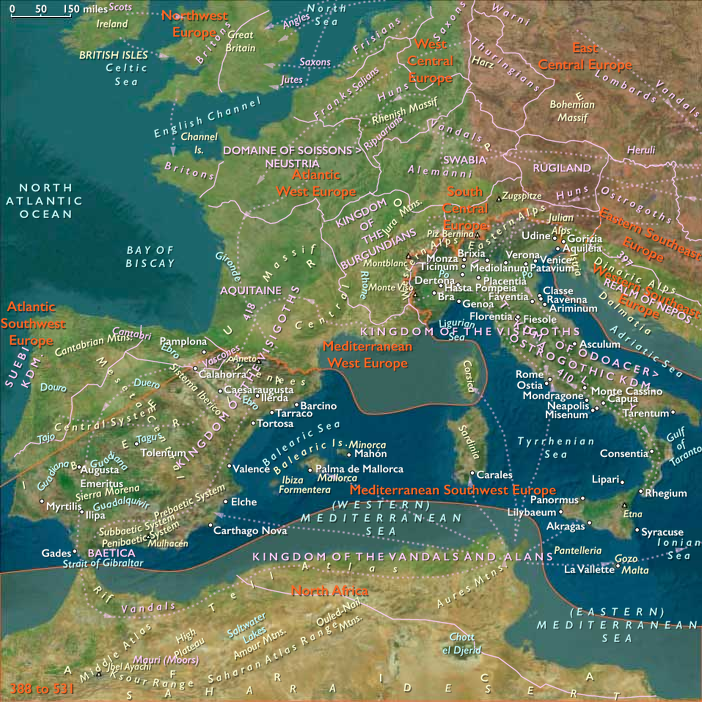
Mediterranean Southwest Europe (400–411 CE): Barbarian Invasions…
400 CE to 411 CE
Mediterranean Southwest Europe (400–411 CE): Barbarian Invasions and Imperial Decline
The era 400–411 CE in Mediterranean Southwest Europe is marked by escalating barbarian incursions, profound imperial decline, and significant shifts in political and social structures, particularly within the Western Roman Empire.
Barbarian Incursions and Alaric’s Visigoths
At the start of the fifth century, increased pressure from Germanic tribes profoundly destabilizes the region. In 401 CE, the Visigothic king Alaric invades Italy, demonstrating Rome’s growing vulnerability. His repeated campaigns culminate dramatically with the sack of Rome itself in 410 CE, a symbolic event underscoring the empire’s diminished military capabilities and political cohesion.
Imperial Weakness under Honorius
Emperor Honorius, ruling from Ravenna, struggles to respond effectively to external threats and internal rebellions. His reign is characterized by political weakness, marked indecisiveness, and an overreliance on military commanders such as Stilicho, whose execution in 408 CE further exacerbates imperial vulnerability.
Economic Disruption and Urban Decline
These invasions severely disrupt regional economies. Agricultural production declines, trade routes fragment, and urban centers experience contraction and impoverishment. The sack of Rome significantly undermines confidence, further accelerating economic and urban decline across Mediterranean Southwest Europe.
Religious Shifts and Christian Resilience
Despite political and economic upheavals, Christianity continues to flourish, solidifying its role as a dominant cultural and spiritual force. Notably, Augustine of Hippo, an influential theologian active during this period, shapes Christian thought profoundly through works like Confessions and The City of God, written partially in response to Rome's sack in 410.
Provincial Autonomy and Local Governance
As centralized imperial authority deteriorates, regional and local authorities increasingly assert autonomy. Provincial governors and military commanders often act independently to defend their territories, reflecting a broader trend toward decentralized governance and localized responsibility.
Cultural Transition and Continuity
Cultural life remains resilient, despite the significant disruptions caused by barbarian invasions. Roman traditions, integrated with robust Christian influences, persist in art, literature, and philosophy, illustrating the adaptive capacity of Roman culture even amidst profound political instability.
Legacy of the Era
The era 400–411 CE signifies a critical juncture marked by significant invasions, imperial weaknesses, and economic disruption. The sack of Rome by Alaric symbolizes a pivotal moment of imperial decline, accelerating the transition toward decentralized governance and reshaping cultural and religious identities throughout Mediterranean Southwest Europe.
Groups
Topics
Subjects
Regions
Southwest Europe
View →Subregions