
Mediterranean Southwest Europe (405–394 BCE): Carthaginian Dominance …
Years: 405BCE - 394BCE
Mediterranean Southwest Europe (405–394 BCE): Carthaginian Dominance and Etruscan Decline
The era 405–394 BCE in Mediterranean Southwest Europe witnesses decisive military conflicts, expanding Carthaginian influence, significant shifts in regional power dynamics, and notable Roman territorial expansion amid continued cultural flourishing.
Carthaginian Supremacy in Sicily
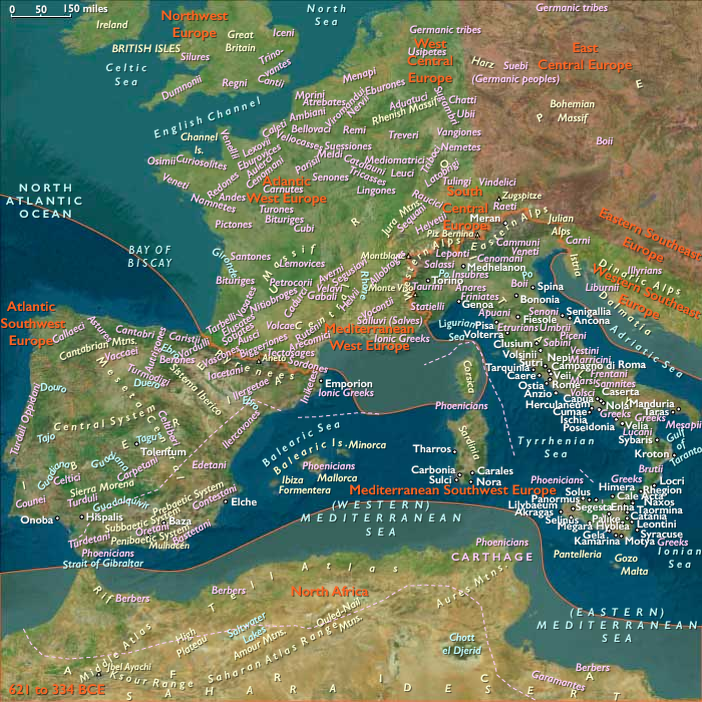
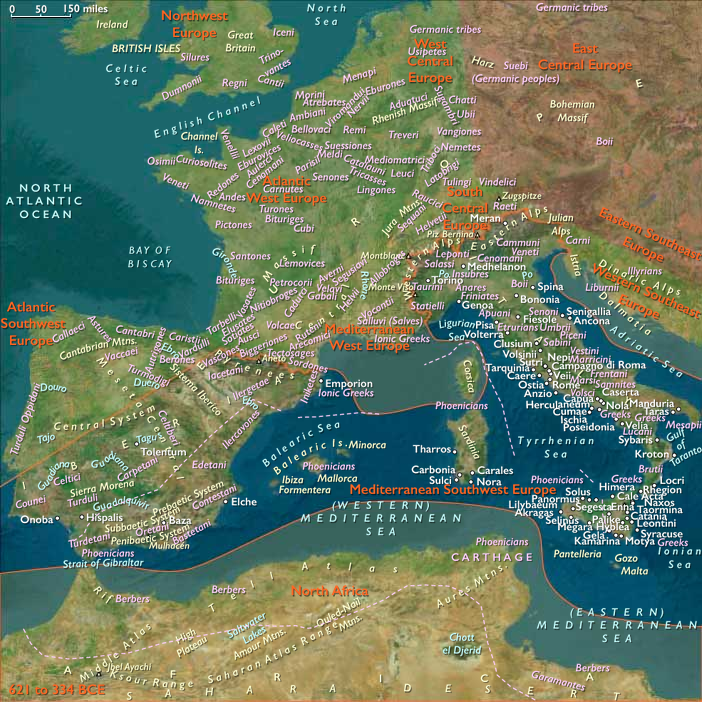
During this period, Carthaginian influence peaks under the command of Himilco, who assumes control of the Carthaginian forces in Sicily. Himilco decisively sacks the city of Camarina and repeatedly defeats the forces of Dionysius I, the newly established tyrant of Syracuse. Despite military success, a devastating plague strikes the Carthaginian army, prompting Himilco to negotiate a peace treaty. The treaty solidifies Carthaginian dominance, making cities such as Selinus, Thermae, Akragas, Gela, and Camarina tributary vassals.
Expansion and Resistance under Dionysius I
In response to Carthaginian pressure, Dionysius I intensifies military efforts from 397 BCE, engaging Carthage in renewed conflict. Dionysius concurrently undertakes aggressive campaigns in southern Italy, capturing Rhegium and attacking its allied cities throughout Magna Graecia. With support from the Lucanians, Dionysius devastates territories belonging to Thurii and Croton in defense of the city of Locri, highlighting Syracuse’s regional ambitions and influence.
Roman Expansion and the Fall of Veii
Significant developments also unfold on the Italian mainland, particularly involving the Roman Republic. Rome, under the leadership of the semi-legendary general Marcus Furius Camillus, initiates a prolonged siege of Veii, the wealthiest city within the Etruscan League. In 396 BCE, Rome successfully captures and occupies Veii, significantly extending its influence and territory. This event marks a turning point, initiating the gradual decline of Etruscan dominance in the region.
Celtic Incursions into Northern Italy
This era also witnesses notable Celtic incursions into northern Italy, significantly reshaping the regional landscape. Around 400 BCE, the Senones, a Gallic tribe originating from present-day France, cross the Alps, settle the eastern Italian coast between Ariminum and Ancona, and establish Sena Gallica (modern Sinigaglia) as their capital. Additionally, Celts seize the city of Melpum (present-day Milan) around 396 BCE and found new settlements including Turin and Bononia (modern Bologna), significantly expanding their territorial foothold.
Cultural and Artistic Continuity
Cultural achievements continue alongside these conflicts. Notable Etruscan artistic production remains vibrant, demonstrated by fine metalwork and sculptural accomplishments. The production of red-figure pottery at Orvieto and Chiusi in Etruria flourishes, representing ongoing artistic innovation and maintaining the region’s rich cultural legacy amid political instability.
Legacy of the Era
The era 405–394 BCE dramatically reshapes Mediterranean Southwest Europe, characterized by Carthaginian ascendancy in Sicily, significant Roman territorial expansion, and influential Celtic settlements in northern Italy. These transformations decisively influence regional power dynamics, setting the stage for subsequent historical developments across the Mediterranean.
People
Groups
- Locrians
- Sicily, classical
- Italy, classical
- Celts
- Carthage, Kingdom of
- Greeks, Classical
- Magna Graecia
- Rhegium, Greek city-state of
- Syracuse, Corinthian city-state of
- Croton (Achaean Greek) city-state of
- Gela (Dorian Greek) city-state of
- Camerina (Dorian Greek) city-state of
- Akragas (Dorian Greek) city-state of
- Roman Republic
- Athenian Empire (Delian League)
- Lucani
- Senones of Gallia Cisalpina
Topics
Commodoties
Subjects
Regions
Subregions
Related Events
Showing 10 events out of 65030 total
Years: 405BCE - 394BCE
People
Groups
- Locrians
- Sicily, classical
- Italy, classical
- Celts
- Carthage, Kingdom of
- Greeks, Classical
- Magna Graecia
- Rhegium, Greek city-state of
- Syracuse, Corinthian city-state of
- Croton (Achaean Greek) city-state of
- Gela (Dorian Greek) city-state of
- Camerina (Dorian Greek) city-state of
- Akragas (Dorian Greek) city-state of
- Roman Republic
- Athenian Empire (Delian League)
- Lucani
- Senones of Gallia Cisalpina
Topics
Commodoties
Subjects
Regions
Subregions