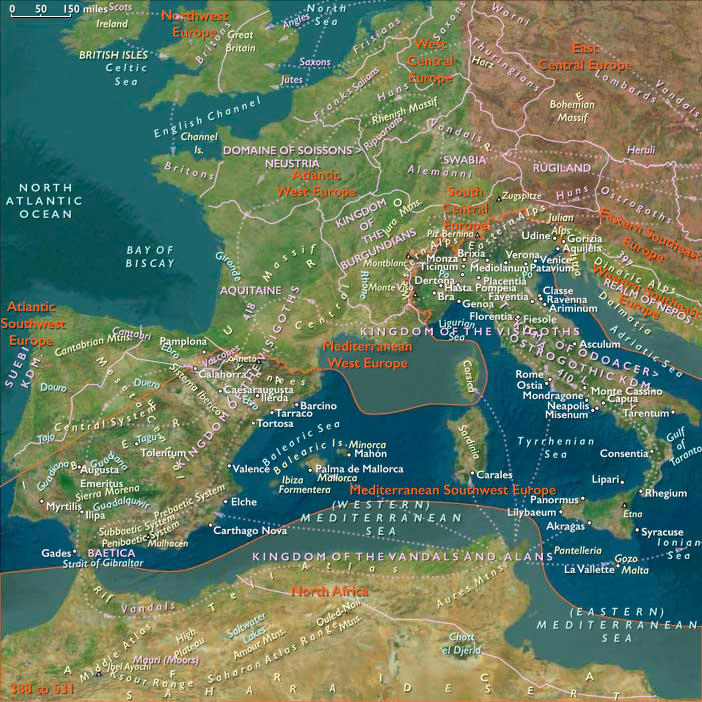
Mediterranean Southwest Europe (496–507 CE): Visigothic Consolidation…
496 CE to 507 CE
Mediterranean Southwest Europe (496–507 CE): Visigothic Consolidation and Frankish Rivalry
The era 496–507 CE in Mediterranean Southwest Europe is characterized by the further consolidation of Visigothic power under King Alaric II, significant political and religious developments, and the increasing rivalry between the Visigoths and the rising Frankish Kingdom under Clovis I.
Alaric II’s Visigothic Rule
Following the death of his father Euric in 484 CE, Alaric II (r. 484–507 CE) continues to consolidate the Visigothic Kingdom across Iberia and southern Gaul. His reign sees the integration of Roman administrative traditions into Visigothic governance, reflecting a deliberate effort to maintain continuity with Rome’s legacy and to stabilize Visigothic rule.
Codification of the Breviary of Alaric
In 506 CE, Alaric II promulgates the Breviary of Alaric (Lex Romana Visigothorum), a comprehensive compilation of Roman laws intended to govern his Roman subjects. This legal codification emphasizes the Visigoths' efforts to accommodate Roman cultural and administrative traditions, underscoring the integration of Germanic and Roman societal structures.
Rise of Clovis and the Frankish Threat
During this period, the Franks under King Clovis I rapidly expand their territory and influence. Clovis, who converts to Catholic Christianity around 496 CE, positions himself as both a religious and political rival to the Arian Christian Visigoths. This deepening religious divide exacerbates tensions between the two kingdoms, setting the stage for future conflict.
Religious Tensions and Ecclesiastical Influence
Religious differences become a central point of tension. The Visigoths remain predominantly Arian Christians, while the Franks under Clovis align with Roman Catholic orthodoxy. The Catholic Church increasingly sides with the Frankish ruler, influencing regional religious and political dynamics, and complicating Visigothic efforts to maintain authority over Roman Catholic populations.
Battle of Vouillé and Visigothic Defeat
Mounting tensions culminate in the decisive Battle of Vouillé in 507 CE, where Clovis decisively defeats Alaric II. The Visigothic King Alaric II is killed in battle, marking a turning point that significantly reduces Visigothic holdings in Gaul, forcing the Visigoths to retreat predominantly into the Iberian Peninsula.
Cultural and Economic Continuity
Despite political upheaval, cultural and economic activities remain robust. Visigothic Iberia continues to demonstrate resilience, with urban centers, trade networks, and agricultural productivity maintaining regional economic stability. Cultural life, influenced heavily by Roman and Christian traditions, remains dynamic, evident in ongoing artistic and ecclesiastical developments.
Legacy of the Era
The era 496–507 CE significantly reshapes the political landscape of Mediterranean Southwest Europe, marking the transition from Visigothic dominance in southern Gaul to Frankish ascendancy. The period also sets the stage for the emergence of distinct political and religious identities in both Gaul and Iberia, profoundly influencing the medieval history of the region.
Groups
Topics
Regions
Southwest Europe
View →Subregions