
Mediterranean Southwest Europe (489–478 BCE): Roman …
Years: 489BCE - 478BCE
Mediterranean Southwest Europe (489–478 BCE):
Roman Consolidation, Greek-Carthaginian Relations, and Etruscan Decline
Between 489–478 BCE, Mediterranean Southwest Europe experiences significant shifts marked by Rome’s political stabilization, dynamic interactions between Carthaginian and Greek city-states, and signs of gradual Etruscan decline.
Roman Political and Military Strengthening
During this era, the Roman Republic solidifies its political foundations and military strength. In 486 BCE, Rome successfully engages and defeats the Volsci and the Aequi, securing regional stability in Latium. These victories allow Rome to reinforce its political influence and assert its leadership within the Latin League, laying groundwork for future territorial expansion.
Carthaginian and Greek Dynamics in Sicily
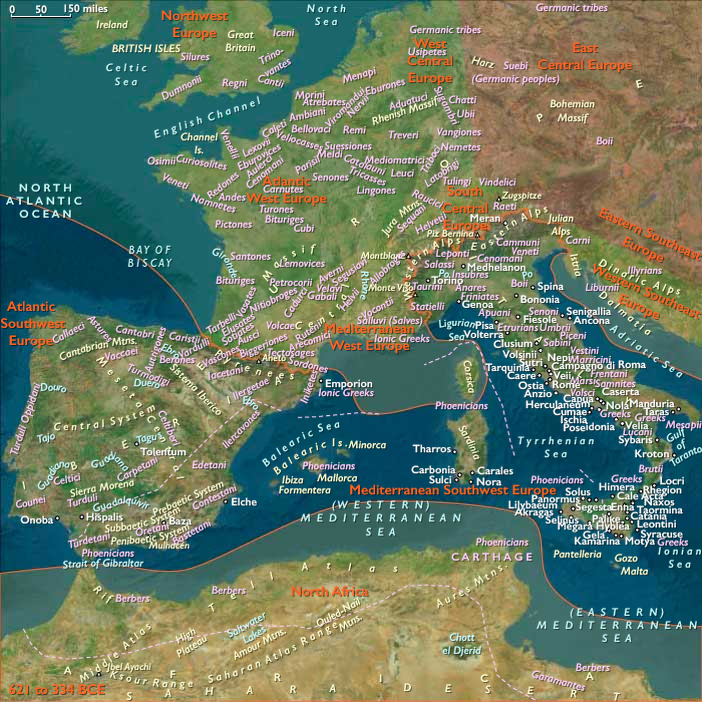
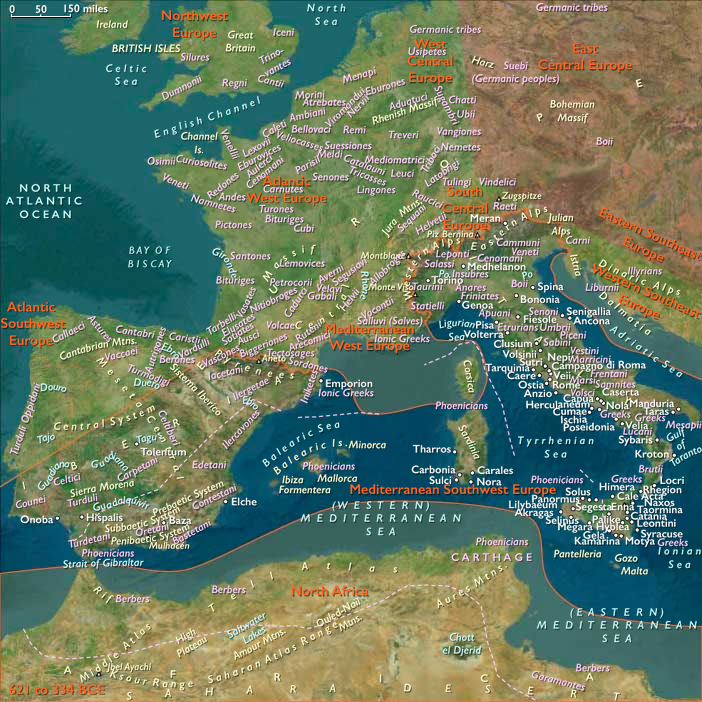
In 483 BCE, Gelo, now the powerful ruler of Gela, extends his influence by seizing the prominent city of Syracuse, becoming its tyrant and significantly consolidating Greek power in Sicily. This realignment heightens tensions with Carthaginian interests, notably around Carthaginian-aligned cities such as Motya, Panormus (Palermo), and Solus. Despite their rivalry, limited diplomatic engagements suggest cautious coexistence, as both Greek and Carthaginian powers seek to stabilize their respective territorial claims.
Decline of Etruscan Dominance
Etruscan influence, prominent earlier in the century, begins to wane. In 479 BCE, the city of Veii suffers defeat in a conflict with Rome, symbolizing diminishing Etruscan military prowess and political influence. Although Etruscan cities remain culturally significant, Rome’s growing assertiveness foreshadows a broader Etruscan decline in the coming decades.
Cultural and Artistic Continuity
Despite political and military upheavals, Mediterranean Southwest Europe continues its vibrant cultural development. Etruscan artisans maintain their renowned artistic traditions, notably producing bronze mirrors and sculptures characterized by sophisticated craftsmanship. Concurrently, Greek colonies in southern Italy and Sicily remain important cultural centers, sustaining flourishing artistic and intellectual exchanges with mainland Greece.
Legacy of the Era
The years 489–478 BCE establish critical precedents for the region’s future. Rome’s internal stability and external assertiveness, the cautious Greek-Carthaginian diplomacy, and early indications of Etruscan decline collectively influence Mediterranean Southwest Europe's evolving geopolitical landscape, setting the stage for subsequent transformations.
People
Groups
- Sicily, classical
- Italy, classical
- Volsci (Italic tribe)
- Aequi
- Carthage, Kingdom of
- Greeks, Classical
- Roman Kingdom
- Magna Graecia
- Syracuse, Corinthian city-state of
- Etruria
- Roman Republic
Topics
Commodoties
Subjects
Regions
Subregions
Related Events
Showing 10 events out of 65624 total
Years: 489BCE - 478BCE
People
Groups
- Sicily, classical
- Italy, classical
- Volsci (Italic tribe)
- Aequi
- Carthage, Kingdom of
- Greeks, Classical
- Roman Kingdom
- Magna Graecia
- Syracuse, Corinthian city-state of
- Etruria
- Roman Republic
Topics
Commodoties
Subjects
Regions
Subregions