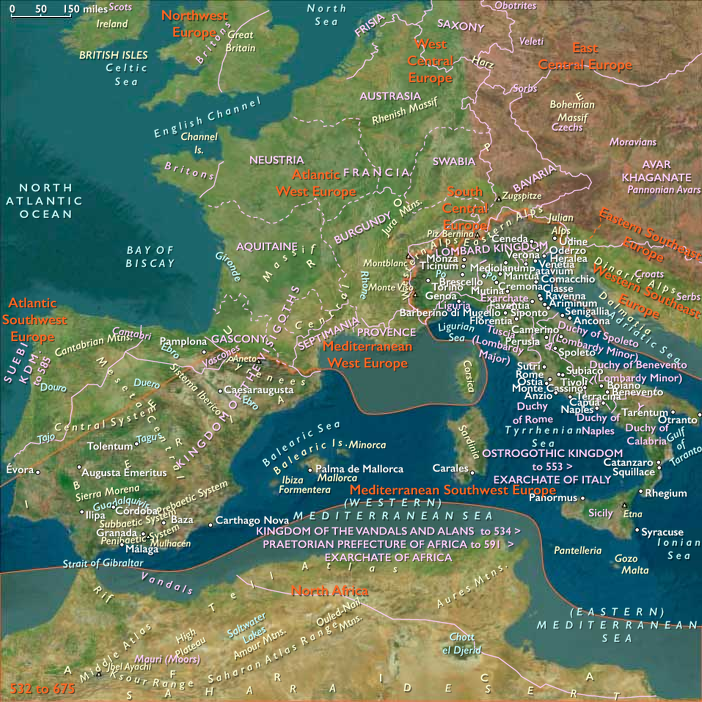
Mediterranean Southwest Europe (544–555 CE): Byzantine Reconquest…
544 CE to 555 CE
Mediterranean Southwest Europe (544–555 CE): Byzantine Reconquest and Gothic Decline
The era 544–555 CE in Mediterranean Southwest Europe is marked by the Byzantine Empire’s renewed and intensified efforts to reclaim Italy, resulting in significant setbacks for the Ostrogoths, and further consolidation of Visigothic authority within Iberia.
Byzantine Reconquest and Ostrogothic Decline
Under Emperor Justinian I, the Eastern Roman Empire (Byzantium) renews military campaigns against the Ostrogoths in Italy, marking a decisive turning point in the protracted Gothic War. General Belisarius initially leads the Byzantine efforts, achieving important but inconclusive gains. In 552 CE, his successor, Narses, achieves a critical victory at the Battle of Taginae (Busta Gallorum), decisively defeating the Ostrogothic King Totila, who is killed in battle. This decisive defeat effectively marks the end of substantial Ostrogothic resistance, facilitating the full restoration of Byzantine rule across the Italian Peninsula.
Destruction and Reconstruction in Italy
The prolonged conflict leaves Italy economically devastated and significantly depopulated. Major urban centers such as Rome, Ravenna, and Milan suffer extensive destruction, undermining the region’s long-term prosperity. Despite the heavy toll, Byzantine rule initiates a phase of gradual administrative reconstruction, integrating Italy more directly under Eastern Roman governance, though full recovery remains slow and uneven.
Visigothic Stability and Governance in Iberia
Meanwhile, the Visigothic Kingdom in Iberia enjoys relative political stability, firmly anchored around the capital of Toledo. Internal governance strengthens under King Agila I (r. 549–554 CE), although his rule is marked by intermittent internal dissent. The Visigoths consolidate their control over local Roman and indigenous populations, laying firmer administrative and cultural foundations for future development.
Continued Ecclesiastical Authority
The Church remains a powerful stabilizing force during this turbulent era. Ecclesiastical authorities maintain continuity and order, particularly vital in war-torn Italy. The Papacy increasingly asserts theological authority, reinforcing orthodoxy and providing spiritual leadership that helps stabilize communities disrupted by prolonged military conflicts.
Legacy of the Era
The period 544–555 CE fundamentally reshapes Mediterranean Southwest Europe, decisively weakening Gothic political influence in Italy, reaffirming Byzantine imperial authority, and consolidating Visigothic rule in Iberia. These transformative shifts lay critical foundations for the medieval socio-political and cultural structures that follow.
People
Groups
Regions
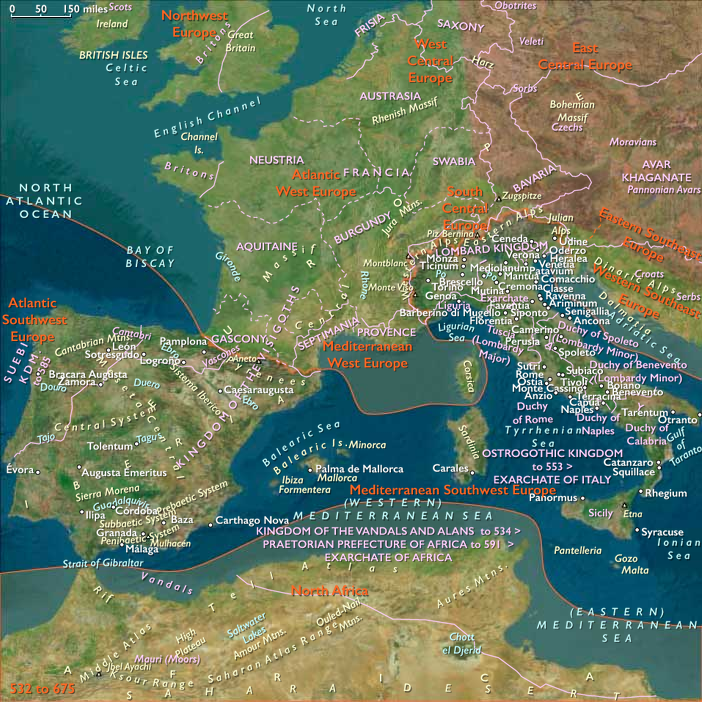
Southwest Europe
View →Subregions