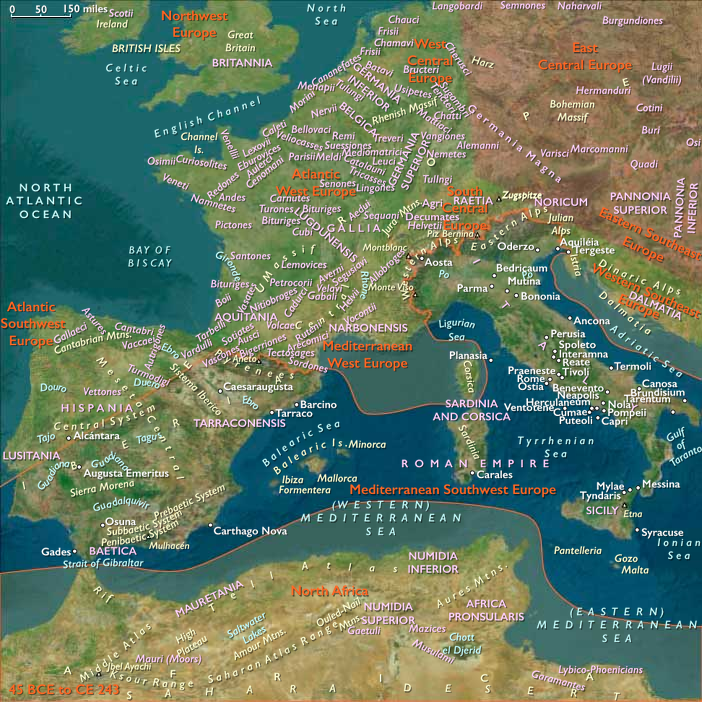
Mediterranean Southwest Europe (189–46 BCE): Republican Consolidation,…
189 BCE to 46 BCE
Mediterranean Southwest Europe (189–46 BCE): Republican Consolidation, Regional Specialization, and the Mature Western Mediterranean
The age 189–46 BCE represents the mature phase of the Roman Republic in Mediterranean Southwest Europe. Throughout Italy, Sicily, Sardinia, Malta, the Balearic Islands, southern Portugal, southern, south-central, and eastern Spain, Andorra, and the central and eastern Spanish Pyrenees, centuries of expanding roads, colonies, ports, and agricultural development produced one of the ancient world's most highly integrated regional economies. Productive landscapes became increasingly specialized, maritime exchange intensified, and administrative institutions grew more sophisticated even as political tensions within the Republic gradually intensified.
Agricultural Intensification and Regional Specialization
Agriculture remained the enduring foundation of Mediterranean society, but regional production became increasingly specialized. Sicily, Sardinia, and parts of southern Italy supplied vast quantities of grain to expanding urban populations, while olive cultivation intensified throughout southern Italy and Mediterranean Iberia. Vineyards spread across favorable hillsides, orchards became more extensive, and mixed farming continued supporting villages and market towns throughout the countryside.
Large agricultural estates expanded in many regions, particularly where commercial production supplied distant markets. Nevertheless, smaller farms, tenant communities, pastoral systems, and village agriculture continued contributing substantially to regional production. The Mediterranean landscape became increasingly organized through carefully managed fields, terraces, irrigation works, roads, bridges, storage facilities, and local marketplaces.
The Mature Roman Countryside
The Italian Peninsula entered its most highly organized republican phase. Roads connected nearly every productive district to market towns, ports, and administrative centers, while colonies increasingly served as permanent nodes of territorial administration rather than purely military settlements.
The countryside itself displayed remarkable institutional maturity. Farmsteads, villas, villages, sanctuaries, workshops, bridges, quarries, and market centers formed continuous regional landscapes in which agricultural production, transportation, and local government became closely integrated. River crossings, coastal ports, and mountain passes were increasingly maintained as parts of an organized territorial network extending well beyond Italy itself.
Hispania and the Expansion of Provincial Landscapes
Mediterranean Iberia became one of Rome's most economically important provincial regions. Agricultural production expanded alongside extensive mining operations producing silver, copper, lead, and iron, while fisheries, salt production, pottery manufacture, and olive cultivation increasingly supplied wider Mediterranean markets.
Roman colonies, roads, and administrative centers gradually reorganized provincial landscapes without eliminating indigenous settlement traditions. Iberian communities remained active participants in regional economic life, adapting Roman institutions to long-established agricultural systems. Local traditions, languages, and artistic practices persisted even as provincial administration became increasingly integrated into the broader Roman world.
Maritime Networks and Commercial Integration
Maritime commerce reached unprecedented levels during this age. Merchant shipping connected Italy, Sicily, Sardinia, Malta, the Balearic Islands, and Mediterranean Iberia through regular movements of grain, olive oil, wine, livestock, metals, ceramics, timber, textiles, and manufactured goods. Ports expanded primarily as logistical and commercial centers serving productive hinterlands rather than as isolated urban monuments.
The western Mediterranean increasingly functioned as a unified economic basin. Coastal shipping linked numerous intermediate ports, while islands served as vital staging points connecting Italy with Hispania, North Africa, and the wider Mediterranean. The sea remained the region's most efficient transportation corridor, complementing the increasingly dense terrestrial road network.
Regional Communities Within an Integrated Republic
Despite growing administrative integration, regional diversity remained one of the Republic's greatest strengths. Greek cities in southern Italy continued contributing intellectual, artistic, and commercial traditions. Etruscan communities remained influential through established patterns of landholding, engineering, religion, and craftsmanship. Iberian societies preserved distinctive agricultural and cultural practices while participating fully in provincial commerce.
Throughout the countryside, village communities retained considerable local autonomy. Market towns coordinated surrounding agricultural districts, while seasonal pastoralism continued across the Apennines, Sardinia, Sicily, and the central and eastern Spanish Pyrenees. The environmental diversity of Mediterranean Southwest Europe remained fundamental to its economic resilience.
Roads, Markets, and Administrative Density
Transportation infrastructure reached an unprecedented level of development. Major roads connected Italy with Alpine passes, Adriatic ports, and southern agricultural districts while provincial roads increasingly linked Mediterranean Iberia's fertile valleys, mining regions, and coastal settlements. Bridges, milestones, warehouses, markets, and harbor installations became common components of regional landscapes.
Administrative organization likewise became denser. Local magistrates, provincial governors, tax officials, merchants, and landowners operated within increasingly standardized legal and commercial frameworks. The resulting landscape reflected a remarkable degree of institutional coordination without requiring political uniformity at every local level.
Republican Strains Within a Successful System
The very success of Roman expansion generated new challenges. Concentrations of wealth, extensive provincial administration, commercial specialization, expanding military commitments, and increasing social inequality placed growing pressure upon republican political institutions. Reform movements, civil conflicts, and political rivalries reflected the difficulties of governing a territorial system that had grown far beyond the scale for which earlier republican institutions had been designed.
Yet these political struggles seldom interrupted the underlying environmental and economic organization of the region. Agricultural production continued, roads remained in use, ports remained active, and regional exchange networks continued functioning even during periods of political instability.
Legacy of the Age
Between 189 and 46 BCE, Mediterranean Southwest Europe reached the height of the Roman Republic's territorial and economic organization. Roads, bridges, ports, colonies, provincial administration, and specialized agricultural landscapes combined to produce an exceptionally integrated western Mediterranean whose productivity rested upon centuries of cumulative environmental management and institutional development.
The age's greatest historical achievement was not simply Rome's political dominance but the maturation of an interconnected regional system in which agriculture, commerce, transportation, and local administration operated at an unprecedented scale. At the same time, the very complexity of this successful republic exposed structural tensions that increasingly challenged traditional political institutions. By 46 BCE, Mediterranean Southwest Europe possessed one of the ancient world's most sophisticated territorial landscapes, prepared for the transition from republican governance to the imperial system that would emerge during the following age.
Images

Mediterranean Southwest Europe in Classical Antiquity III
People
Groups
Topics
Regions
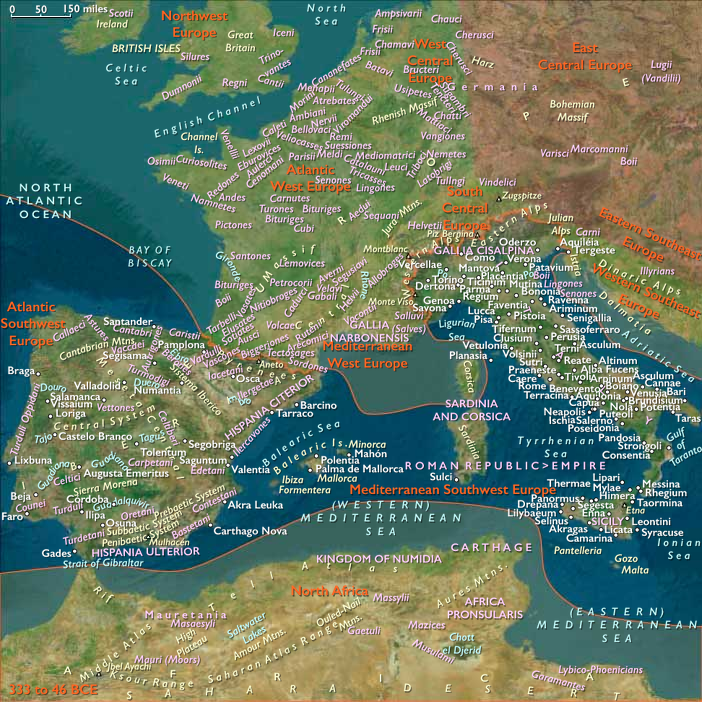
Southwest Europe
View →Subregions