
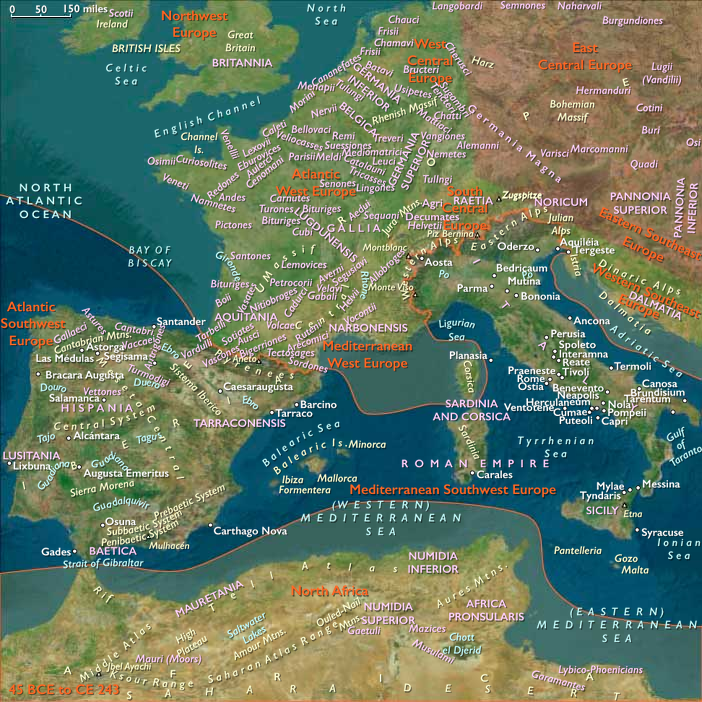
Mediterranean Southwest Europe (45–34 BCE): Caesar's Consolidation …
Years: 45BCE - 34BCE
Mediterranean Southwest Europe (45–34 BCE): Caesar's Consolidation and the End of the Republic
The era 45–34 BCE is pivotal in Roman history, characterized by the consolidation of Julius Caesar’s power and the definitive end of the Roman Republic. This period witnesses Caesar's establishment of unprecedented authority, his assassination, and the subsequent turmoil marking Rome’s transition to imperial governance.
Caesar’s Final Triumphs and Dictatorship for Life
By 45 BCE, Julius Caesar has decisively defeated the remaining senatorial opposition at the Battle of Munda in Hispania, effectively ending the lingering civil war. Caesar’s victory at Munda is notably challenging, and upon his return to Rome, he further solidifies his power by assuming the title dictator perpetuo (dictator for life) in early 44 BCE. This unprecedented move symbolizes the irreversible shift away from the traditional republican model toward autocratic rule.
Caesar undertakes significant administrative reforms, including the recalibration of the Roman calendar—the introduction of the Julian calendar—a major legacy that persists through millennia. He initiates extensive public works, urban renewal in Rome, and large-scale colonization projects, settling veterans and the urban poor in new provincial colonies.
Caesar's Assassination and the Ides of March
Caesar's increasing dominance, however, fuels resentment among senators who view his power as monarchical and antithetical to republican ideals. On the Ides of March (March 15), 44 BCE, Caesar is assassinated by a group of senators led by Marcus Junius Brutus and Gaius Cassius Longinus. The conspirators’ attempt to restore the Republic ironically plunges Rome into further civil war and political instability.
Aftermath and Power Struggle
Following Caesar's assassination, Rome quickly descends into chaos. Initially, public opinion in Rome turns against the conspirators, partly influenced by a stirring funeral oration by Caesar’s ally, Mark Antony, who skillfully sways public sentiment to outrage against the assassins. The conspirators flee Rome as Antony takes control.
Yet Antony’s dominance is quickly challenged. Caesar's adopted heir, the eighteen-year-old Octavian (later Augustus), arrives in Rome to claim his inheritance and political legacy. Despite initial cooperation against Caesar's assassins, Antony and Octavian soon become rivals, each vying for dominance.
Formation of the Second Triumvirate
By 43 BCE, political necessity drives Octavian and Antony, along with Marcus Aemilius Lepidus, to form the Second Triumvirate—a legally sanctioned political alliance. Unlike Caesar’s earlier informal First Triumvirate with Pompey and Crassus, the Second Triumvirate holds official constitutional status, explicitly empowered to rule Rome and reorganize the state.
The triumvirs swiftly proceed with a brutal proscription—a sanctioned purge against their political opponents, resulting in thousands of deaths, including that of the famed orator Marcus Tullius Cicero, whose opposition to Antony proves fatal.
Battle of Philippi and Defeat of the Conspirators
In 42 BCE, Antony and Octavian decisively confront Brutus and Cassius at the Battle of Philippi in Macedonia. The victory over the conspirators solidifies the triumvirate’s rule, effectively ending the republican cause. Brutus and Cassius both commit suicide following their defeat, symbolically marking the death of the republican ideal they had hoped to restore.
Division of Roman Territories and Rising Tensions
The triumvirs subsequently divide Roman territories among themselves. Antony takes control of the East, including Egypt, where he establishes a significant personal and political alliance with Cleopatra VII—an echo of Caesar’s earlier involvement. Octavian governs the western provinces, while Lepidus administers Africa. Despite this arrangement, mutual distrust and ambition sow seeds for future conflicts.
Legacy of the Era
The era 45–34 BCE definitively concludes the Roman Republic’s existence, initiating a complex and violent transition toward imperial rule. Caesar's death does not revive republican governance but instead plunges Rome into further civil war and political reconfiguration. The power struggles and political rearrangements following his assassination inexorably move Rome toward the establishment of imperial authority under Octavian, who will later emerge as Augustus, Rome's first emperor.
People
- Augustus
- Cicero
- Cleopatra VII
- Gaius Cassius Longinus
- Julius Caesar
- Marcus Aemilius Lepidus (triumvir)
- Marcus Junius Brutus the Younger
- Marcus Licinius Crassus (consul 30 BCE)
- Mark Antony
- Pompey
Groups
Topics
- Roman Republic, Crisis of the
- Roman Civil War, Great, or Caesar's Civil War
- Munda, Battle of
- Roman Civil War of 44-31 BCE
- Post-Caesarian civil war
- Liberators' civil war
- Philippi, Battle of
Subjects
Regions
Subregions

Years: 45BCE - 34BCE
People
- Augustus
- Cicero
- Cleopatra VII
- Gaius Cassius Longinus
- Julius Caesar
- Marcus Aemilius Lepidus (triumvir)
- Marcus Junius Brutus the Younger
- Marcus Licinius Crassus (consul 30 BCE)
- Mark Antony
- Pompey
Groups
Topics
- Roman Republic, Crisis of the
- Roman Civil War, Great, or Caesar's Civil War
- Munda, Battle of
- Roman Civil War of 44-31 BCE
- Post-Caesarian civil war
- Liberators' civil war
- Philippi, Battle of
Subjects
Regions
Subregions