Mediterranean West Europe (388–531 CE): Post-Imperial Adaptation…
388 CE to 531 CE
Mediterranean West Europe (388–531 CE): Post-Imperial Adaptation and the Christian Provincial Landscape
Geographic and Environmental Context
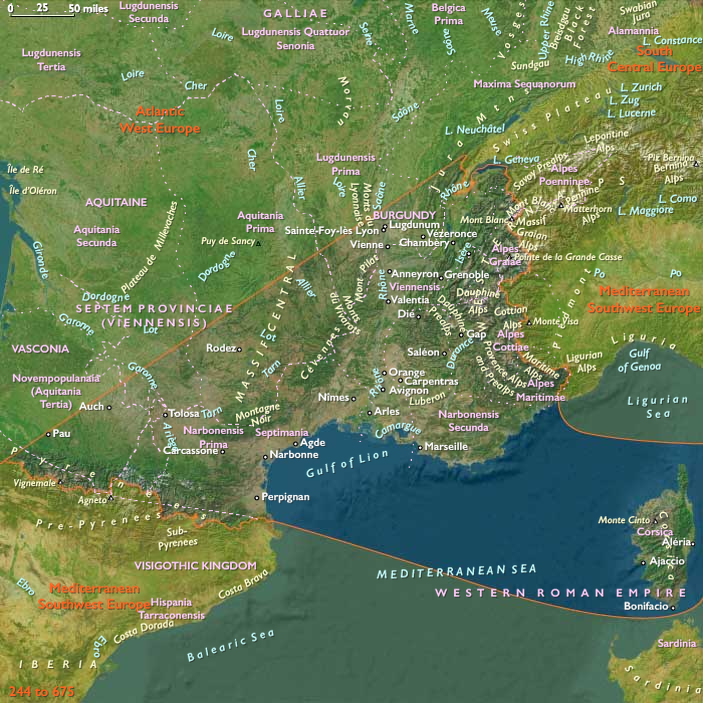
Mediterranean West Europe comprises southern France below an imaginary line extending from approximately 43.03476° N, 1.17208° W to 46.45234° N, 6.07689° E, together with Monaco and Corsica. During the late fourth through early sixth centuries CE, the Rhône valley continued to organize movement between the Mediterranean and inland Gaul. Braided river channels, fertile floodplains, Mediterranean coasts, limestone uplands, wooded ravines, vineyards, orchards, and seasonal pastures remained the enduring environmental framework despite the gradual dissolution of Western Roman political authority.
Political institutions changed profoundly, but the productive landscape remained remarkably continuous.
Agricultural Continuity and Local Resilience
Agriculture continued to provide the foundation of regional life. Vineyards, orchards, grain fields, pasture, woodland management, and river fisheries sustained communities whose economies became increasingly oriented toward regional stability rather than imperial markets. Large estates remained important, but villages, farmsteads, local markets, and ecclesiastical properties assumed growing responsibility for organizing production and exchange.
The countryside therefore remained visually and economically dominant. Productive landscapes adapted to changing institutions rather than declining.
The Rhône after Imperial Unity
The Rhône remained one of western Europe's principal transportation corridors, although long-distance commercial exchange became somewhat less regular than during the High Empire. River transport, local markets, coastal navigation, and regional caravan routes continued linking agricultural districts with Mediterranean ports, but commercial activity became increasingly distributed among numerous local centers.
Warehouses, transfer stations, river landings, and bridges remained active through repair, reuse, and gradual adaptation rather than large-scale reconstruction.
The Transformation of Provincial Authority
As imperial administration weakened, authority increasingly shifted toward bishops, municipal leaders, regional aristocrats, and large landholders. Local institutions assumed responsibility for maintaining roads, bridges, irrigation systems, marketplaces, and agricultural infrastructure that earlier centuries had managed through more centralized provincial administration.
The landscape therefore became organized through resilient local networks rather than through imperial bureaucracy.
Christian Landscapes
Christian institutions became increasingly prominent throughout Mediterranean West Europe. Churches, episcopal complexes, monasteries, charitable establishments, cemeteries, and pilgrimage routes gradually became enduring features of both towns and countryside. Rather than replacing Roman settlements, these institutions typically occupied inherited urban centers, villas, market settlements, and rural estates, adapting existing buildings to new religious purposes.
Christianity increasingly organized education, charity, local administration, and agricultural management while remaining physically integrated within older landscapes.
Settlement Evolution
Urban centers generally contracted modestly while preserving their commercial and religious importance. Former Roman public buildings increasingly served new administrative, commercial, or ecclesiastical functions. Villages, rural estates, artisan communities, and surviving indigenous settlements remained active components of the provincial economy.
Settlement therefore evolved through adaptation rather than abandonment. The visual identity of the region remained one of inhabited continuity rather than widespread ruin.
Successor Kingdoms and Cultural Continuity
Visigothic, Burgundian, and local Roman authorities successively governed different portions of Mediterranean West Europe during this age. Political boundaries shifted repeatedly, yet agricultural production, river transport, and regional commerce continued with surprising continuity. Roman law, Latin literacy, Greek mercantile traditions, and indigenous agricultural knowledge increasingly coexisted within new political frameworks.
The succession of rulers proved less visually significant than the remarkable persistence of the underlying environmental and economic systems.
Corsica and Maritime Continuity
Corsica likewise experienced changing political authority while maintaining long-established agricultural and maritime traditions. Coastal communities continued participating in western Mediterranean exchange, whereas upland farming, woodland management, and seasonal pastoralism remained central to the island's environmental organization. Local continuity continued to outweigh political instability.
Legacy of the Age
By 531 CE, Mediterranean West Europe had successfully navigated the end of imperial political unity without abandoning the mature agricultural and commercial landscape developed during previous centuries. The Rhône corridor remained a vital artery of communication, productive agriculture continued supporting regional prosperity, and Christian institutions increasingly coordinated social and economic life alongside resilient local communities. The age therefore marked not the disappearance of the Roman provincial landscape, but its gradual transformation into the Christian regional society that would characterize the early medieval Mediterranean.
Images

Mediterranean West Europe in Late Antiquity II
People
Groups
Regions

West Europe
View →Subregions