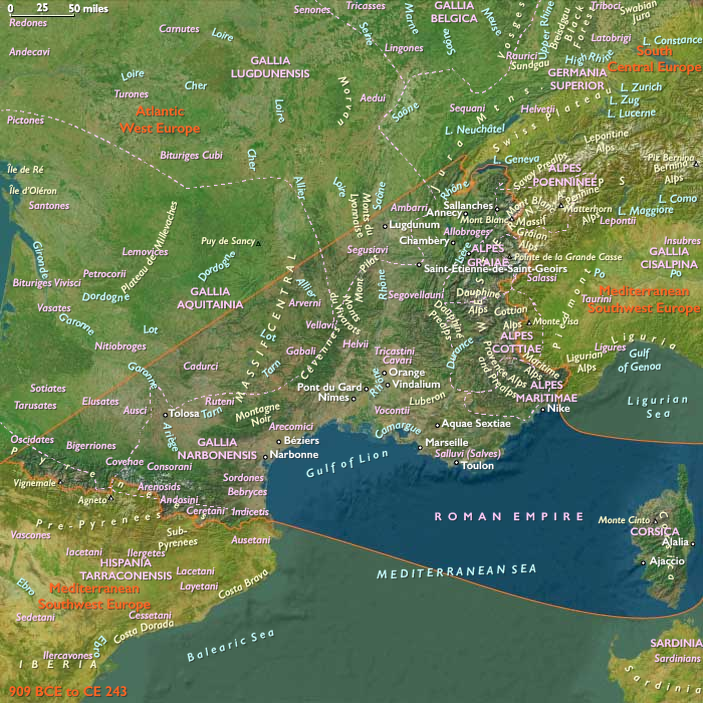
Mediterranean West Europe (100–243 CE): Prosperity, Urban…
100 CE to 243 CE
Mediterranean West Europe (100–243 CE): Prosperity, Urban Expansion, and Roman Cultural Flourishing
Between 100 and 243 CE, Mediterranean West Europe—comprising southern France (below an imaginary line from approximately 43.03476° N, 1.17208° W to 46.45234° N, 6.07689° E), Corsica, and Monaco—experiences continued prosperity, extensive urban growth, and profound Roman cultural integration. Stability under the Pax Romana fosters significant economic development and deepens the Romanization of society, while local cities and provincial centers reach their zenith.
Urban Development and Architectural Splendor
This era witnesses substantial urban expansion, particularly in prominent provincial cities such as Nemausus (Nîmes), Arelate (Arles), and Massalia (Marseille). Roman engineering achievements enhance local infrastructure, including amphitheaters, theaters, baths, temples, and aqueducts. Nîmes, for example, becomes famed for its remarkably preserved structures, such as the Maison Carrée temple and the Pont du Gard aqueduct, illustrating Roman architectural ingenuity and urban planning.
Economic Prosperity and Agricultural Intensification
Economic prosperity flourishes as Mediterranean West Europe solidifies its role within the broader Roman economy. The region becomes a crucial supplier of agricultural products—particularly wine, olive oil, and cereals—to Rome and other imperial markets. Corsica’s agricultural output remains significant, further integrating into the Roman trading network. Maritime commerce through bustling ports such as Massalia continues to expand, connecting the region with distant parts of the empire.
Cultural Integration and Local Identity
Cultural integration deepens as Roman customs, language, religion, and civic institutions become central to local identity. Latin becomes the lingua franca across southern France and Corsica, facilitating administration, trade, and cultural exchange. Indigenous elites fully adopt Roman civic roles, strengthening their positions and loyalty within the imperial system. Local religious practices increasingly merge with Roman deities, reflecting an integrated provincial culture.
Stability and Roman Administrative Efficiency
This period is marked by administrative stability, driven by effective Roman governance and efficient taxation. The provinces of Mediterranean West Europe benefit from the empire's legal uniformity and organized bureaucratic system. Monaco, despite its small size, maintains a stable economic role as a coastal trading post, benefiting from its strategic maritime location.
Signs of Challenges and Future Shifts
Although largely prosperous, by the late second and early third centuries CE, signs of strain begin to appear. Economic disparities and increased taxation contribute to localized tensions, hinting at challenges that would later surface as the Roman Empire moves toward periods of instability in subsequent eras.
Enduring Legacy
By 243 CE, Mediterranean West Europe remains a vibrant, economically prosperous, and culturally Romanized region. The achievements of this era, notably in urban expansion, infrastructure, and cultural assimilation, leave a lasting imprint, shaping the historical and cultural character of the region for centuries to come.
Groups
Topics
Commodities
Subjects
Regions
West Europe
View →Subregions