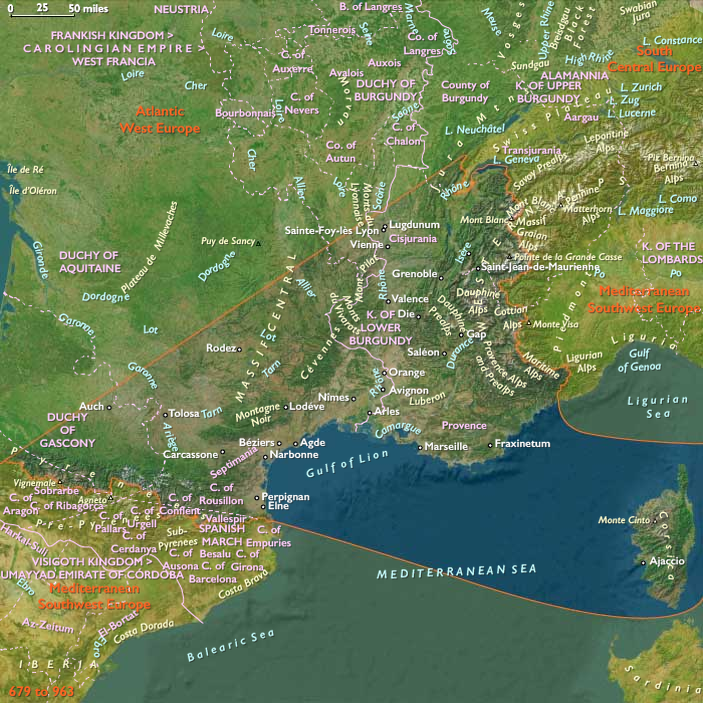
Mediterranean West Europe (676–819 CE): Carolingian Expansion,…
676 CE to 819 CE
Mediterranean West Europe (676–819 CE): Carolingian Expansion, Islamic Incursions, and Religious Consolidation
Between 676 and 819 CE, Mediterranean West Europe—encompassing southern France (below an imaginary line from approximately 43.03476° N, 1.17208° W to 46.45234° N, 6.07689° E), Corsica, and Monaco—undergoes profound geopolitical changes, marked by the rise of the Carolingian dynasty, the impact of Islamic incursions, and continued religious and cultural integration.
Carolingian Expansion and Political Consolidation
This era sees the ascendancy of the Carolingian dynasty, initiated by Charles Martel and solidified under his successors, Pepin the Short and Charlemagne. Charles Martel decisively halts Islamic expansion into Europe at the Battle of Tours in 732 CE, significantly altering the geopolitical landscape. Subsequently, Pepin the Short consolidates Carolingian authority, laying foundations for the expansive Carolingian Empire under Charlemagne, who extends control over southern France, integrating the region firmly into his realm and significantly diminishing local autonomy.
Islamic Incursions and the Emergence of Septimania
Southern France, particularly the region of Septimania, experiences periodic Islamic incursions originating from al-Andalus (Muslim Spain). These incursions leave lasting impacts, introducing new cultural influences and posing intermittent military challenges. The strategic city of Narbonne becomes a focal point, remaining under Muslim control until it is retaken by Frankish forces in 759 CE, reintegrating it into the Carolingian dominions and stabilizing the region.
Religious Consolidation and Monastic Influence
Christianity further entrenches itself in the region, with monastic institutions playing pivotal roles in societal organization and religious life. Monasteries such as Saint-Guilhem-le-Désert and the continued prominence of Lérins Abbey become centers of spiritual learning, agricultural innovation, and manuscript preservation, reinforcing the cultural cohesion of the region. Charlemagne’s support for religious and educational reform enhances the influence of monastic networks, aligning them closely with imperial governance.
Cultural and Administrative Integration
Under Carolingian rule, Roman, Germanic, and now Frankish influences merge into a cohesive administrative and legal framework. Charlemagne's establishment of counties and marches in the region ensures more effective governance and defense against external threats. Latin literacy revives, notably through the Carolingian Renaissance, fostering scholarly activity and cultural exchange across the Mediterranean and broader Frankish domains.
Economic Revitalization and Urban Renewal
The era sees a cautious resurgence in urban life, as Carolingian stability encourages trade and limited economic renewal. Coastal cities such as Marseille and Nice experience modest revival through maritime commerce, benefiting from connections with Byzantine and Islamic trade networks. Agricultural productivity also improves under monastic and imperial guidance, gradually reinvigorating rural economies.
Prelude to Medieval Stability
By 819 CE, Mediterranean West Europe emerges firmly embedded within the Carolingian political and cultural sphere, laying strong foundations for medieval stability. The successful integration of diverse cultural legacies—Roman, Germanic, Islamic, and Frankish—ensures the region’s resilience and positions it as a critical nexus in the broader Mediterranean geopolitical and cultural landscape.
Groups
Commodities
Subjects
Regions
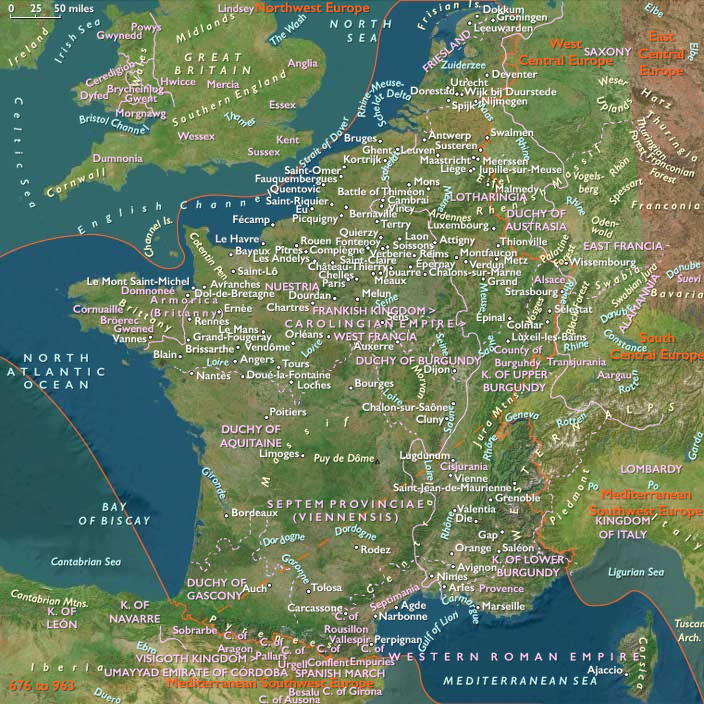
West Europe
View →Subregions