
Mediterranean West Europe (820 – 963 CE):…
820 CE to 963 CE
Mediterranean West Europe (820 – 963 CE): Carolingian Lotharingia, Early Provence, and Rhone–Mediterranean Trade
Geographic and Environmental Context
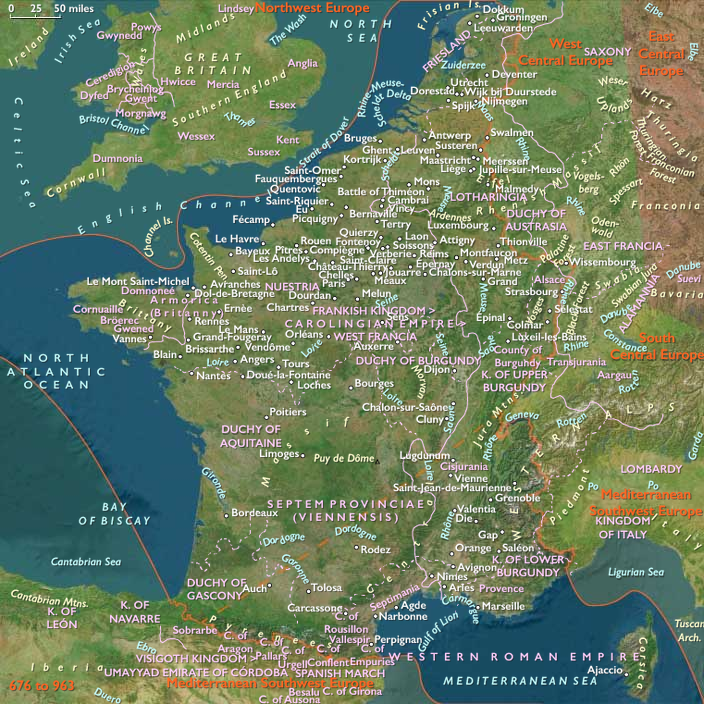
Mediterranean West Europe includes southern France (from the Rhône valley to the Pyrenees, including Languedoc, Provence, and Roussillon), Monaco, Corsica, Lyon, and the southern Jura.
-
Anchors: the Rhône Valley (Lyon–Avignon–Arles–Marseille), the southern Jura gateways to Burgundy and Helvetia, the Provençal littoral (Nice, Toulon, Avignon, Marseille), the Languedoc plain (Narbonne, Carcassonne, Montpellier), the Roussillon/Catalan marches (Perpignan, Pyrenean passes to Aragon/Andorra), Corsica in the Tyrrhenian, and Monaco as a fortified seigneurial port.
Climate and Environmental Shifts
-
The early Medieval Warm Period improved cereal yields and vineyard productivity.
-
The Rhône valley and Languedoc plain supported olives, vines, and wheat; Jura uplands supported cattle and dairying.
Societies and Political Developments
-
After the Treaty of Verdun (843), much of the Rhône–Provence–Languedoc fell into Middle Francia (Lothair’s realm), later fragmenting into Burgundian and Provençal polities.
-
County of Provence consolidated around Arles and Marseille.
-
Septimania/Languedoc: local counts balanced between Frankish kings and Umayyad/Andalusian influence from across the Pyrenees.
-
Corsica: contested between local lords and Saracen raids.
-
Lyon emerged as an ecclesiastical center and a nodal point in Carolingian administration.
Economy and Trade
-
Rhone trade: wine, salt, and grain moved downstream to Arles and Marseille; luxury goods and silks from Italy passed upriver toward Lyon.
-
Agriculture: wheat, olives, and vines in Provence/Languedoc; cattle and cheese in Jura.
-
Corsica provided timber and pasturage.
Belief and Symbolism
-
Christianity anchored in monastic reform (Cluniac currents rising in the Jura).
-
Episcopal sees (Lyon, Arles, Narbonne) supervised cultural continuity.
Long-Term Significance
By 963, Mediterranean West Europe was a frontier zone of Carolingian heirs, with Rhône–Provençal commerce, Languedoc counts, and Corsican raiding setting the stage for 11th-century growth.
Images

Mediterranean West Europe (with civilization) ©2024-25 Electric Prism, Inc. All rights reserved.
People
Groups
Topics
Commodities
Subjects
Regions
West Europe
View →Subregions
