
Mehmet reestablishes Ottoman control over much of…
1418 CE
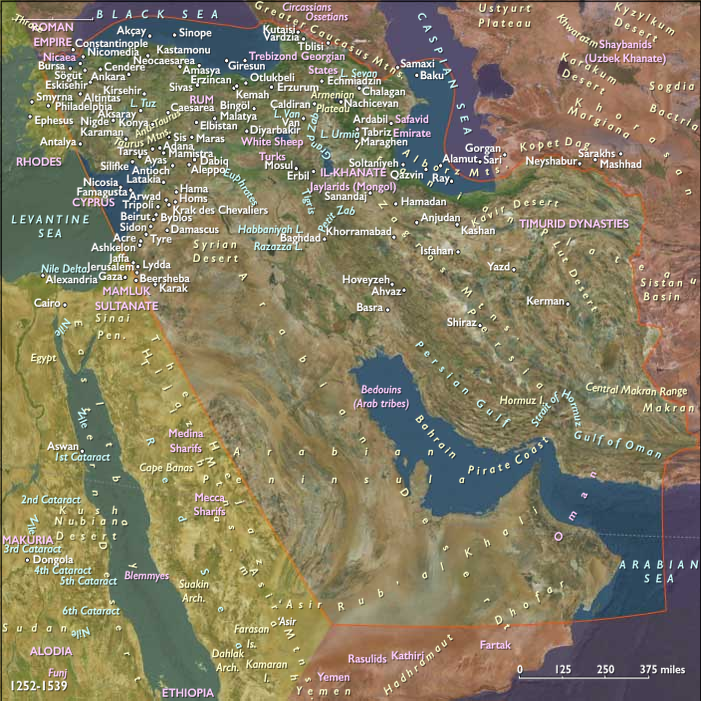
Mehmet reestablishes Ottoman control over much of the western provinces in Anatolia, and …
Locations
People
Commodities
Subjects
Regions

The Near and Middle East
View →Subregions
Middle East
View →Related Events
No active filters.
Showing 10 events out of 42302 total
…reduces the Karaman principality to submission.
The Goharshad Mosque, a large-domed structure named for a Timurid queen who contributed her own wealth for its construction, is completed in 1418 as part of the complex of structures that comprises the shrine of the Imam Riza in Mashhad.
The architect of the edifice is Ghavameddin Shirazi, who is responsible for so many of Shah Rukh's great buildings, with the architectural and decorative manpower supplied from Shiraz and Isfahan.
The First Peace of Thorn had in 1411 ended the Polish–Lithuanian–Teutonic War, in which the Teutonic Knights fought the Kingdom of Poland and Grand Duchy of Lithuania.
However, the peace was not stable and further conflicts arose regarding demarcation of the Samogitian borders.
The tensions had erupted into the brief Hunger War in summer 1414.
It was concluded that the disputes would be mediated by the Council of Constance.
The propaganda war had soon grown from a border quarrel to a fundamental dispute of the Teutonic mission – did the Knights have the right to wage the crusade?
was it a Just War?
The Polish position is defended by Paulus Vladimiri, rector of the Jagiellonian University, who challenges the legality of the Teutonic crusade, arguing that a forced conversion is incompatible with free will, which is an essential component of a genuine conversion.
Therefore, the Knights could only wage a defensive war if pagans violated natural rights of the Christians.
Vladimiri further stipulates that infidels have rights that have to be respected, and neither the Pope nor the Holy Roman Emperor has the authority to violate them.
The Poles and Lithuanians also bring a group of Samogitian representatives to testify concerning atrocities committed by the Knights.
John of Falkenberg proves to be the fiercest opponent of the Poles.
In his Liber de doctrina, Falkenberg argues that "the Emperor has the right to slay even peaceful infidels simply because they are pagans (...).
The Poles deserve death for defending infidels, and should be exterminated even more than the infidels; they should be deprived of their sovereignty and reduced to slavery."
In Satira, he attacks Polish King Jogaila, calling him a "mad dog" unworthy to be king.
Falkenberg is condemned and imprisoned for such libel, but is not officially accused of heresy.
Other opponents include the Grand Master's proctor Peter Wormditt, Dominic of San Gimignano, John Urbach, Ardecino de Porta of Novara, and Bishop of Ciudad Rodrigo Andrew Escobar, who argue that the Knights are perfectly justified in their crusade as it is a sacred duty of Christians to spread the true faith Cardinal Pierre d'Ailly publishes an independent opinion that attempts to somewhat balance both the Polish and Teutonic positions.
The Council does not make any political decisions.
It establishes the Diocese of Samogitia, with its seat in Medininkai and subordinate to Lithuanian dioceses, and appoints Matthias of Trakai as the first bishop.
Pope Martin V appoints Polish King Jogaila and Lithuanian Grand Duke Vytautas as vicar generals in Pskov and Veliky Novgorod in recognition of their Catholicism.
Vincent had labored to have Benedict XIII end the schism, but Benedict XIII did not resign as all candidates in the conclave had sworn to do, despite losing the support of the French king and nearly all of the cardinals.
After an extended period of receiving empty promises, Vincent encourages Ferdinand, Regent of Castile for John II, to withdraw his support from Benedict XIII.
Work on the Florence Cathedral, begun in the gothic style and halted due to the Black Death in 1348, had resumed in 1349 under a series of architects, commencing with Francesco Talenti, who had finished the campanile and enlarged the overall project to include the apse and the side chapels.
In 1359, Talenti had been succeeded by Giovanni di Lapo Ghini (1360–1369) who had divided the center nave in four square bays.
Other architects were Alberto Arnoldi, Giovanni d'Ambrogio, Neri di Fioravante and Andrea Orcagna.
By 1375, the old church, Santa Reparata, had been pulled down.
The nave was finished by 1380, and the huge masonry octagon intended to support the dome had been completed in 1414.
By 1418 only the dome itself remains incomplete.
The Arte della Lana on August 18, 1418, announces a structural design competition for erecting Neri's dome.
The two main competitors are the two master goldsmiths Lorenzo Ghiberti and Filippo Brunelleschi, the latter supported by Cosimo de Medici.
Ghiberti had been winner of a competition for a pair of bronze doors for the Baptistery in 1401 and lifelong competition between the two remains acute.
Brunelleschi wins and receives the commission.
The Reunification of Poitou with the French Crown (1416) and the Exile of the Royal Parliament to Poitiers (1418–1436)
In 1416, Poitou was formally reunited with the French Crown, strengthening royal authority in western France at a time when the kingdom was fractured by civil war and English invasions.
Two years later, in 1418, as John the Fearless, Duke of Burgundy, seized Paris, the royal parliament was forced to flee, relocating to Poitiers, where it would remain in exile until the Plantagenets were expelled from the capital in 1436.
I. The Reunification of Poitou with France (1416)
- Poitou, historically contested between the French Crown and its vassals, had seen fluctuating control during the Hundred Years’ War.
- By 1416, it was firmly restored to direct royal rule, reinforcing French governance in western France.
- This provided a key stronghold for the Armagnac faction, which was battling both the Burgundians and the English.
II. The Burgundian Seizure of Paris and the Flight of the Royal Parliament (1418)
- In May 1418, John the Fearless, Duke of Burgundy, took advantage of internal conflicts and orchestrated the capture of Paris, driving out the Armagnac-controlled government.
- The Dauphin Charles (the future Charles VII) barely escaped with his life, retreating south to Bourges, where he would later establish his shadow court.
- The French royal parliament, unable to function under Burgundian rule, relocated to Poitiers, where it would remain in exile for nearly two decades.
III. Poitiers as the Seat of Exiled Government (1418–1436)
- While in Poitiers, the parliament continued to exercise legal and administrative functions, supporting the Dauphin’s claim to the throne.
- The city became a center of Armagnac resistance, serving as a political and judicial base against Burgundian and English domination in northern France.
IV. The Parliament’s Return to Paris (1436)
- The exile of the royal government ended in 1436, when Charles VII’s forces, supported by the Burgundians after the Treaty of Arras (1435), retook Paris from the English.
- With the capital back under Valois control, the parliament was restored to its rightful seat, marking a turning point in the Hundred Years’ War.
V. Consequences and Legacy
- The reunification of Poitou (1416) and the exile of the parliament (1418–1436) were key moments in the political fragmentation of France during the Hundred Years’ War.
- Poitiers remained a crucial Armagnac stronghold, playing an essential role in the survival of Charles VII’s government.
- The restoration of the parliament to Paris in 1436 symbolized the beginning of French recovery and the eventual expulsion of the English from France.
The flight of the French royal parliament to Poitiers in 1418 reflected the political chaos of the time, but its return in 1436 marked a significant step toward the reunification of France under Charles VII.
Jacqueline of Bavaria’s Second Marriage and the Resurgence of the Hook and Cod Wars (1418)
By 1418, Jacqueline of Bavaria, unable to maintain her position as sovereign of Holland, Zeeland, and Hainaut alone, was forced to remarry for political protection. Her uncle and guardian, John the Fearless, Duke of Burgundy, arranged a marriage between Jacqueline and her cousin, John IV, Duke of Brabant and Limburg.
At the same time, her other uncle, John III of Bavaria-Straubing, renounced his ecclesiastical career, reclaiming secular rule in Holland and Zeeland, which reignited the Hook and Cod civil war.
I. Jacqueline’s Marriage to John IV of Brabant (1418)
- John the Fearless, aiming to strengthen Burgundian influence in the Low Countries, orchestrated Jacqueline’s marriage to John IV, Duke of Brabant and Limburg.
- This marriage was intended to:
- Consolidate Jacqueline’s rule by securing an alliance with Brabant.
- Bolster Burgundian dominance over Holland and Zeeland.
- Prevent her uncle John III of Bavaria from seizing control of her inherited lands.
However, this political union proved weak, as John IV lacked the military strength or political will to effectively defend Jacqueline’s claims.
II. John III of Bavaria’s Return and the Hook and Cod Civil War Resumes
- John III of Bavaria-Straubing, formerly Bishop of Liège, abandoned his religious office and reclaimed secular power in Holland and Zeeland.
- His return reignited the Hook and Cod Wars, the ongoing struggle between rival factions for control over Holland:
- The Hook Party (Hoeken) supported Jacqueline, favoring local autonomy and noble control.
- The Cod Party (Kabeljauwen) aligned with John III of Bavaria, favoring centralized governance and Burgundian influence.
This civil war further destabilized the Low Countries, drawing in neighboring principalities and intensifying Burgundian intervention.
III. Consequences and Jacqueline’s Continued Struggles
- Jacqueline’s marriage to John IV of Brabant failed to provide the support she needed against her uncle’s claims.
- The Hook and Cod Wars continued to destabilize Holland, making it increasingly vulnerable to outside intervention.
- Burgundian influence continued to expand, as John the Fearless sought greater control over the fractured territories of the Low Countries.
The marriage of Jacqueline of Bavaria to John IV of Brabant in 1418 was a strategic but ultimately ineffective attempt to secure her rule, as the Hook and Cod Wars reignited with the return of John III of Bavaria, further fragmenting Holland and paving the way for Burgundian dominance.
Thomas a Kempis enters a monastery of the Augustinian canons at Zwolle and is ordained in 1413 at about age thirty-three.
At this monastery, he copies manuscripts and writes many works of devotion that display the influence of the tradition of Gerhard Groote and the Brethren of the Common Life.
The Imitation of Christ, first circulated in 1418 and long attributed to Thomas, embodies many of the principal ideas of the devotio moderna: emphasis on being faithful to the movements of grace, on poverty and humility, and on cautions about protecting the senses against distractions and temptations.
Thomas à Kempis and The Imitation of Christ: A Devotional Legacy (1413–1418)
In 1413, Thomas à Kempis (c. 1380–1471), a Dutch-German monk and writer, entered the monastery of the Augustinian Canons at Zwolle, where he was ordained at about thirty-three years old. Influenced by the Devotio Moderna movement, founded by Gerhard Groote and the Brethren of the Common Life, Thomas devoted himself to copying manuscripts and writing devotional works, emphasizing inner spirituality and personal piety.
Among the most famous devotional texts attributed to him is The Imitation of Christ, which first circulated in 1418and became one of the most widely read Christian texts of the late medieval and early modern periods.
I. Thomas à Kempis and the Devotio Moderna
- The Devotio Moderna emphasized:
- Personal devotion and interior spirituality, rather than elaborate scholastic theology.
- Poverty and humility as the core of a sincere Christian life.
- Self-discipline and avoidance of worldly distractions to cultivate a deep relationship with God.
- Thomas à Kempis, as a member of the Augustinian Canons Regular, was deeply influenced by Gerhard Groote's teachings, which focused on living a Christ-centered, practical, and disciplined life.
II. The Imitation of Christ (1418) and Its Themes
- The text first circulated in 1418, though its authorship remains debated.
- It encapsulates the core ideals of the Devotio Moderna, stressing:
- Faithfulness to divine grace and rejecting worldly pride.
- The necessity of self-denial, humility, and simplicity.
- The importance of guarding the senses against temptation and cultivating inner contemplation.
- The work is structured as a spiritual guide, urging believers to imitate Christ’s life of suffering, devotion, and obedience.
III. Influence and Legacy
- The Imitation of Christ became one of the most influential Christian texts, second only to the Bible in popularity among late medieval and early modern Christians.
- It shaped European devotional life, influencing figures such as Ignatius of Loyola, Teresa of Ávila, and John Wesley.
- The work remains a cornerstone of Christian spirituality, continuing to be read by monastic orders, theologians, and laypeople alike.
IV. Conclusion: A Lasting Spiritual Masterpiece
Thomas à Kempis’ entry into the Augustinian monastery (1413) and the circulation of The Imitation of Christ(1418) marked a turning point in Christian devotional literature, reinforcing the practical, inner-focused spirituality of the Devotio Moderna and influencing generations of believers worldwide.
The Assassination of Bernard VII, the Burgundian Seizure of Paris, and the Path to the Meeting at Montereau (1418–1419)
On June 12, 1418, Bernard VII, Count of Armagnac, and other key members of the Armagnac faction were slaughtered by a Parisian mob during a violent uprising. With their deaths, John the Fearless, Duke of Burgundy, once again seized control of Paris, consolidating his political and military dominance in France.
John's capture of the capital allowed him to negotiate with the English, even appearing willing to recognize Henry V of England’s claim to the French throne. This forced Dauphin Charles (the future Charles VII of France) to seek a rapprochement with the Burgundians, hoping to prevent an Anglo-Burgundian alliance.
I. The Paris Massacre and Burgundian Triumph (June 1418)
- Following an internal coup in Paris, Burgundian-aligned mobs revolted against the Armagnacs, whom they saw as oppressive rulers.
- Bernard VII, leader of the Armagnac faction, was brutally murdered, along with other high-ranking members of the Dauphin’s party.
- The Burgundians effectively seized control of Paris, making John the Fearless the most powerful man in France.
II. John the Fearless’ Position and Negotiations with England
- With Paris under his control, John:
- Entered into negotiations with the English, signaling a willingness to support Henry V’s claim to the French throne.
- Expanded Burgundian control over large portions of the kingdom, though his financial situation remained dire.
- The possibility of a Burgundian-English alliance alarmed the Dauphin Charles, who remained in exile in Bourges, controlling only parts of central France.
III. The Dauphin’s Efforts to Reconcile with Burgundy
- To prevent an Anglo-Burgundian alliance, the Dauphin opened secret negotiations with John the Fearless.
- John, despite his dominance over France, faced severe financial difficulties and saw an opportunity for a political settlement.
- Several meetings were arranged between the two sides, aiming for a mutually advantageous peace agreement.
IV. The Path to the Meeting at Montereau (1419)
- As negotiations continued, both sides recognized the need for a diplomatic resolution to avoid complete English domination of France.
- These efforts culminated in a planned meeting at Montereau on September 10, 1419, which would ultimately lead to John the Fearless’ assassination.
V. Consequences and the Ongoing Civil War
- While the Paris massacre of 1418 cemented Burgundian control, it also escalated tensions with the Dauphin’s supporters, ensuring that peace would be difficult to achieve.
- The negotiations between Burgundy and the Dauphin proved to be fragile and ultimately doomed, as mistrust between the factions remained high.
- The French civil war continued, allowing England to further advance its conquest of France under Henry V.
The murder of Bernard VII and the Burgundian capture of Paris in 1418 gave John the Fearless immense power, but also forced a desperate reconciliation attempt with the Dauphin, setting the stage for the fateful meeting at Montereau and the continued fragmentation of France.