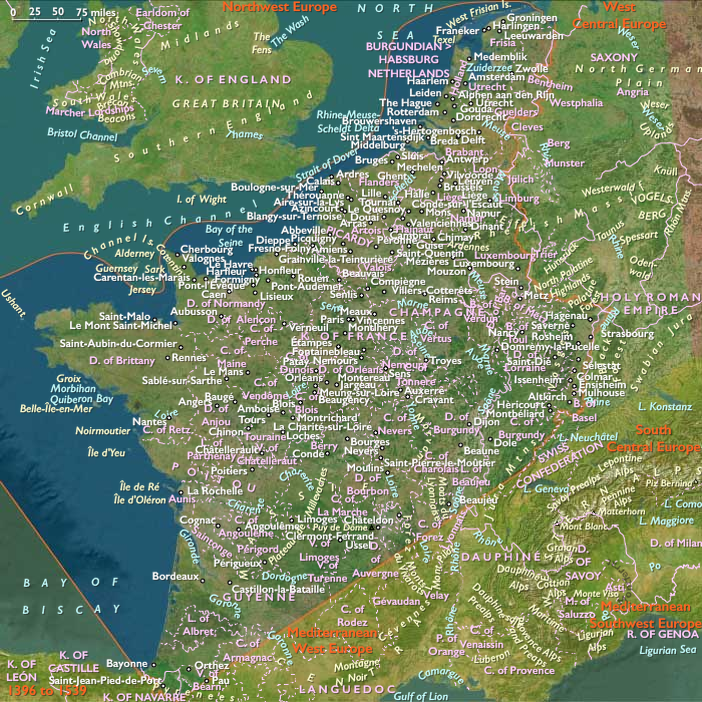
The Reunification of Poitou with the French…
1418 CE
The Reunification of Poitou with the French Crown (1416) and the Exile of the Royal Parliament to Poitiers (1418–1436)
In 1416, Poitou was formally reunited with the French Crown, strengthening royal authority in western France at a time when the kingdom was fractured by civil war and English invasions.
Two years later, in 1418, as John the Fearless, Duke of Burgundy, seized Paris, the royal parliament was forced to flee, relocating to Poitiers, where it would remain in exile until the Plantagenets were expelled from the capital in 1436.
I. The Reunification of Poitou with France (1416)
- Poitou, historically contested between the French Crown and its vassals, had seen fluctuating control during the Hundred Years’ War.
- By 1416, it was firmly restored to direct royal rule, reinforcing French governance in western France.
- This provided a key stronghold for the Armagnac faction, which was battling both the Burgundians and the English.
II. The Burgundian Seizure of Paris and the Flight of the Royal Parliament (1418)
- In May 1418, John the Fearless, Duke of Burgundy, took advantage of internal conflicts and orchestrated the capture of Paris, driving out the Armagnac-controlled government.
- The Dauphin Charles (the future Charles VII) barely escaped with his life, retreating south to Bourges, where he would later establish his shadow court.
- The French royal parliament, unable to function under Burgundian rule, relocated to Poitiers, where it would remain in exile for nearly two decades.
III. Poitiers as the Seat of Exiled Government (1418–1436)
- While in Poitiers, the parliament continued to exercise legal and administrative functions, supporting the Dauphin’s claim to the throne.
- The city became a center of Armagnac resistance, serving as a political and judicial base against Burgundian and English domination in northern France.
IV. The Parliament’s Return to Paris (1436)
- The exile of the royal government ended in 1436, when Charles VII’s forces, supported by the Burgundians after the Treaty of Arras (1435), retook Paris from the English.
- With the capital back under Valois control, the parliament was restored to its rightful seat, marking a turning point in the Hundred Years’ War.
V. Consequences and Legacy
- The reunification of Poitou (1416) and the exile of the parliament (1418–1436) were key moments in the political fragmentation of France during the Hundred Years’ War.
- Poitiers remained a crucial Armagnac stronghold, playing an essential role in the survival of Charles VII’s government.
- The restoration of the parliament to Paris in 1436 symbolized the beginning of French recovery and the eventual expulsion of the English from France.
The flight of the French royal parliament to Poitiers in 1418 reflected the political chaos of the time, but its return in 1436 marked a significant step toward the reunification of France under Charles VII.
Locations
People
Topics
Commodities
Subjects
Regions
West Europe
View →Subregions