Middle Africa (1864–1875 CE): Portuguese Ambitions, German…
1864 CE to 1875 CE
Middle Africa (1864–1875 CE): Portuguese Ambitions, German Commercial Expansion, and Fernando Pó’s Multicultural Society
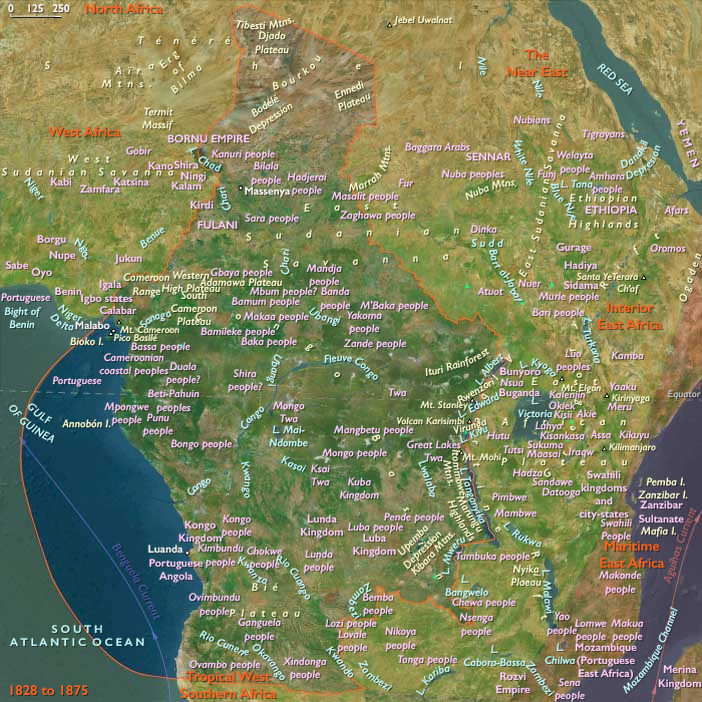
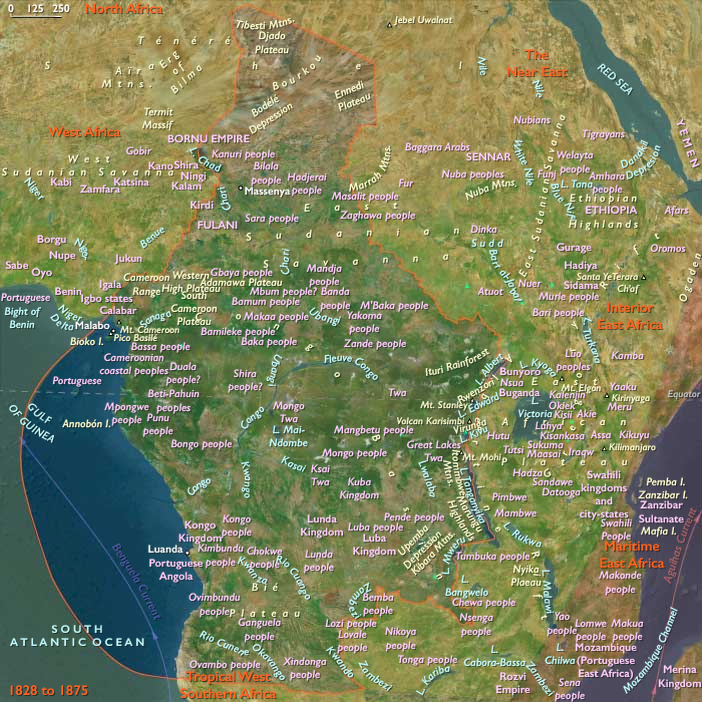
Between 1864 and 1875 CE, Middle Africa—comprising modern Chad, Cameroon, Central African Republic, Equatorial Guinea, São Tomé and Príncipe, Gabon, Republic of the Congo, Democratic Republic of the Congo (DRC), and Angola including its Cabinda enclave—experiences renewed European ambitions, the onset of systematic German commercial activity, and significant demographic and cultural developments in Spanish-controlled Fernando Pó.
Portuguese Aspirations for a Trans-African Territory
In the early 1870s, Portugal formulates plans to create a continuous territorial belt connecting Angola on the Atlantic coast to Mozambique on the Indian Ocean coast. An advisory commission attached to Portugal’s Ministry of the Navy and Colonies promotes this ambitious trans-African expedition, reflecting Lisbon’s strategic aspirations to control a contiguous zone across central Africa. Despite government enthusiasm and initial funding, these ambitions remain unfulfilled. Portugal finds itself unable to effectively assert control over the expansive and difficult-to-navigate African interior, where local polities maintain significant autonomy and power.
Portuguese Expansion Renewed and Lisbon Geographical Society
By the mid-1870s, renewed expansionist efforts emerge within Portugal, driven significantly by the influential Lisbon Geographical Society, established in 1875. Composed of industrialists, scholars, colonial officials, and military officers, this society stimulates public and governmental interest in Portugal’s African territories, fostering colonial enthusiasm at home.
Responding to these growing interests, the Portuguese government allocates substantial financial resources toward public works in African colonies and initiates a minor revival of missionary activities. Although concrete territorial gains remain limited, these developments set the stage for intensified Portuguese efforts in subsequent decades.
German Commercial Expansion in Kamerun
In 1868, the German trading company C. Woermann from Hamburg establishes the first German trading post in the Duala area (modern-day Douala, Cameroon), located at the Kamerun River delta (today the Wouri River delta). Johannes Thormählen, Woermann’s agent in Gabon, expands operations to this region, and in 1874 collaborates with another merchant, Wilhelm Jantzen, Woermann’s agent in Liberia, to form their own commercial enterprise, Jantzen & Thormählen.
These pioneering commercial ventures rapidly develop into larger operations, obtaining extensive acreage from local chiefs and introducing systematic plantation agriculture, notably banana cultivation. Additionally, both Woermann and Jantzen & Thormählen soon expand into shipping, deploying their own sailing ships and steamers and establishing scheduled passenger and freight services connecting Hamburg directly to Duala. These enterprises mark the beginning of German economic and commercial penetration into Central Africa, laying important groundwork for subsequent colonial claims.
Multicultural Evolution of Fernando Pó
The Spanish-controlled island colony of Fernando Pó (modern-day Bioko, Equatorial Guinea) sees significant social and demographic transformations. By this era, the plantations on Fernando Pó are predominantly managed by a prosperous black Creole elite, later known as the Fernandinos. These elites trace their roots back to approximately two thousand settlers from Sierra Leone and freed slaves who had been settled by the British during their period of control (1827–1843).
Following the British departure, limited but steady immigration continues from West Africa, the West Indies, and other regions, augmenting the local population. Freed Angolan slaves, Portuguese-African Creoles, Nigerians, Liberians, and other West African immigrants also settle on Fernando Pó, integrating into the emerging multicultural society. Moreover, the demographic mix is further enriched by arrivals of Cubans, Filipinos, Catalans, Jews, and various Spaniards—including political exiles deported by Spain for criminal or political reasons, and small numbers of government-sponsored settlers.
This diverse demographic mosaic contributes significantly to the unique cultural and social dynamics on Fernando Pó, distinguishing it from other colonial holdings in the region and laying the groundwork for its future social complexity.
Legacy of the Era
The period 1864–1875 marks a crucial juncture in Middle Africa, characterized by ambitious Portuguese colonial initiatives, burgeoning German commercial activity, and the multicultural expansion of Fernando Pó. These developments significantly influence subsequent patterns of European intervention and African resistance, shaping the economic, social, and political landscape of the region in the decades that follow.
Groups
Commodities
Regions
Middle Africa
View →Subregions