
Ming dynasty naval forces fight and repulse…
1516 CE to 1527 CE
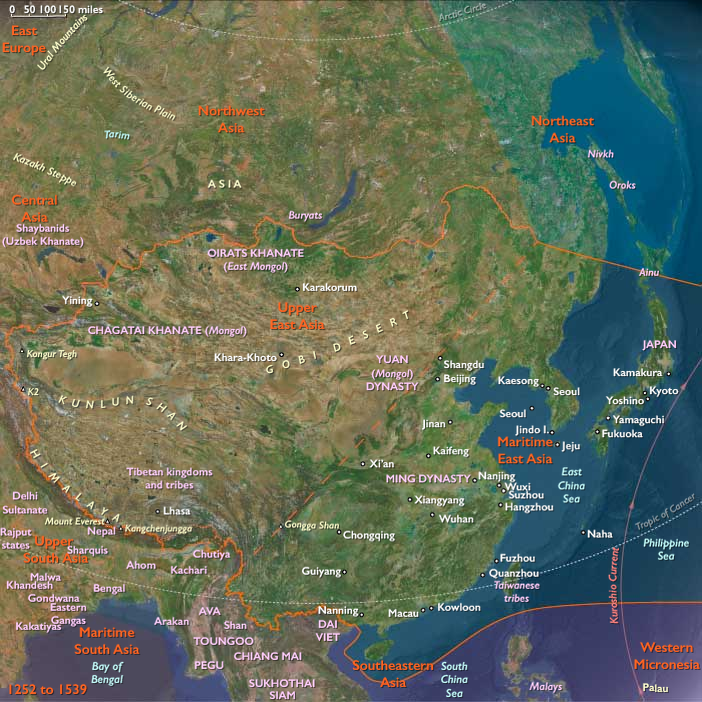
Ming dynasty naval forces fight and repulse Portuguese ships in 1521 at Tuen Mun, where some of the first breech-loading culverins are introduced to China, and again fight off the Portuguese in 1522.
Locations
People
Groups
Commodities
Subjects
Regions
East Asia
View →Subregions
Maritime East Asia
View →Related Events
No active filters.
Showing 10 events out of 39088 total
Portuguese mariners on illicit reconnaissance missions into Pacific Ocean territory assigned to Spain under the 1494 Treaty of Tordesillas have secretly mapped the east coasts of both North Island and South Island by 1522.
Sailors lose a Portuguese-made brass cannon at Broome Bay in northwest Australia around 1525 (it will be found centuries later).
Portuguese navigators reach the Spice Islands, stopping at various island Muslim Sultanates and visiting the large Indonesian island of Sulawesi (also known as Celebes), then go on to sight the island of New Guinea.
Austronesian people, who had spread down from Taiwan, through the Southeast Asian archipelago, colonizing many of the islands on the way, are another wave of people who had arrived on the shores of New Guinea in more recent millennia.
The Austronesian people had technology and skills extremely well adapted to ocean voyaging and Austronesian language speaking people are present along much of the coastal areas and islands of New Guinea.
These Austronesian migrants are considered the ancestors of most people in insular Southeast Asia, from Sumatra and Java to Borneo and Sulawesi, as well as coastal new Guinea.
The western part of the island is in contact with kingdoms in other parts of modern-day Indonesia.
Negarakertagama mentions he region of Wanin in eastern Nusantara as part of Majapahit's tributary.
This has been identified with the Onin Peninsula, part of the Bomberai Peninsula near the city of Fakfak.
The sultans of Tidore, in the Maluku Islands, claim sovereignty over various coastal parts of the island.
During Tidore's rule, the main exports of the island during this period are resins, spices, slaves and the highly priced feathers of the bird-of-paradise.
The first European contact with New Guinea is by Portuguese and Spanish sailors in 1526-27, when the Portuguese explorer Jorge de Meneses sees the western tip of New Guinea and names it ilhas dos Papuas.
He lands on the northern coasts of the Bird's Head Peninsula and on the islands of Biak (Cenderawasih Bay), and Waigeo Island while he awaits the passing of the monsoon season.
The Portuguese have not only monopolized the European spice trade after the conquest of Malacca in 1511 but also meet and trade avidly with Chinese merchants.
When Portuguese under Diogo Lopes de Sequeira had earlier arrived in Malacca in 1509 to open trade relations, he had been supported by the local Chinese merchants there (along with Javanese and Tamil merchants).
Alfonso D'Albuquerque had sent Jorge Álvares to explore northward; his expedition had sailed along the coast of Guangdong in 1513 and hoisted a flag on "Tuen Mun island".
Jorge Álvares had been the first to land on Lintin Island in the Pearl River Delta in May 1513, but it is Rafael Perestrello—a cousin, by marriage, of the famed Christopher Columbus—who becomes the first European explorer to land on the southern coast of mainland China and trade in Guangzhou in 1516, commanding a Portuguese vessel with a crew from a Malaysian junk that had sailed from Malacca.
He provides an enticing report to other Portuguese on the lucrative trade in China.
This prompts Fernão Pires de Andrade to speed up the course of his mission while stalled in Malacca and debate with his crew on whether to go to China or Bengal.
The Portuguese send a large subsequent expedition in 1517 to enter port at Guangzhou to trade with the Chinese merchants here.
During this expedition the Portuguese attempt to send an inland delegation in the name of Manuel I of Portugal to the court of the Zhengde Emperor.
Fernão Pires de Andrade is able to meet the Zhengde Emperor while the latter is touring Nanjing in May 1520.
Pires de Andrade's mission waits in Beijing to meet the Zhengde Emperor once more, but the emperor dies in 1521.
The new Grand Secretary, Yang Tinghe, rejects eunuch influence at court and rejects this new foreign embassy by the Portuguese once Malaccan ambassadors arrive in China damning the Portuguese for deposing their king; the Portuguese diplomatic mission languishes in a Chinese prison where they die.
Simão de Andrade, brother to ambassador Fernão Pires de Andrade, had also stirred Chinese speculation that the Portuguese were kidnapping Chinese children to cook and eat them; Simão had purchased children as slaves who will later be found by Portuguese authorities in Diu, India.
The Chaudor tribe leads a powerful Turkmen tribal union in the north of present Turkmenistan during the sixteenth and seventeenth centuries, while the Salor tribe is dominant in the south.
One of the Turkmens' principal occupations for centuries after the decline of Mongol rule has been robbing passing caravans.
Their organization is exclusively tribal, and the tribes are either nomadic and independent or subject to neighboring Persia or to the khanates of Khiva and Bukhara.
The Rise of Humanist Political Thought: The Courtier and The Education of a Christian Prince (1516)
Alongside Niccolò Machiavelli’s The Prince (1513, published 1532), the year 1516 saw the publication of two influential humanist political treatises:
- Baldassare Castiglione’s The Book of the Courtier (Il Libro del Cortegiano)
- Erasmus of Rotterdam’s The Education of a Christian Prince (Institutio Principis Christiani)
Like The Prince, these works encouraged a new model of education and leadership, blending humanist ideals, classical learning, and practical governance.
1. The Book of the Courtier by Baldassare Castiglione (1516)
- Written as a dialogue set in the court of Urbino, Castiglione’s work describes the ideal Renaissance courtier.
- Emphasizes grace, wit, and refined manners alongside military skill and classical learning.
- Introduces the concept of sprezzatura (effortless mastery), the ability to appear graceful and skilled without seeming to try.
- Advocates for humanistic education, including knowledge of history, poetry, music, and philosophy.
- The Courtier became the definitive guide to courtly behavior, influencing European aristocracy for centuries.
2. The Education of a Christian Prince by Erasmus (1516)
- A humanist response to Machiavelli’s The Prince, Erasmus’ treatise focused on the moral and ethical responsibilities of rulers.
- Advocated for a prince who rules justly, with wisdom and virtue, rather than through fear and manipulation.
- Drew on classical and Christian traditions, urging monarchs to lead with humility, reason, and concern for the common good.
- Criticized tyranny and war, promoting peaceful governance and diplomacy.
- Written for Charles V, the future Holy Roman Emperor, Erasmus hoped to shape the young ruler’s approach to kingship.
Comparison with Machiavelli’s The Prince
| Work | Philosophy | Ideal Leader | Approach to Power |
|---|---|---|---|
| Machiavelli's The Prince(1513) | Pragmatic and ruthless Realpolitik | A ruler who is feared, not necessarily loved | Power is maintained through cunning, force, and deception |
| Castiglione's The Courtier(1516) | Refined, elegant humanism | A charismatic, educated courtier, adept in both arms and letters | Influence through diplomacy, wit, and personal skill |
| Erasmus' The Education of a Christian Prince (1516) | Ethical, moral leadership | A just, virtuous, and wise Christian ruler | Power used for peace, justice, and the common good |
Impact on European Thought and Education
- These humanist texts reshaped Renaissance political and educational ideals, influencing:
- Royal courts and aristocratic society, particularly in Italy, Spain, France, and England.
- The education of rulers, especially Charles V and later monarchs.
- The debate between moral leadership and realpolitik, which continues in political philosophy today.
Conclusion: A New Model of Leadership and Education
In 1516, The Courtier and The Education of a Christian Prince helped solidify humanist education as essential for leaders and courtiers. These works, alongside Machiavelli’s The Prince, shaped the political culture of the Renaissance, influencing diplomacy, governance, and the expectations of rulers and noblemen for generations to come.
East Europe (1516–1527 CE): Muscovite Authority and Diplomatic Complexity
Political and Military Developments
Expansion and Strengthening of Muscovite Control
From 1516 to 1527 CE, Muscovy continued its territorial expansion, further consolidating regional authority under Vasili III. The era saw heightened administrative centralization and efficient governance practices.
Diplomatic Dynamics with Regional Powers
Diplomatic relations with the Khanates of Kazan, Crimea, and Astrakhan remained strategically complex, involving periodic conflicts and negotiations. Muscovy navigated these relationships adeptly, reinforcing its diplomatic stature and regional dominance.
Military Enhancements and Defense Innovations
Muscovy made further advancements in military strategy, developing enhanced fortifications, sophisticated siege tactics, and cavalry improvements, significantly bolstering its territorial defense.
Economic and Technological Developments
Continued Economic Prosperity
Economic stability and growth persisted, driven by strong domestic markets and active engagement in international trade. Major urban centers, especially Moscow, experienced continued economic prosperity.
Technological Progress in Infrastructure
Technological advancements continued, particularly in urban infrastructure and military defenses, reinforcing regional stability and administrative efficiency.
Cultural and Artistic Developments
Artistic Growth and Cultural Flourishing
Cultural development thrived, with substantial patronage driving notable advancements in architecture, religious art, and secular cultural expressions. These contributions significantly enriched Muscovite cultural identity.
Intellectual and Literary Productivity
Literary and scholarly activities remained dynamic, with extensive documentation of historical events, religious thought, and cultural narratives, reinforcing regional identity and continuity.
Settlement Patterns and Urban Development
Urban Expansion and Infrastructure Development
Cities, particularly Moscow, continued their demographic and economic expansion, supported by improved infrastructure, strategic urban planning, and administrative sophistication.
Advanced Urban Fortifications
Urban fortifications continued to evolve strategically, enhancing regional defense and urban security amid complex diplomatic and military landscapes.
Social and Religious Developments
Social Integration and Stability
Social cohesion deepened, facilitated by ongoing integration of diverse ethnic communities, including the Mari, Mordvins, Udmurts, Komi, and Vepsians. This integration supported administrative effectiveness and societal harmony.
Continued Influence of the Orthodox Church
The Orthodox Church remained influential, significantly shaping educational standards, moral values, and community cohesion, contributing notably to societal stability and cultural continuity.
Long-Term Consequences and Historical Significance
The period from 1516 to 1527 CE represented continued Muscovite territorial expansion, diplomatic complexity, and cultural enrichment, laying crucial foundations for a centralized and culturally vibrant Russian state.