
Mithridates III invades the Parthian kingdom from…
55 BCE
Mithridates III invades the Parthian kingdom from Syria, but after reigning briefly in 55 BCE is besieged by Surena, general of Orodes II, in Seleucia on the Tigris.
Surena is instrumental in the reinstatement of Orodes upon the Arsacid throne.
Locations
People
Groups
Commodities
Subjects
Regions
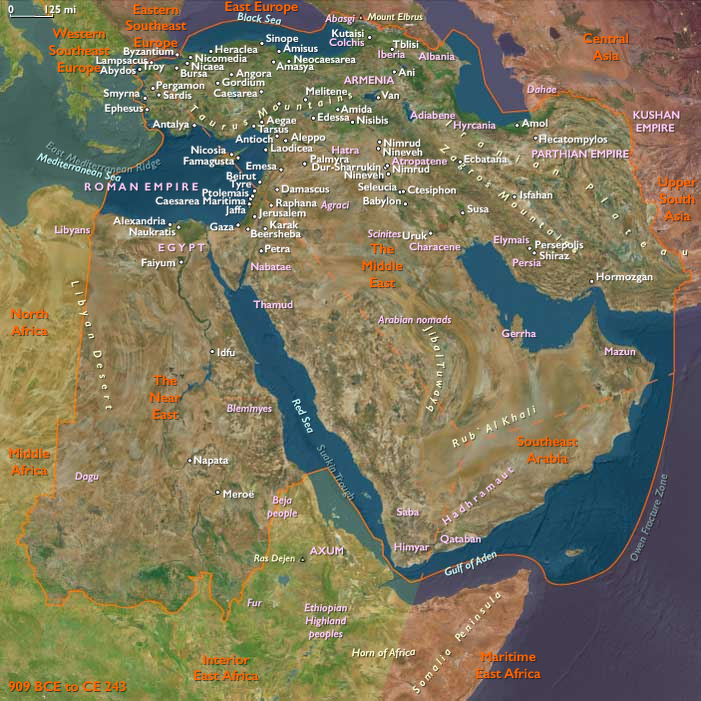
The Near and Middle East
View →Subregions
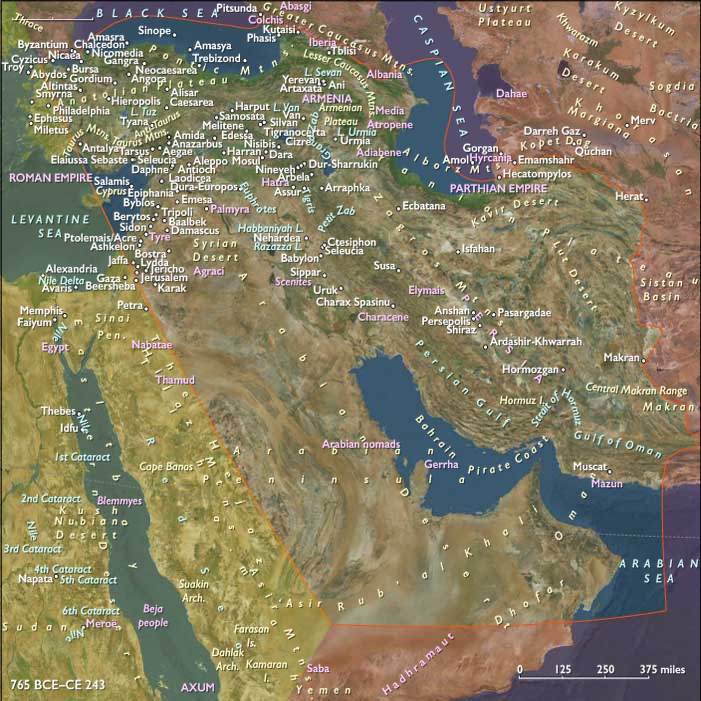
Middle East
View →Related Events
No active filters.
Showing 10 events out of 62546 total
Ptolemy XII has prosecuted his restitution from Rome but has met opposition with certain members of the Senate.
His old ally Pompey had housed the exiled king and his daughter and argued on behalf of Ptolemy's restoration in the Senate.
During this time, Roman creditors realize that they will not get the return on their loans to the Egyptian king without his restoration.
Pressure in 57 BCE from the Roman public had thus forced the Senate's decision to restore Ptolemy.
Rome does not wish to invade Egypt to restore the king, however, as the Sibylline books state that if an Egyptian king asks for help and Rome proceeds with military intervention, great dangers and difficulties will occur.
Egyptians have heard rumors of Rome's possible intervention and dislike the idea of their exiled king's return.
Cassius Dio reports that a group of one hundred men were sent as envoys from Egypt to make their case to the Romans against Ptolemy XII's restoration, but Ptolemy had their leader (a philosopher named Dion) poisoned and most of the other protesters killed before they reached Rome to plead their desires.
Ptolemy XII finally recovers his throne in 55 BCE by paying Aulus Gabinius ten thousand talents to invade Egypt.
Gabinius's army, sent by Pompey without the consent of the Senate, after defeating the frontier forces of the Egyptian kingdom, proceeds to attack the palace guards but the guards surrenders before a battle commences.
The exact date of Ptolemy XII's restoration is unknown; the earliest possible date of restoration is January 4, 55 BCE and the latest possible date is June 24 the same year.
Ptolemy, upon entering the palace, has his daughter Berenice and her supporters executed.
Around two thousand Roman soldiers and mercenaries, the so-called Gabiniani, are stationed in Alexandria to ensure Ptolemy XII's authority on the throne.
Rome in exchange is able to exert its power over the restored king.
His daughter Cleopatra VII becomes his coregent.
Pompey and Crassus are elected as consuls for 55 BCE against a background of bribery, civil unrest and electioneering violence.
Construction begins in the same year on Rome’s first permanent theater, financed by Pompey to gain political popularity during his second consulship.
The inspiration for the theater had been Pompey's visit in 62 BCE to a Greek theater in Mytilene, on Lesbos.
Cicero, humiliated at Luca, has turned to writing philosophical and rhetorical treatises, beginning with De Oratore, a dialogue set in 91 BCE, when Lucius Licinius Crassus dies, just before the social war and the civil war between Marius and Sulla, during which Marcus Antonius Orator, the other great orator of this dialogue, dies.
Written to to describe the ideal orator and imagine him as a moral guide of the state, De Oratore is intended not merely as a treatise on rhetoric, but goes beyond mere technique to make several references to philosophical principles.
Cicero understands that the power of persuasion—the ability to verbally manipulate opinion in crucial political decisions—is a key issue.
The power of words in the hands of a man without scruples or principles will endanger the whole community.
The Massacre of the Usipetes and Tencteri (55 BCE): Caesar’s Ruthless Suppression of Germanic Tribes
In the winter of 55 BCE, the Tencteri and Usipetes, two Germanic tribes, arrived at the mouth of the Rhine after being driven from their homeland by the expansionist Suebi, who had dominated the region through constant warfare and military pressure. Failing to find new lands elsewhere in Germania, the Tencteri and Usipetes entered the territory of the Menapii, a Belgic tribe that controlled lands on both sides of the Rhine.
The Germans' Tactical Deception and Conquest of Menapian Lands
- Alarmed by the large-scale incursion, the Menapii withdrew from their lands east of the Rhine and successfully blocked the Germanic tribes from crossing the river.
- The Tencteri and Usipetes feigned a retreat, luring the Menapii into reoccupying their abandoned eastern lands.
- In a night attack, the Germanic cavalry returned, ambushed the Menapii, seized their ships, and crossed the river into their villages and towns.
- They spent the rest of the winter living off Menapian supplies, securing a temporary base in Gaul.
Caesar’s Response: Political Maneuvering and War Preparation
- Julius Caesar, fearing a Germanic-Gallic alliance, quickly moved against the Tencteri and Usipetes, knowing their presence threatened his authority in the region.
- Some Gallic tribes attempted to bribe the Germans to leave, but the Tencteri and Usipetes interpreted this as a sign of weakness and moved further into Gallic lands, reaching the territories of the Condrusi and Eburones, under the protection of the Treveri.
- Caesar summoned Gallic chieftains, pretending to be unaware of their attempted bribery, and demanded both provisions and cavalry for his campaign.
Failed Negotiations Between Caesar and the Germanic Tribes
-
As Caesar’s army advanced, the Tencteri and Usipetes sent ambassadors, boasting of their military prowess and offering an alliance with Rome.
-
They requested that Caesar assign them land, but Caesar refused any agreement while they remained in Gaul.
-
He offered to resettle them across the Rhine in the territory of the Ubii, a Germanic tribe seeking Roman protection from the Suebi.
-
The ambassadors requested a three-day truce to consult their leaders, but Caesar suspected delays were meant to buy time for their cavalry, which had crossed the Meuse to plunder the Ambivariti.
-
Caesar refused the request, offering only one day and instructing his officers to hold position and not provoke battle.
The Roman Attack and the Massacre of the Usipetes and Tencteri
-
Despite being outnumbered, the Germanic cavalry struck first, forcing the Roman Gallic horsemen to retreat.
-
Caesar accused them of breaking the truce, refused further negotiations, and arrested their ambassadors.
-
Without further warning, Caesar ordered his entire army to attack the Germanic camp.
-
The Tencteri and Usipetes were thrown into chaos, attempting to flee toward the confluence of the Rhine and Meuse.
-
Roman cavalry relentlessly pursued them, and thousands died by the sword, spear, or while attempting to cross the river.
-
Many women and children drowned as they tried to escape across the Rhine.
Caesar’s Claim vs. Modern Estimates of the Death Toll
- Caesar boasted that his troops had killed 430,000 people, nearly exterminating the Tencteri and Usipetes.
- Some survivors escaped across the Rhine and found refuge among the Sicambri, another Germanic tribe.
- A 2015 archaeological discovery near Kessel has led historians to revise the actual death toll to between 150,000 and 200,000 people.
Significance and Legacy
- The massacre of the Usipetes and Tencteri was one of Caesar’s most ruthless actions during the Gallic Wars, demonstrating his brutality in dealing with non-Gallic adversaries.
- The event outraged the Roman Senate, with Cato the Younger demanding that Caesar be handed over to the Germans as punishment for violating diplomatic protocol.
- The slaughter sent a chilling message to other Germanic and Gallic tribes, reinforcing Rome’s military dominance and Caesar’s willingness to annihilate those who opposed him.
- The battle also set the stage for Caesar’s later crossing of the Rhine, as he sought to demonstrate Rome’s ability to strike beyond its borders.
The massacre of the Tencteri and Usipetes remains one of the darkest episodes in Caesar’s conquests, marking a turning point in Rome’s expansion into Germania while solidifying Caesar’s reputation as both a strategic genius and a ruthless conqueror.
Julius Caesar, waging the Gallic War, now builds a great bridge across the Rhine (between present Koblenz and Andernach) to punish the Sicambri, after which he withdraws and destroys the bridge, accomplishing little, but gaining great publicity.
Claudius Ptolemy located the Sicambri, together with the Bructeri Minores, at the most northern part of the Rhine and south of the Frisii who inhabit the coast north of the river.
Strabo located the Sicambri next to the Menapii, “who dwell on both sides of the river Rhine near its mouth, in marshes and woods. It is opposite to these Menapii that the Sicambri are situated".
This information places the Sicambri near the lower Rhine in or near what is now called the Netherlands.
The Triumvirate, comprising Casear, Pompey, and Marcus Linius Crassus, had held a conference during the spring of 56 BCE, as Rome was in turmoil and Caesar's political alliance was coming undone.
The meeting had renewed the Triumvirate and extended Caesar's governorship for another five years.
The conquest of the north is soon completed, while a few pockets of resistance remain.
Caesar now has a secure base from which to launch an invasion of Britain.
Caesar crosses into Britain in August 55 with eighty transports and two legions, claiming that the Britons had aided one of his enemies the previous year, possibly the Veneti of Brittany.
His intelligence information is poor, and although he gains a beachhead on the coast between Deal and Walmer, where high tides swamp and damage many of his ships, he cannot advance further, and returns to Gaul for the winter, having accomplished little but gaining great publicity.
The Roman triumvir Marcus Licinius Crassus, replacing Gabinius as governor of Syria in 54, attempts to gain military glory to balance that of his partners, Pompey and Caesar, by embarking on an unwarranted invasion of Parthia, to the east.
With seven legions (about forty-four thousand men), but insufficient cavalry, Crassus invades Mesopotamia, which is defended by a Parthian noble of the Suren family (whose personal name is not known).
Mithridates III flees Seleucia for Babylon, and after a long siege is taken prisoner and killed in 54 BCE by Orodes II.
Roman creditors at the moment of Ptolemy XII's restoration had demanded the return on their investments, but the Alexandrian treasury could not repay the king's debt.
Learning from previous mistakes, Ptolemy XII shifts popular resentment of tax increases from the king to a Roman, his main creditor Gaius Rabirius Postumus, whom he appoints Dioiketes (minister of finance); Rabirius is thus placed in charge of debt repayment.
Perhaps Aulus Gabinius had also put pressure on Ptolemy XII to appoint Rabirius, who now has direct access to the financial resources of Egypt but exploits the land too much.
The king has to imprison Rabirius to protect his life from the angry people, then arranges his escape to Rome, where, at the end of the year 54 BCE, he is accused under the Lex Julia de repetundis, a law of 59 BCE that restricts the number of 'gifts' that a Governor could receive during his term in a province, and also ensures that governors balanced their accounts before leaving a province.
Defended by Cicero, Rabirius is probably acquitted.
Syria has been devastated by robbers during Gabinius' absence in Egypt, and Alexander, son of Aristobulus, has again taken up arms with the object of depriving Hyrcanus II of the high-priesthood.
Gabinius with some difficulty restores order and in 54 BCE hands over the province to his successor, Marcus Licinius Crassus.
Ptolemy IX Soter had refused to give aid to the Romans in the course of their war with Pontus, but after the Roman sack of Athens in 86, the Egyptian rulers had helped rebuild the city, for which commemorative statues of them are erected.
The Odeum is rebuilt through the generosity of King Ariobarzanes of Cappadocia.