
Mithridates’ second attempt at Cappadocia is undertaken …
Years: 93BCE - 93BCE
Mithridates’ second attempt at Cappadocia is undertaken by his son-in-law, Tigranes.
Locations
People
- Lucius Cornelius Sulla
- Mithridates II of Parthia
- Mithridates VI of Pontus
- Nicomedes IV of Bithynia
- Tigranes the Great
Groups
- Iranian peoples
- Armenian people
- Roman Republic
- Cappadocia, Kingdom of
- Greeks, Hellenistic
- Pontus, Kingdom of
- Bithynia, Kingdom of
- Parthian Empire
- Armenia, Empire of
Topics
Commodoties
Subjects
Regions
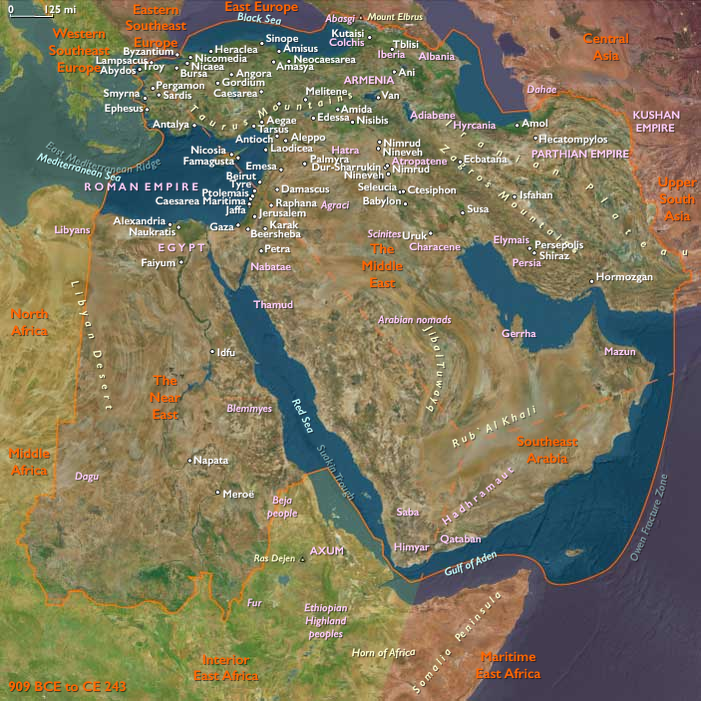
Subregions
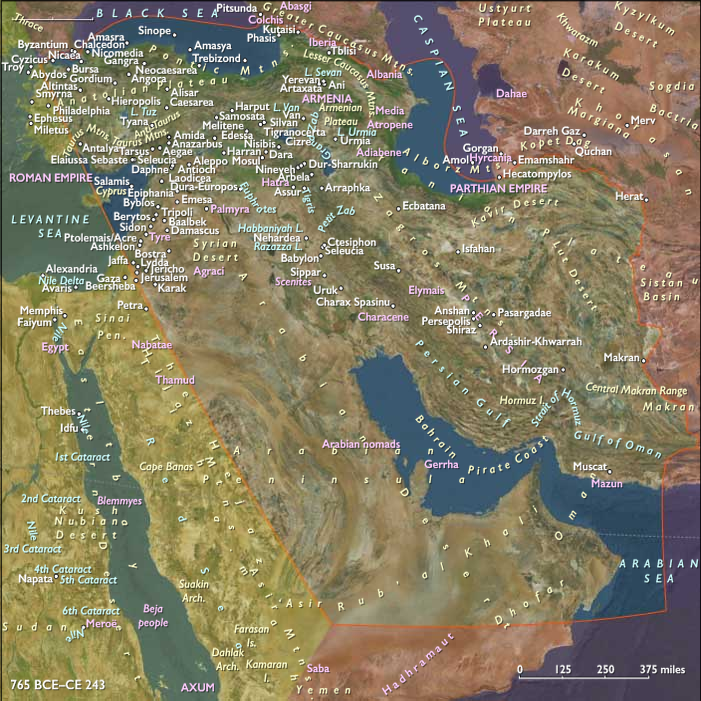
Related Events
Filter results
Showing 10 events out of 214 total
The Middle East (1828–1971 CE): Qajar and Ottoman Struggles, Oil Empires, and Cold War Realignments
Geography & Environmental Context
The Middle East includes Iraq, Iran, Syria, Armenia, Georgia, Azerbaijan, Qatar, Bahrain, the United Arab Emirates, most of Turkey (except its European and southwestern parts), eastern Jordan, nearly all of Lebanon, eastern Saudi Arabia, and northern Oman. Anchors include the Tigris–Euphrates basin, the Zagros and Caucasus ranges, the Iranian plateau, the Caspian littoral, the Levantine corridor, and the Persian/Arabian Gulf. This subregion connected Mediterranean, Russian, and Indian Ocean worlds while enduring pressures from empire, revolution, and global energy demand.
Climate & Environmental Shifts
The waning Little Ice Age gave way to modern warming trends, but aridity remained dominant. The Fertile Crescent endured cycles of drought and flood, disrupting agriculture. The Caspian and Persian Gulf coasts supported fisheries and palm groves, while deserts of Iraq, Syria, and Arabia constrained settlement. Earthquakes (notably in Iran and Turkey) punctuated the landscape. After the mid-20th century, dams like the Aswan High Dam’s regional counterparts (e.g., Iran’s Karaj Dam, Turkey’s Keban project) sought to control rivers and support hydroelectricity.
Subsistence & Settlement
-
Agriculture: Wheat, barley, and rice dominated in Mesopotamia and Iran’s plains; date groves thrived in Basra, Khuzestan, and Gulf oases. Tobacco, cotton, and citrus became key cash crops in Syria, Lebanon, and northern Iran.
-
Pastoralism: Nomadic and semi-nomadic tribes (Bedouin, Bakhtiari, Kurdish, Turkmen) persisted, though sedentarization campaigns curtailed mobility in the 20th century.
-
Urbanization: Cities like Baghdad, Damascus, Tehran, Tabriz, Aleppo, and Baku grew as administrative centers. Beirut blossomed as a Levantine port; Gulf towns like Manama, Doha, and Dubai remained small but were transformed by oil after the 1950s.
-
Oil settlements: From the 1900s, Abadan, Kirkuk, Dhahran, and Bahrain became boomtowns linked to Anglo-Iranian and American oil companies.
Technology & Material Culture
-
19th century: Telegraph lines, railways (Berlin–Baghdad, Hejaz, Trans-Iranian), and steam navigation linked the region to Europe.
-
20th century: Oil refineries, pipelines (Kirkuk–Haifa, Abadan–Mediterranean), and dams modernized infrastructure. Cars, radios, and cinemas spread after WWII; by the 1960s, televisions and concrete apartment blocks reshaped urban life.
-
Everyday life: Bazaar craft traditions—carpets, textiles, ceramics—coexisted with imported mass goods. Mosques, churches, and synagogues continued as architectural anchors.
Movement & Interaction Corridors
-
Imperial routes: Russian expansion in the Caucasus (taking Armenia, Georgia, Azerbaijan) and British routes through the Gulf redefined boundaries.
-
Trade: Caravans from Iran and Iraq moved wool, carpets, and livestock; steamships carried oil and pilgrims.
-
Pilgrimage: Shiʿi shrines at Najaf and Karbala attracted millions; Sunni routes to Mecca drew eastern pilgrims via Basra and Gulf ports.
-
Oil corridors: Tankers carried Gulf crude to Europe and Asia; pipelines bound Kirkuk and Abadan to Mediterranean ports.
-
Diaspora & labor: Armenians, Assyrians, and Kurds migrated amid wars; Palestinian refugees after 1948 and 1967 transformed Jordan, Lebanon, and Syria.
Cultural & Symbolic Expressions
-
Religion: Islam predominated (Sunni in Anatolia, Syria, Iraq; Shiʿi in Iran, southern Iraq, eastern Arabia); Christian minorities (Armenian, Assyrian, Maronite, Greek Orthodox) and Jewish communities remained vital until large-scale emigration after 1948.
-
Intellectual life: The Nahda (Arab Renaissance) spread through Beirut, Damascus, and Baghdad; Iranian reformers blended constitutionalism with Shiʿi thought.
-
Arts & media: Persian poetry, Arabic novels, Turkish press, and Levantine theater flourished; postwar Egyptian cinema circulated regionally. Radio speeches—Nasser, Mossadegh, Baʿath leaders—became political rituals.
-
Identity movements: Pan-Arabism, pan-Islamism, and early pan-Turkism shaped discourse. Kurdish nationalism emerged, while Zionist movements abroad affected regional politics through immigration to neighboring Palestine.
Environmental Adaptation & Resilience
-
Irrigation: Canals in Iraq and Iran expanded, though salinization plagued Mesopotamian soils.
-
Oases: Wells, qanats, and date-palm agroforestry sustained Gulf and Iranian plateau communities.
-
Nomadic strategies: Seasonal migration and diversified herds buffered risk; modern states sought to sedentarize tribes, often disrupting resilience.
-
Urban adaptation: Markets, hammams, and communal charities supported survival in famine and flood; post-WWII welfare states extended these functions through subsidies and public works.
Political & Military Shocks
-
Ottoman decline & Russian advance: Russo-Persian wars led to treaties (Turkmenchay 1828) ceding Caucasian lands to Russia. Ottoman Syria and Iraq faced autonomy movements.
-
Iran: The Qajar dynasty (1789–1925) managed concessions to Britain and Russia, sparking nationalist protest; the 1906 Constitutional Revolution curtailed monarchy briefly.
-
Iraq: British occupied Mesopotamia in WWI; mandate rule (1920–32) preceded monarchy and eventual 1958 revolution.
-
Syria & Lebanon: French mandate (1920–46); independence brought coups and eventual Baʿathist ascendancy.
-
Turkey: Atatürk’s republic (1923) reformed Anatolia’s western and central regions, overlapping with this subregion’s borders in Adana and southeastern Turkey.
-
Oil politics: 1901 D’Arcy concession (Iran), 1908 oil discovery at Masjed Soleyman, and formation of Anglo-Iranian Oil Company (later BP). Gulf sheikhdoms signed British treaties, setting the stage for independence in the 1960s–70s.
-
Arab–Israeli conflict: Though Israel itself lies outside this subregion, wars of 1948 and 1967 deeply reshaped its neighbors—Jordan lost East Jerusalem, Syria lost the Golan, Lebanon absorbed refugees.
-
Revolutions & coups: Egypt’s Free Officers inspired Iraq (1958) and Syria (1963); Iran’s Mossadegh nationalized oil (1951) before a 1953 coup restored the Shah.
Transition
Between 1828 and 1971, the Middle East was remade from Ottoman and Qajar borderlands into a set of oil-rich nation-states entangled in global power struggles. Early decades saw imperial encroachment, concessions, and mandates; the 20th century brought oil exploitation, nationalist revolts, and Cold War alignments. The rise of Baʿathism, Arab socialism, and pan-Islamic calls reshaped identity, while Gulf emirates edged toward independence under British withdrawal (1971). By the end of this period, pipelines, refineries, and revolutionary movements had replaced caravan and oasis rhythms, making the Middle East both the strategic heart of the Cold War and the stage for new conflicts over sovereignty, resources, and ideology.
The Near and Middle East (1828–1971 CE)
Empires in Decline, Nations in Transition, and Oil in Ascendancy
Geography & Environmental Context
The Near and Middle East includes three fixed subregions:
-
The Near East — Israel, Egypt, Sudan, western Saudi Arabia, Yemen, Jordan, southwestern Turkey, and southwestern Cyprus.
-
The Middle East — Iraq, Iran, Syria, Armenia, Georgia, Azerbaijan, Qatar, Bahrain, the United Arab Emirates, eastern Jordan, eastern Saudi Arabia, and northern Oman.
-
Southeast Arabia — southern Oman, eastern Yemen, and the island of Socotra.
This vast region links the Mediterranean, Red Sea, Persian Gulf, and Caspian Basin, bridging Africa, Europe, and Asia. It is dominated by deserts and highlands, punctuated by fertile river valleys (the Nile, Tigris, and Euphrates) and strategic straits — the Suez Canal, the Bab el-Mandeb, and the Strait of Hormuz — that define global trade and geopolitics.
Climate & Environmental Shifts
Aridity remained the defining condition. The 19th century brought episodes of famine and epidemic following droughts in Egypt, Iran, and the Arabian Peninsula. Irrigation schemes and canal building, such as the Suez Canal (opened 1869) and the Assiut Barrage (1902), transformed riverine agriculture. Petroleum exploration and urban expansion in the 20th century accelerated desertification and water demand. Monsoon moisture sustained oases in Oman and Yemen, while seasonal Nile floods continued until the Aswan High Dam (1960–70) reshaped the river’s ecology.
Subsistence & Settlement
-
Agrarian bases persisted in the Nile Valley, the Fertile Crescent, and the Iranian Plateau, producing wheat, cotton, dates, and fruits.
-
Nomadic and pastoral tribes in Arabia, the Levant, and Sudan maintained camel and sheep herding, adapting to modern markets.
-
Urbanization surged in Cairo, Istanbul, Tehran, Baghdad, Beirut, and Jeddah, intensified by European trade and oil wealth.
-
Port cities—Aden, Basra, Kuwait City, Manama, and Doha—grew into nodes of global commerce.
Technology & Material Culture
European imperial penetration introduced telegraphs, railways (notably the Hejaz Railway, 1908), and modern weaponry. In the 20th century, oil extraction and refining brought pipelines, tankers, and industrial zones. Traditional crafts—carpets, calligraphy, metalwork, and ceramics—remained vital symbols of identity. Concrete architecture and Western education transformed cities, while mosques and bazaars continued as cultural anchors.
Movement & Interaction Corridors
-
Trade routes: The Suez Canal reoriented world shipping; the Persian Gulf became an oil artery.
-
Pilgrimage: The Hajj connected Muslims globally through Mecca and Medina.
-
Migration: Rural–urban drift filled cities; labor migration later linked Yemenis, Egyptians, and Iranians to Gulf oil fields.
-
Military corridors: The Near and Middle East served as theaters of imperial rivalries—British in the Gulf and Egypt, Russians in the Caucasus, Ottomans across Anatolia and Arabia.
Cultural & Symbolic Expressions
-
Religion and reform: Islamic modernists such as Jamal al-Din al-Afghani and Muhammad Abduh sought synthesis of faith and reason; Christian minorities in Lebanon and Armenia fostered education and journalism.
-
Literature and art: The Nahda (Arab Renaissance) revived Arabic prose and poetry; Persian and Turkish writers blended realism with nationalism.
-
Architecture: Cairo’s modern boulevards, Tehran’s avenues, and oil-era Gulf skylines redefined urban form while domed mosques and minarets remained emblems of continuity.
-
Music and media: Radio and cinema from Cairo, Tehran, and Istanbul spread popular culture across linguistic and sectarian boundaries.
Environmental Adaptation & Resilience
Desert agriculture expanded through artesian wells and canals; the introduction of cash crops like cotton in Egypt and tobacco in Iran restructured rural economies. Oases sustained date-palm and grain cultivation, while pastoralists adjusted routes to motor transport and border restrictions. In coastal cities, desalination and modern infrastructure emerged to offset water scarcity.
Political & Military Shocks
-
Imperial decline and reform:
-
The Ottoman Empire weakened, culminating in its dissolution after World War I.
-
Egypt’s Muhammad Ali dynasty modernized administration and industry but fell under British occupation (1882).
-
Iran’s Qajar dynasty faced constitutional revolution (1905–11) and later Pahlavi modernization (from 1925).
-
-
World Wars and mandates: British and French mandates carved up former Ottoman territories; Iraq, Syria, Lebanon, Transjordan, and Palestine emerged under European oversight.
-
Nationalism and revolution:
-
Turkey’s Republic (1923) under Mustafa Kemal Atatürk secularized and industrialized Anatolia.
-
Arab nationalism surged—Nasser’s Egypt championed anti-imperial unity.
-
Iran underwent the 1951 oil nationalization crisis and the White Revolution (1963).
-
The Zionist movement culminated in the creation of Israel (1948) and successive Arab–Israeli wars (1948, 1956, 1967).
-
-
Oil and Cold War: The discovery of major oil fields (Iran 1908; Iraq 1927; Saudi Arabia 1938; Kuwait 1938) made the region central to global power politics. U.S. and Soviet rivalry deepened through alliances and arms races.
Transition
Between 1828 and 1971, the Near and Middle East transformed from imperial provinces and desert sultanates into a mosaic of nation-states, revolutionary republics, and monarchies bound by oil and ideology. The collapse of Ottoman and colonial empires unleashed nationalist movements, while petroleum wealth and Cold War geopolitics redefined economies and alliances. In the deserts of Arabia and the deltas of the Nile and Tigris-Euphrates, modernization coexisted with faith, and cities like Cairo, Tehran, and Riyadh became centers of a region poised between deep tradition and global transformation
The Lebanon, Syria and Transjordan are decolonized in 1946.
The Middle East (1948–1959): Independence, Conflict, and Cold War Alignments
The era from 1948 to 1959 dramatically reshapes the political landscape of the Middle East, marked by the establishment of new states, the eruption of intense conflicts, and the region’s growing strategic importance amid Cold War rivalries. This period sees the founding of Israel, a surge in Arab nationalism, and major shifts in geopolitical alliances, all of which have profound long-term consequences.
Establishment of Israel and the Arab-Israeli Conflict
In 1947, the United Nations proposes partitioning British-mandated Palestine into separate Jewish and Arab states, igniting fierce Arab opposition. On May 14, 1948, the State of Israel declares independence, immediately triggering the 1948 Arab-Israeli War, as neighboring Arab states—including Egypt, Syria, Jordan, Iraq, and Lebanon—launch attacks aiming to prevent Israel's establishment.
Despite initial setbacks, Israel emerges victorious, expanding its territory beyond the original UN partition boundaries. Jordan takes control of the West Bank and East Jerusalem, while Egypt occupies the Gaza Strip. The conflict results in the mass displacement of over 700,000 Palestinian Arabs, marking the beginning of the Palestinian refugee crisis.
Armistice agreements in 1949 do not lead to peace; instead, a fragile ceasefire prevails. Tensions persist, shaping Arab-Israeli relations for decades.
Egypt and the Rise of Nasser
The early 1950s see a nationalist revolution in Egypt. In July 1952, a military coup led by Colonel Gamal Abdel Nasser overthrows King Farouk, abolishing Egypt’s monarchy and establishing a republic in 1953. Nasser rapidly rises as Egypt's foremost leader, championing Arab nationalism, anti-imperialism, and economic reform.
In 1956, Nasser nationalizes the Suez Canal, previously controlled by British and French interests, to finance the construction of the Aswan High Dam. Britain, France, and Israel respond with the Suez Crisis (1956), launching a coordinated invasion to retake control. International pressure, particularly from the United States and Soviet Union, forces the invading powers to withdraw, dramatically elevating Nasser’s prestige as a symbol of Arab resistance against colonialism and Western interference.
Syria and Lebanon: Political Instability and Emerging Nationalism
In Syria, the early independence period is turbulent, with frequent military coups and shifting governments. Syrian politics become increasingly radicalized, influenced by Arab nationalism, socialism, and a growing alignment with the Soviet Union. In 1958, Syria briefly unites with Egypt to form the United Arab Republic (UAR) under Nasser’s leadership, reflecting widespread Arab nationalist aspirations. However, the union proves short-lived due to internal disagreements, eventually dissolving in 1961.
In contrast, Lebanon experiences relative stability in the early 1950s but faces rising internal tensions by the decade’s end. The influx of Palestinian refugees after 1948 alters Lebanon’s delicate sectarian balance, increasing internal strain. President Camille Chamoun’s pro-Western stance in the late 1950s triggers unrest, culminating in the 1958 Lebanese crisis. U.S. Marines intervene militarily to support Chamoun, stabilizing the situation temporarily but highlighting Lebanon’s vulnerability to regional and sectarian pressures.
Iraq: Monarchy, Revolution, and the Emergence of the Republic
Iraq initially remains a conservative monarchy closely aligned with Britain. However, growing dissatisfaction with economic inequalities, British influence, and the monarchy’s pro-Western policies lead to mounting nationalist agitation.
In July 1958, a military coup led by General Abd al-Karim Qasim overthrows the Hashemite monarchy, brutally killing King Faisal II and his family. Iraq becomes a republic under Qasim, who institutes land reform, expands social welfare, and distances Iraq from Western alliances. Although initially popular, Qasim faces fierce internal struggles between Arab nationalist factions (including Ba'athists) and communists, foreshadowing further turmoil.
Iran: Mossadegh, Oil Nationalization, and the 1953 Coup
Iran in the early 1950s is dominated by nationalist leader Prime Minister Mohammad Mossadegh, who in 1951 nationalizes the British-owned Anglo-Iranian Oil Company, sparking a severe international crisis. Britain and the United States, concerned by Mossadegh’s increasingly independent policies and potential Soviet influence, orchestrate a covert operation (Operation Ajax) in 1953, removing Mossadegh and reinstating Shah Mohammad Reza Pahlavi’s autocratic rule.
The Shah consolidates his power, aligning firmly with Western interests, especially the United States. Though initially stabilizing Iran’s economy and securing Western support, this event sows deep resentment, fueling anti-Western sentiment and laying groundwork for future revolutionary movements.
Turkey and NATO Membership
Amid increasing Cold War tensions, Turkey moves decisively toward the West, joining the North Atlantic Treaty Organization (NATO) in 1952. This strategic alignment provides Turkey with military security and substantial U.S. economic aid. NATO membership firmly places Turkey as a critical Western ally bordering the Soviet Union, influencing regional dynamics significantly during the Cold War.
Saudi Arabia and the Gulf States: Rising Oil Revenues
The Arabian Peninsula experiences profound economic transformations during this era due to oil discoveries and exports. Saudi Arabia, under King Saud (1953–1964), rapidly expands infrastructure and development projects financed by burgeoning oil revenues. Saudi Arabia's geopolitical importance rises dramatically, becoming a key Western ally and an influential voice in Arab politics.
Smaller Gulf states such as Kuwait, Qatar, and Bahrain also benefit from increased oil revenues, transforming from impoverished sheikhdoms into wealthy states. These countries continue under British protection, maintaining traditional tribal governance structures but modernizing their economies rapidly.
Jordan: Consolidation under King Hussein
Jordan, having annexed the West Bank after the 1948 war, faces a significant Palestinian population and rising nationalist sentiment. King Hussein, ascending the throne in 1952, stabilizes his rule by balancing British and American support with domestic political reforms, carefully navigating regional tensions. Despite persistent challenges, Jordan emerges as a relatively stable monarchy in a volatile region.
Legacy of the Era (1948–1959)
The years between 1948 and 1959 leave an enduring legacy on Middle Eastern geopolitics. The establishment of Israel and subsequent Arab-Israeli conflict define regional hostilities for decades. The rise of assertive Arab nationalism, particularly under Nasser, reshapes political ideologies throughout the Arab world, challenging Western dominance. Iran’s pivotal 1953 coup plants seeds of future revolutionary upheaval, while oil wealth transforms the Arabian Peninsula into a global economic center. Amid Cold War dynamics, Turkey’s NATO membership and strategic alignments further polarize regional politics, embedding global tensions within local conflicts. The complex interplay of nationalism, colonial legacies, and superpower rivalry profoundly reshapes the Middle East, influencing regional and global politics for generations.
Events immediately before and during Israel's War of Independence and during the first years of statehood remain, as far as those events involve the Arab residents of Palestine, matters of bitter and emotional dispute.
Palestinian Arab refugees, who number in the hundreds of thousands, insist that they have been driven out of their homeland by Jewish terrorists and regular Jewish military forces; the government of Israel asserts that the invading Arab forces had urged the Palestinian Arabs to leave their houses temporarily to avoid the perils of the war that would end the Jewish intrusion into Arab lands.
Immediately after the armistice agreements of 1949, Israel had begun encroachments into the demilitarized zones along with military attacks with many civilian casualties and the expulsion of thousands of Arabs, some of whom subsequently form terrorist bands that carry out what they presumably regard as reprisals and what Israel and its supporters refer to as unprovoked terrorism.
These actions set the stage for further conflicts with Egypt and Syria.
Israeli encroachments in the demilitarized zones in the north for water diversion projects and agricultural development, including armed encroachments into areas farmed by Palestinians, lead ultimately to the shelling of Israel from the Golan Heights.
Israeli attacks into the Gaza Strip lead to fedayeen attacks that serve as the pretext for the 1956 Israeli-French-British invasion of Egypt, though Egypt had been attempting to calm the border region in fear of such an attack.
Initially these forces consist of approximately eight thousand to ten thousand Egyptians, two thousand to four thousand Iraqis, four thousand to five thousand Transjordanians, three thousand to four thousand Syrians, one thousand to two thousand Lebanese, and smaller numbers of Saudi Arabian and Yemeni troops; about twenty-five thousand in all.
Goldie Myerson, a signatory of Israel's independence declaration and newly appointed minister to Moscow, had personally attempted to dissuade King Abdullah of Transjordan from joining the invasion of Israel decided on by other Arab states.
Israeli forces composed of the Haganah, such irregular units as the Irgun and the Stern Gang, and women's auxiliaries, number thirty-five thousand or more, armed with Czechoslovakian weapons sent at the behest of the Soviet Union.
Moshe Dayan commands the Jerusalem area; Yitzhak Rabin directs the defense of Jerusalem (and also fights the Egyptians in the Negev).
The invading Arab League forces occupy the areas in southern and eastern Palestine not apportioned to the Jews, then capture the small Jewish quarter of the Old City of Jerusalem.
The Israelis, meanwhile, win control of the main road to Jerusalem through the Yehuda Mountains (Judaean Hills) and successfully beat off Arab attacks.
The Arab League has fielded only a few well-trained units.
In addition, some Arab logistical lines are long, making resupply and communication difficult.
The most formidable Arab force is Transjordan's Arab Legion, commanded by Glubb Pasha, but Abdullah has secret relations with the Zionists and strongly opposes a Palestinian state led by his enemy al-Husseini.
Other states, such as Egypt and Iraq, also have different objectives, and this internal strife, disorganization, and military ineptitude prevents the Arabs from mounting a coordinated attack.
Abdullah's primary purpose, which he has spelled out in secret discussions with Jewish envoys, is to extend his rule to include the area allotted to the Palestinian Arabs under the United Nations partition resolution of November 1947.
Accordingly, he engages his forces in the area of Palestine popularly known as the West Bank and expels Jewish forces from East Jerusalem (the Old City).
'Akko is occupied by regular Israeli troops on May 17, 1948.
The citadel of the city of 'Akko, or Acre, had never been successfully forced until the previous May when, as a British prison, it was taken by the Irgun, though the city had surrendered to the Egyptian viceroy Ibrahim Pasha in 1832.
Most of the city's Arab inhabitants flee during the Israeli takeover, but about three thousand remain. (The city's population in the late twentieth century will be about three-fourths Jewish.)
The UN calls for a cease-fire on May 20 and appoints Swedish soldier, humanitarian, and diplomat Folke, Count Bernadotte, as mediator.
A nephew of King Gustav V of Sweden, Bernadotte, commissioned in the Swedish Army in 1918, had become an official of the Boy Scout movement and during the Second World War had headed the Swedish Red Cross, securing the exchange of many prisoners of war and being credited with saving some twenty thousand inmates of German concentration camps.
His excellent reputation among all the combatant nations in Europe had led the Nazi official Heinrich Himmler to employ him to transmit a fruitless offer (April 24, 1945) that Germany surrender unconditionally to the United Kingdom and the United States but not to the Soviet Union.
The Israeli forces, after a number of failed attempts to occupy Bayt Daras on the Lachish River, thirty-two kilometers northeast of Gaza, mobilize a large contingent and surround the village on May 21.
Women and children fleeing the fighting are met with lethal gunfire by the besiegers.
Short of arms and training, the Israeli forces still have the advantage of having just beaten al-Husseini's irregulars, and their morale is high.
A key element of Ben-Gurion's statism is the integration of Israel's independent military forces into a unified military structure.
On May 25, 1948, Ben-Gurion presents the following aims to his general staff: “…we should prepare to go over to the offensive with the aim of smashing Lebanon, Transjordan and Syria...The weak point in the Arab coalition is Lebanon [for] the Moslem regime is artificial and easy to undermine. A Christian state should be established, with its southern border on the Litani river [within Lebanon]. We will make an alliance with it. When we smash the [Arab] Legion's strength and bomb Amman, we will eliminate Transjordan too, and then Syria will fall. If Egypt still dares to fight on, we shall bomb Port Said, Alexandria, and Cairo.” (Chomsky, Noam: Fateful Triangle: the United States, Israel, and the Palestinians (p. 162, 1983 Updated Edition 1999, South End Press, Boston MA, USA.)
Years: 93BCE - 93BCE
Locations
People
- Lucius Cornelius Sulla
- Mithridates II of Parthia
- Mithridates VI of Pontus
- Nicomedes IV of Bithynia
- Tigranes the Great
Groups
- Iranian peoples
- Armenian people
- Roman Republic
- Cappadocia, Kingdom of
- Greeks, Hellenistic
- Pontus, Kingdom of
- Bithynia, Kingdom of
- Parthian Empire
- Armenia, Empire of
Topics
Commodoties
Subjects
Regions
Subregions