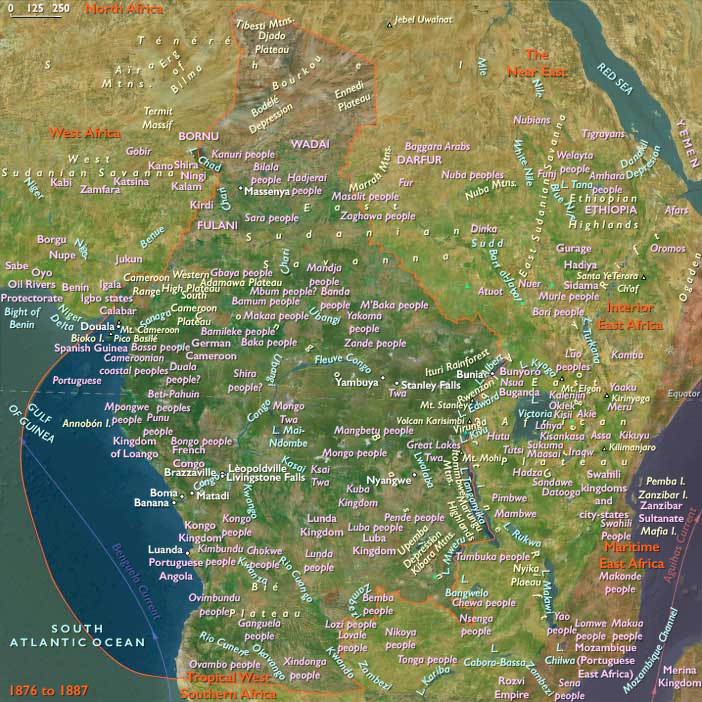
The protectorate of Kamerun, or Cameroon, is…
1876 CE to 1887 CE
Germany had begun to establish roots in Cameroon in 1868 when the Woermann Company of Hamburg built a warehouse on the estuary of the Wouri River.
By 1884, Adolph Woermann, representing all West African companies as their spokesman, petitions the imperial foreign office for "protection" by the German Empire
Otto von Bismarck, the Imperial Chancellor, seeks to utilize the traders on site in governing the region via "chartered companies".
However, in response to Bismarck's proposal, the companies withdraw their petition.
At the core of the commercial interests is pursuit of profitable trading activities under the protection of the Reich, but these entities are determined to stay away from political engagements.
Eventually, Bismarck yields to the Woermann position and instructs the admiralty to dispatch a gunboat.
As a show of German interest, the small gunboat SMS Möwe arrives in West Africa.
Germany is particularly interested in Cameroon's agricultural potential and it is entrusted to large firms to exploit and export it.
Chancellor Bismarck defines the order of priorities as follows: "first the merchant, then the soldier".
It is under the influence of Adolph Woermann, whose company sets up a trading house in Douala, that Bismarck, initially skeptical about the interest of the colonial project, is convinced.
Large German trading companies (Woermann, Jantzen und Thoermalen) and concession companies (Sudkamerun Gesellschaft, Nord-West Kamerun Gesellschaft) establish a massive presence in the colony.
Letting the big companies impose their order, the administration simply supports them, protects them and eliminates native uprisings.
Germany is planning to create a great African empire, which will connect Kamerun through the Congo to its East African possessions.
The German Foreign Minister will say shortly before the First World War that the Belgian Congo is too large a colony for a country too small.
Gustav Nachtigal, the German explorer, medical doctor, imperial consul and commissioner for West Africa, is the driving force toward the colony's establishment, making a treaty with one of the local kings to annex the region for the German emperor.
By this time well over a dozen German companies, based in Hamburg and Bremen, conduct trading and plantation activities in Cameroon.
Locations
Topics
Commodities
Regions

Middle Africa
View →Subregions