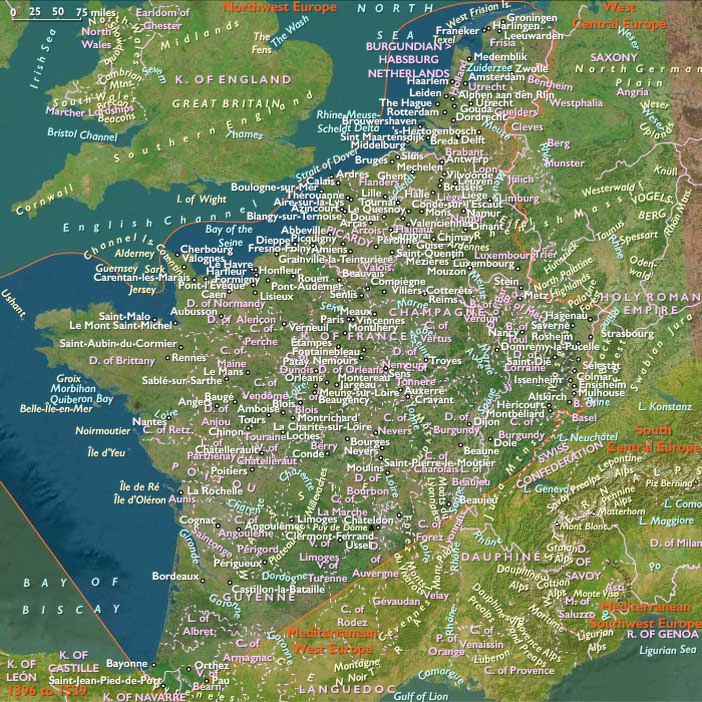
The County of Montbéliard: A Holy Roman…
1407 CE
The County of Montbéliard: A Holy Roman Imperial Territory in Eastern France (1397–1407)
Montbéliard, a county of the Holy Roman Empire situated at the junction of the Luzine and Allaine rivers in eastern France, had been settled by the 8th century and remained an imperial fief throughout the Middle Ages. In 1397, the county passed into Württemberg control through the betrothal of its heiress, Henriette of Montbéliard, to Eberhard IV, Count of Württemberg.
Eberhard IV took an active role in the governance of Montbéliard from 1407, marking the beginning of centuries of Württemberg influence over the county, which would later become one of the few Protestant enclaves in France, specifically Lutheran.
I. The Marriage Alliance and the Transition to Württemberg Rule (1397–1407)
- Henriette of Montbéliard, the eleven-year-old heiress of the county, was betrothed to Eberhard IV of Württemberg in 1397, securing a dynastic union between the two territories.
- Though Henriette remained nominal ruler, Eberhard IV assumed full control of Montbéliard in 1407, effectively integrating the county into the Württemberg domain while still maintaining its status as an imperial fief.
- This transition strengthened ties between Montbéliard and the German-speaking lands of the Holy Roman Empire, ensuring its distinct cultural and political identity within France for centuries.
II. The Protestant Legacy of Montbéliard
- Due to its long association with the House of Württemberg, Montbéliard remained aligned with German political and religious influences, even as surrounding French territories remained Catholic.
- When the Dukes of Württemberg embraced Lutheranism during the Reformation (16th century), Montbéliard became one of the few Protestant enclaves in France.
- Despite pressures from the Catholic French monarchy, the county retained its Lutheran identity for centuries, distinguishing it from the surrounding Catholic regions of Franche-Comté and Lorraine.
III. Long-Term Impact and Legacy
- Montbéliard’s association with the Holy Roman Empire and Württemberg allowed it to maintain administrative and religious independence for an extended period.
- It remained a Protestant stronghold within Catholic France, contributing to regional tensions during the Reformation and subsequent religious wars.
- The county was not fully annexed to France until 1793, during the French Revolutionary period, marking the end of Württemberg rule but not the immediate end of its Lutheran tradition.
The betrothal of Henriette of Montbéliard and Eberhard IV in 1397 marked a crucial turning point, linking Montbéliard to Württemberg for centuries and establishing it as one of France’s few lasting Protestant enclaveswithin a predominantly Catholic nation.
Locations
Subjects
Regions
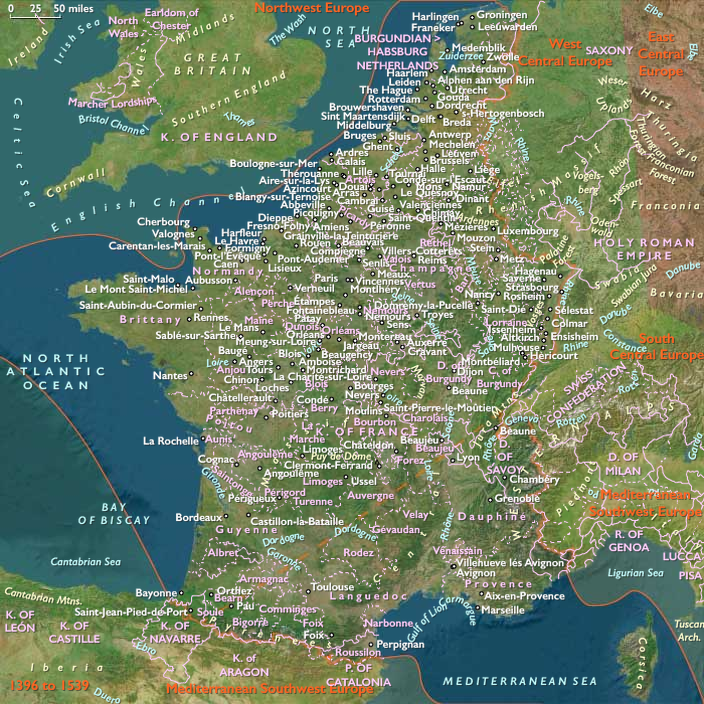
West Europe
View →Subregions