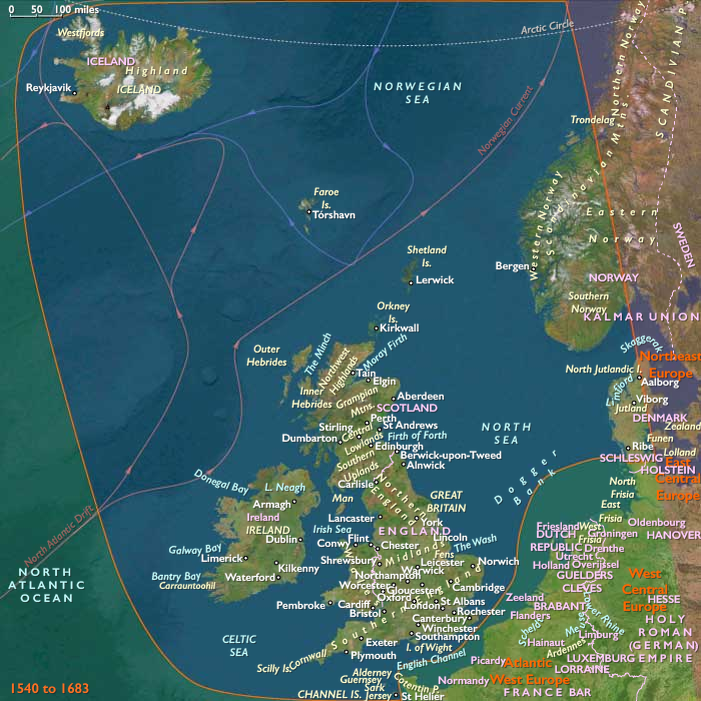
Montrose joins Hurry at the Ord of…
April 1650 CE
Montrose joins Hurry at the Ord of Caithness, whence their combined force advances along the coast to Dunrobin Castle, garrisoned for the government by the tenants of the Earl of Sutherland, as are the smaller fortresses at Skelbo Castle, Skibo Castle and Dornoch Castle.
Avoiding these obstacles, the royalists turn aside, marching up Strathfleet towards Strathoykell.
The Oykell is forded just to the west of its junction with the Cassley, and the trek continues along the southern bank.
Montrose has counted on the support of the Mackenzies, but their chief, the Earl of Seaforth, is in exile, and even his brother, Sir Thomas Mackenzie of Pluscardine, who had led the rising the previous year, remains quiet.
With no support in the hills the rebels continue back towards the coastal plain, on April 27 halting at Carbisdale on the southern side of the Kyle of Sutherland.
Strachan is by now at Tain conferring with the earl of Sutherland.
Learning of Montrose's whereabouts, he decides on an immediate surprise attack.
Montrose's army is in a narrow glen, where the Culrain Burn flows into the Kyle of Sutherland.
To his rear the ground rises up to the wooded hill of Creag a' Choineachan.
With a good view of the surrounding countryside he will be able to deploy his men on the hill if subject to a sudden attack.
Yet, believing there is only a small body of enemy horse in the area, he fails to carry out a thorough reconnaissance, thus making the same mistake that had led to the disaster at Philiphaugh.
Strachan has now reached Western Fern to the south-east of Carbisdale.
On his onward march he still has the River Carron to cross by a ford which leaves him some miles short of the enemy position.
A direct approach will only alert the royalists to his position.
Fortunately, much of the way is covered by thick broom, which ends just before the Culrain Burn is reached.
Close to the Burn, Strachan conceals his men in a gully overshadowed by broom, allowing only a single troop to emerge into the open.
Montrose sends his cavalry under Major John Lisle to investigate, while the infantry takes cover in the woods of Creag a' Choineachan.
Before these deployments are complete Strachan's whole force emerges and charges.
Lisle is immediately overwhelmed, as the Covenanters ride on towards the infantry.
The Germans and Danes, seeing their cavalry defeated, retreat into nearby Scroggie Wood.
Here, Clan Munro and Clan Ross join in the fight, eager to grab their share of any plunder.
The Germans and Danes fight gallantly, retreating deeper and deeper into the wood, but they are losing the battle.
The need for self preservation takes over and those that are left attempt to flee, with the bloodshed in the wood continuing for over two hours.
Even after the battle ends the slaughter does not cease; the clansmen of Ross-shire and Sutherland for many days after are to continue pursuing and killing those who had escaped the battle.
Hurry and some of the Danish and German musketeers attempt to make a stand, but the Orcadians crumble in panic.
Two hundred of them are drowned trying to escape across the waters of the Kyle of Sutherland.
The whole affair is over in a matter of minutes.
Carbisdale is not a battle: it is a rout.
The defeated soldiers are hunted over the slopes of Creag a' Choineachan by Strachan's troopers and local hostile clansmen for two hours.
Four hundred are killed, and over four hundred and fifty taken prisoner, including Sir John Hurry, whose amazing career as a soldier is shortly to come to an end.
People
Topics
Commodities
Subjects
Regions
North Europe
View →Subregions