
Müntzer’s Mühlhausen troop marches around the countryside…
May 1525 CE
Müntzer’s Mühlhausen troop marches around the countryside in north Thuringia at the beginning of May but fails to meet up with other troops, being content to loot and pillage locally.
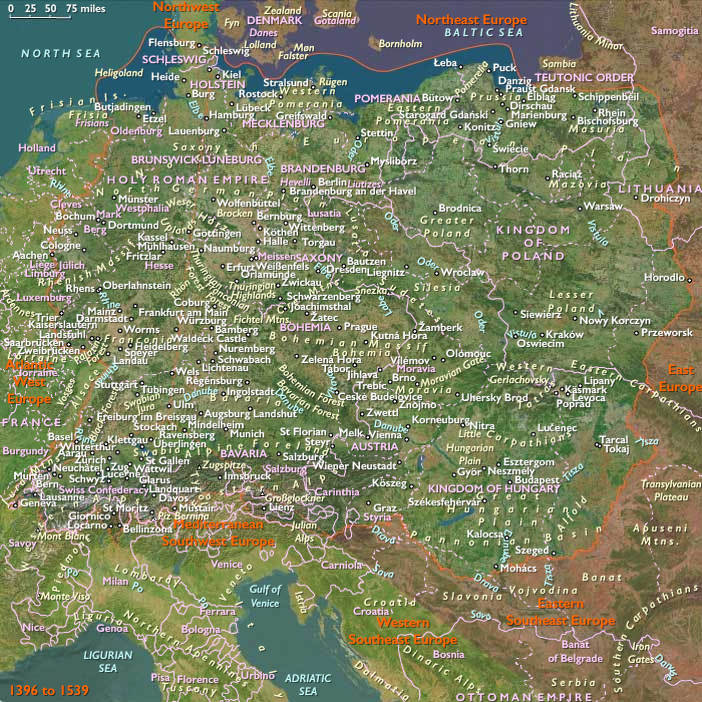
In the following days, a rising number of insurgents gathers around the town, and when Müntzer arrives with three hundred fighters from Mühlhausen on May 11, meeting up with rebels here who have been asking for help for some time, several thousand peasants of the surrounding Thuringian and Saxon estates camp in the fields and pastures.
However, Philip of Hesse and his father-in-law George of Saxony are on Müntzer's trail and direct their Landsknecht troops toward Frankenhausen.
No sooner have the Mühlhausen troop set up camp on a hill than the princes’ army arrives, having already crushed the rebellion in southern Thuringia.
The princes' troops are mostly mercenaries.
As such they are well equipped, are well trained, and have good morale.
The peasants, in contrast, are badly equipped with scythes and flails, have no training whatsoever, and furthermore are in disagreement whether to fight against or to negotiate with the enemy.
Nevertheless, on May 14 they are able to ward off some smaller attacks of the Hesse and Brunswick troopers, though they fail to reap the benefits of their victory.
Instead the insurgents arrange a ceasefire and withdraw into a wagon fort to coordinate their further course of action, while the Saxon forces approach.
The next day Philip's troops unite with the Saxon army of Duke George and immediately break the truce, starting a heavy combined infantry, cavalry and artillery attack.
The peasants are caught off guard and flee in panic to the town, followed and continuously attacked by the mercenaries.
The battle lasts only a few minutes, and leaves the streams of the hill running with blood.
Most of the insurgents are slain in what turns out to be a massacre.
Casualty figures are unreliable but peasant losses have been estimated at three thousand to ten thousand and the Landsknecht casualties estimated as low as six (two of whom were only wounded).
Many more rebels are executed in the following days.
Müntzer flees, but is captured as he hides in a house in Frankenhausen.
His identity is revealed by a sack of papers and letters that he is clutching.
People
Groups
Commodities
Subjects
Regions
Central Europe
View →Subregions
