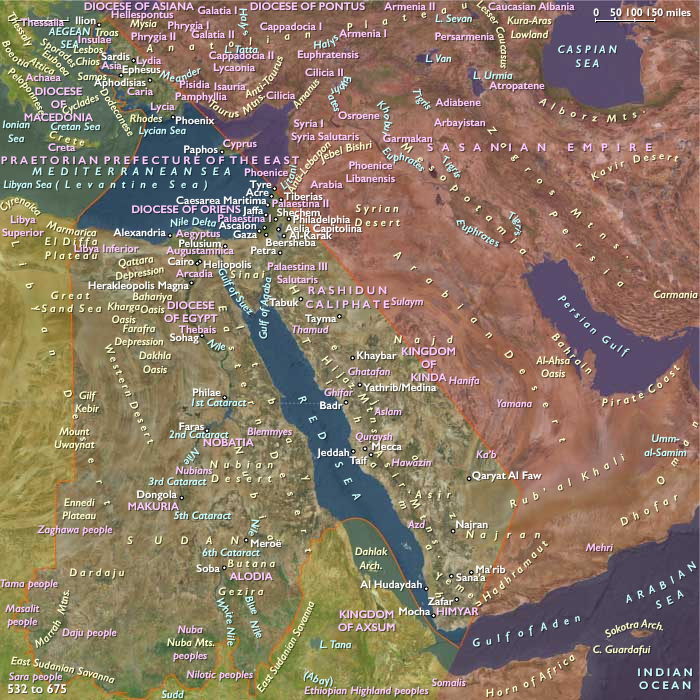
Near East (544–555 CE): Stability Amid Challenges…
544 CE to 555 CE
Near East (544–555 CE): Stability Amid Challenges
Between 544 and 555 CE, the Near East experiences a period of relative stability despite the challenges posed by earlier disruptions, such as the Plague of Justinian. Significant developments continue in political, religious, and cultural spheres.
Recovery from the Plague
The devastating Plague of Justinian continues to influence life throughout the Near East. The initial outbreak had significantly diminished populations, disrupted economies, and strained administrative structures, but by the mid-550s, communities begin to stabilize and gradually recover. This recovery phase sees the re-establishment of trade routes, the revival of agricultural productivity, and a cautious rebuilding of urban centers.
Consolidation in Makuria
In the kingdom of Makuria, centered in the fortress city of Old Dongola along the Nile, Christian influence further solidifies. Building upon the religious foundations laid in previous decades, Makuria continues to develop its distinct Christian identity, notably through the construction of new religious edifices. This period reinforces Makuria's role as a significant political and religious power in Nubia, bridging cultural and trade connections between Sub-Saharan Africa and the Mediterranean world.
Religious and Cultural Flourishing in Jerusalem
Under continuing Byzantine influence, Jerusalem flourishes as a vital pilgrimage and spiritual center. The extensive building initiatives of Emperor Justinian, particularly the restoration of the Church of the Resurrection (Church of the Holy Sepulchre) and surrounding religious complexes, draw pilgrims from across the Christian world. Jerusalem's significance is further heightened by ongoing theological discourse and the establishment of numerous monasteries and hospices that support its role as a major hub of Christian devotion and scholarship.
Legacy of the Era
The era 544–555 CE consolidates the Near East's recovery from epidemic and turmoil, reinforcing the region’s critical role as a nexus of religious, cultural, and political interactions. Makuria emerges as an influential Christian kingdom in Africa, while Jerusalem remains central to Christian religious life, reflecting the enduring capacity of Near Eastern societies to adapt and flourish despite significant challenges.
People
Groups
Regions
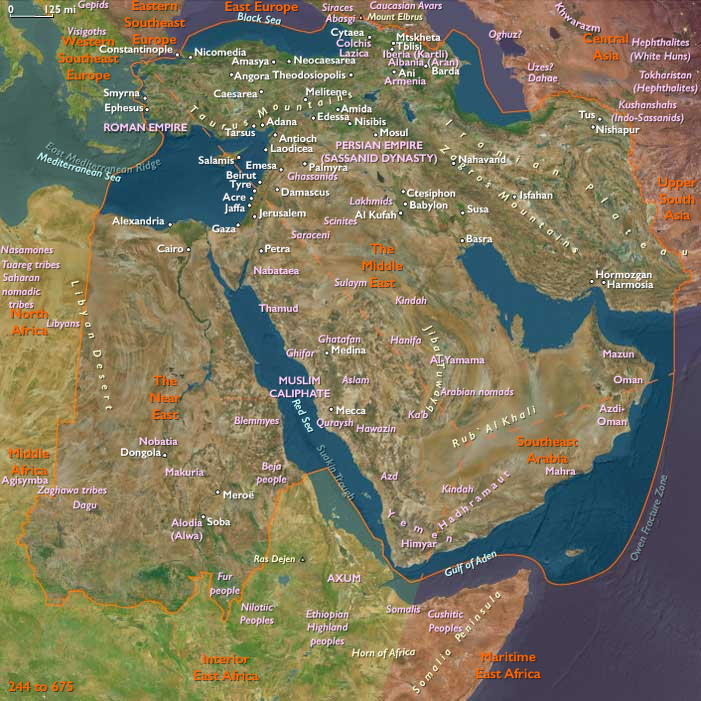
The Near and Middle East
View →Subregions