
Near East (621–610 BCE): Religious Reform and…
621 BCE to 610 BCE
Near East (621–610 BCE): Religious Reform and Regional Realignment
Josiah's Monotheistic Reforms
During this era, Josiah, traditionally recognized as the sixteenth successor of David as king of Judah in Jerusalem, undertakes profound religious and political reforms. Historically, Judah, much like the former Hebrew kingdom of Israel, alternated between devotion to Yahweh and the worship of various other Canaanite, Phoenician, and Syrian deities, occasionally involving human sacrifice. Josiah vigorously reforms Hebrew religion into a strictly monotheistic cult, centralizing worship of Yahweh in Jerusalem. He envisions reunifying Judah and Israel under Babylonian protection, aspiring to restore Davidic authority over the historic territories of Israel, leveraging the declining influence of Assyria.
Nahum's Prophecy and the Fall of Nineveh
Amidst regional turmoil, the prophet Nahum emerges as a vocal commentator. His writings, positioned chronologically between Micah and Habakkuk, celebrate the fall of Nineveh. Nahum depicts the Assyrian capital’s conquest by the Medes and Babylonians as divine judgment upon oppressive rulers, notably abstaining from directing his prophetic condemnation toward Israel or Judah. Although Nahum's prophecies likely date shortly after Nineveh's destruction in 612 BCE, they are framed as predictions of forthcoming events, highlighting their theological significance.
Egyptian Revival under Psamtik I
In Egypt, Wahibre Psammetichus I (also known as Psamtik), ruler of the Twenty-sixth Dynasty, solidifies his country's stability and growth. During his fifty-four-year reign, he fosters close ties with Greek settlers, promoting their establishment of colonies and their enlistment into Egyptian military and administrative services. By Psamtik’s death in 610 BCE, Egypt experiences a notable cultural and economic revival, becoming a significant regional power.
Pharaoh Necho II and the Assyrian Collapse
Upon Psamtik’s death, his successor, Wahemibre Necho II, faces the chaos wrought by raids from the Cimmerians and the Scythians, who significantly disrupt Asia west of the Euphrates and accelerate Assyria's collapse at the hands of the resurgent Babylonians. At this juncture, the once-mighty Assyrian empire is reduced to remnants rallied by General Ashur-uballit II at Harran. Necho II attempts to support this dwindling Assyrian resistance, but his dispatched forces are insufficient, forcing a withdrawal west of the Euphrates.
Athens' Expansion to Sigeum
Further west, economic pressures compel the grain-dependent city-state of Athens to secure overseas territories for agricultural supply. By approximately 610 BCE, Athens establishes control over Sigeum, strategically positioned en route to the grain-rich regions around the Black Sea, marking an early instance of Athenian territorial expansion aimed at securing crucial resources.
Legacy of the Era
This period represents a transformative era characterized by significant religious reforms, regional power shifts, and economic revitalization. Josiah's monotheistic revolution profoundly reshapes Hebrew identity and religious practice. Concurrently, Egypt’s resurgence under Psamtik I and Necho II, alongside Athens' initial overseas expansion, foreshadows broader Mediterranean geopolitical changes, setting foundational dynamics for subsequent historical developments.
Groups
Commodities
Regions
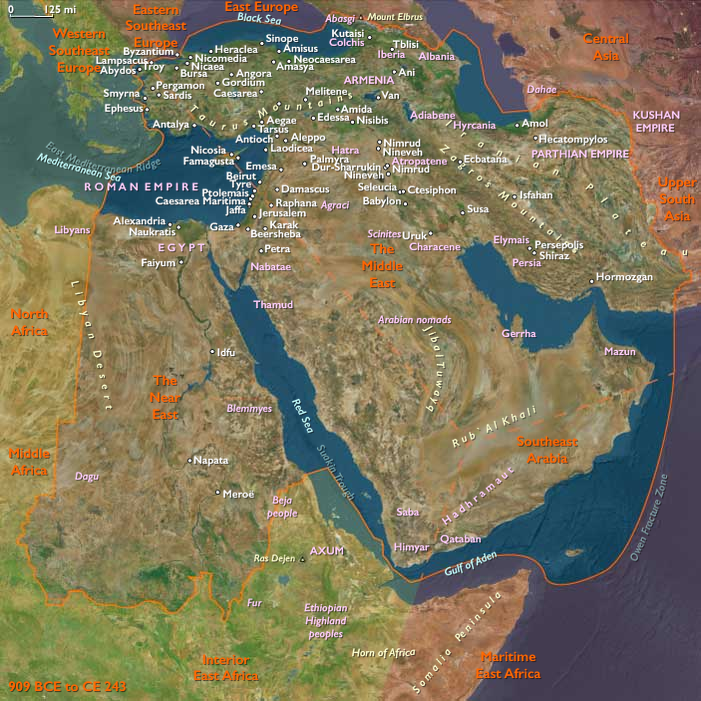
The Near and Middle East
View →Subregions
