
...Parma also being heavily affected.
1624 CE to 1635 CE
Locations
Groups
Subjects
Regions
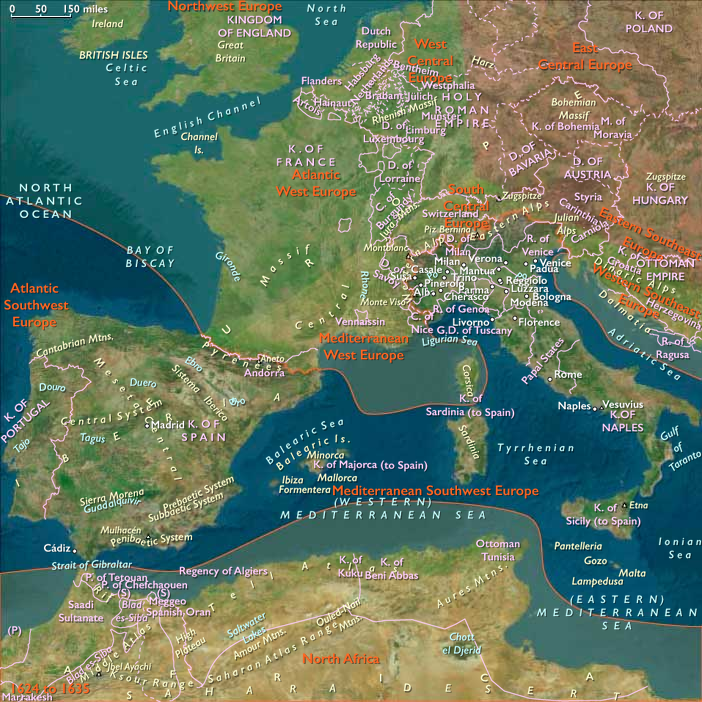
Southwest Europe
View →Subregions
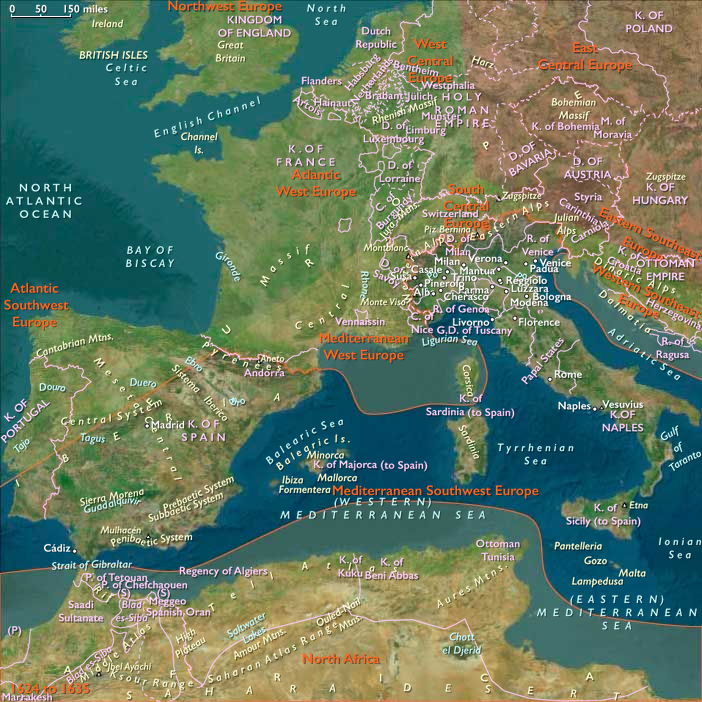
Mediterranean Southwest Europe
View →Related Events
Showing 10 events out of 124 total
The East India Company's mainstay businesses are by this time cotton, silk, indigo dye, saltpeter, and tea.
Early Dutch colonists had attempted but failed to control Macau and the Penghu islands.
VOC admiral Cornelis Reyersz had set sail in July 1622, for the island of Formosa (Taiwan) in search of a suitable new location to build a trading post, and in 1624 establishes a small fort named Orange on Tayouan.
The fort is then expanded and renamed Fort Zeelandia.
Unfortunately, the site chosen lacks adequate supplies of fresh water, which had to be shipped in from the mainland.
The settlement is initially designed as a base to attack their Spanish rivals and as a trading post between China and Batavia.
Later the post is to become the Dutch center of trade between China, Japan and Europe.
Large scale immigration from the Chinese mainland begins as the Dutch colonists begin to import workers from Fujian and Penghu (Pescadores) as laborers, many of whom settle.
Jan Pieterszoon Coen, the fourth governor of the Dutch East Indies, had handed his post to Pieter de Carpentier on February 1, 1623, and returned to the Netherlands, where he had received a hero's welcome off the coast of Texel.
He had then become head of the VOC chamber in Hoorn and worked on establishing new policies.
During his absence from the East Indies, difficulties with the English had been exacerbated by the Amboyna Massacre.
Coen had on On October 3, 1624, been reappointed governor-general in the East Indies, but his departure had been hindered by the English.
He married in 1625 and in 1627 departed incognito for the East Indies with his wife, their newborn child and her brother and sister, starting work on September 30.
The English abandon Batavia after his arrival and establish their headquarters in Bantam.
One of Yamada’s ships transporting rice in 1628 from Ayutthaya to Malacca is arrested by a Dutch warship blockading the city.
The ship is released once the identity of the owner becomes clear, since the Dutch know that Yamada is held in great respect by the King of Siam, and they do not wish to enter into a diplomatic conflict.
Yamada is also valued by the Dutch as a supplier of deer hide, and they invite him to trade more with Batavia (Accounts of the castle of Batavia, March 1, 1628).
Almost the entire native population of the Banda Islands has been driven away by 1629, starved to death or killed in an attempt to replace them with Dutch plantations.
Readings of historical sources suggest around one thousand Bandanese likely survive in the islands, and have been spread throughout the nutmeg groves as forced laborers.
Post conquest, the Dutch have subsequently resettled the islands with imported slaves, convicts and indentured laborers (to work the nutmeg plantations), as well as immigrants from elsewhere in Indonesia.
These plantations are used to grow cloves and nutmeg for export.
Coen had hoped to settle large numbers of Dutch colonists in the East Indies, but this part of his policies will never materialize, because the Heeren XVII (the seventeen Lords of the VOC) are wary of large, open-ended financial commitments.
Yamada Nagamasa visits Japan in 1629 with an embassy from the Thai king Songtham.
The newly built Batavia, commissioned by the Dutch East India Company, had sailed on October 28, 1628, from Texel for the Dutch East Indies, to obtain spices.
It sails under commandeur and opperkoopman (upper- or senior merchant) Francisco Pelsaert, with Ariaen Jacobsz serving as skipper.
These two had previously encountered each other in Surat, India.
Although some animosity had developed between them there, it is not known whether Pelsaert even remembered Jacobsz when he boarded Batavia.
Also on board is the onderkoopman (under- or junior merchant) Jeronimus Cornelisz, a bankrupt pharmacist from Haarlem who is fleeing the Netherlands, in fear of arrest because of his heretical beliefs associated with the painter Johannes van der Beek, also known as Torrentius.
Jacobsz and Cornelisz during the voyage have conceived a plan to take the ship, which will allow them to start a new life somewhere, using the huge supply of trade gold and silver then on board.
After leaving Cape Town, where they had stopped for supplies, Jacobsz had deliberately steered the ship off course, away from the rest of the fleet.
Jacobsz and Cornelisz have already gathered a small group of men around them and arrange an incident from which the mutiny is to ensue.
This involves molesting a high-ranking young female passenger, Lucretia Jans, in order to provoke Pelsaert into disciplining the crew.
They hope to paint his discipline as unfair and recruit more members out of sympathy.
The woman is able to identify her attackers, however.
The mutineers are then forced to wait until Pelsaert makes arrests, but he never acts.
The ship on June 4, 1629, strikes a reef near Beacon Island, part of the Houtman Abrolhos off the Western Australian coast.
Forty people drown, but most of the three hundred and twenty-two passengers and crew manage to get ashore.
The survivors, including all the women and children, are then transferred to nearby islands in the ship's longboat and yawl.
An initial survey of the islands finds no fresh water and only limited food (sea lions and birds).
Pelsaert realizes the dire situation and decides to search for water on the mainland.
A group comprising Captain Jacobsz, Francisco Pelsaert, senior officers, a few crew members, and some passengers leave the wreck site in a thirty-foot (nine point one meters) longboat, in search of drinking water.
After an unsuccessful search for water on the mainland, they abandon he other survivors and head north in a danger-fraught voyage to the city of Batavia, now known as Jakarta.
This journey, which ranks as one of the greatest feats of navigation in open boats, takes thirty-three days and, extraordinarily, all aboard survive.
After the arrival in Batavia, the boatswain, a man named Jan Evertsz, is arrested and executed for negligence and "outrageous behavior" before the loss of the ship (he is suspected to have been involved).
Jacobsz is also arrested for negligence, although his position in the potential mutiny is not guessed by Pelsaert.
Batavia's Governor General Coen immediately gives Pelsaert command of the Sardam to rescue the other survivors, as well as to attempt to salvage riches from the Batavia's wreck.
Jeronimus Cornelisz, who had been left in charge of the survivors, is well aware that if that party ever reached the port of Batavia, Pelsaert would report the impending mutiny, and his position in the planned mutiny might become apparent.
Therefore, he makes plans to hijack any rescue ship that might return and use the vessel to seek another safe haven.
Cornelisz even makes far-fetched plans to start a new kingdom, using the gold and silver from the wrecked Batavia.
However, to carry out this plan, he first needs to eliminate possible opponents.
Cornelisz's first deliberate act is to have all weapons and food supplies commandeered and placed under his control.
He then moves a group of soldiers, led by Wiebbe Hayes, to nearby West Wallabi Island, under the false pretense of searching for water.
They are told to light signal fires when they find water and they will then be rescued.
Convinced that they will be unsuccessful, he then leaves them there to die.
Cornelisz now has complete control.
The remaining survivors are to face two months of unrelenting butchery and savagery.
“With a dedicated band of murderous young men, Cornelisz began to systematically kill anyone he believed would be a problem to his reign of terror, or a burden on their limited resources.
The mutineers become intoxicated with killing, and no one can stop them.
They needed only the smallest of excuses to drown, bash, strangle or stab to death any of their victims, including women and children.”
Cornelisz never commits any of the murders himself, although he tries and fails to strangle a baby.
Instead, he uses his powers of persuasion to coerce others into doing it for him, firstly under the pretense that the victim had committed a crime such as theft.
Eventually, the mutineers begin to kill for pleasure, or simply because they are bored.
He plans to reduce the island's population to around forty-five so that their supplies will last as long as possible.
Between them, his followers murder at least one hundred and ten men, women, and children.