
The Rings-Schumm engine, a pioneering internal-combustion engine,…
1876 CE
The Rings-Schumm engine, a pioneering internal-combustion engine, appears in autumn 1876 and is immediately successful, its thermodynamic efficiency far surpassing that of steam engines.
Nikolaus Otto, the son of a farmer who also ran the local post office, had served an apprenticeship in commerce and subsequently worked as a businessman in Frankfurt am Main and in Cologne.
After relocating to Cologne, he had quit his office job in order to construct small gas engines, starting out by seeking to improve on the existing design of Étienne Lenoir.
Otto had met another engineer, Eugen Langen, in 1864.
The technically trained Langen had recognized the potential of Otto's development, and one month after the meeting, founded the first engine factory in the world, NA Otto & Cie.
Their improved engine had been awarded the Grand Prize at the 1867 Paris World Exhibition.
The principle of operation had been described by the Italian inventors Eugenio Barsanti and Felice Matteucci in their British Patent no. 1625 of 1857, though they never produced a marketable example.
For all its success, with the company producing six hundred and thirty-four engines a year by 1875, the Otto and Langen engine had hit a technical dead end: it produces only 3 hp (2.2 kW; 3.0 PS), yet requires ten to thirteen feet (three to four meters) of headroom to operate, and is noisy besides.
Otto had turned his attention to the four-stroke cycle (as described in a pamphlet by Alphonse Beau de Rochas in 1862).
This was largely due to the efforts of Franz Rings and Herman Schumm, brought into the company by Gottlieb Daimler.
It is this engine (the Otto Silent Engine), and not the Otto & Langen engine, to which the Otto cycle refers.
This is the first commercially successful engine to use in-cylinder compression (as patented by William Barnett in 1838).
People
Regions
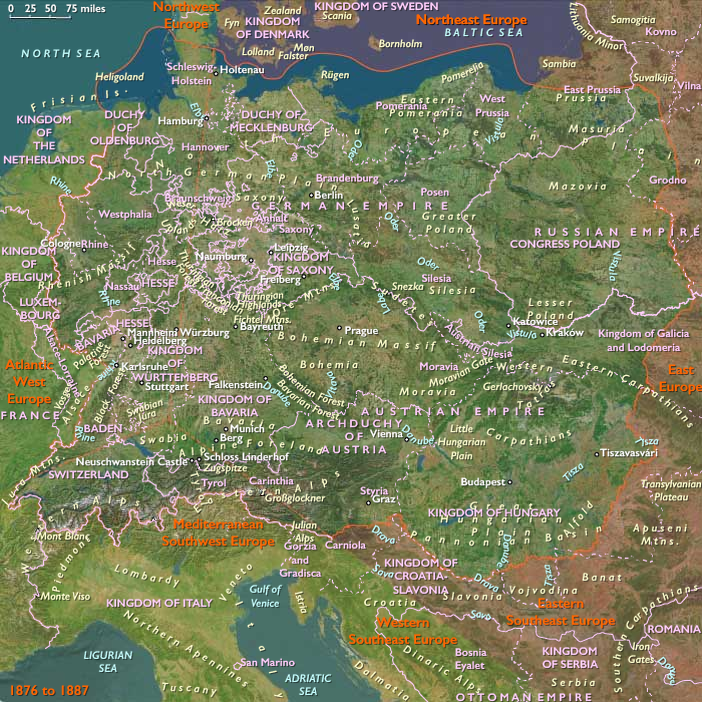
Central Europe
View →Subregions
