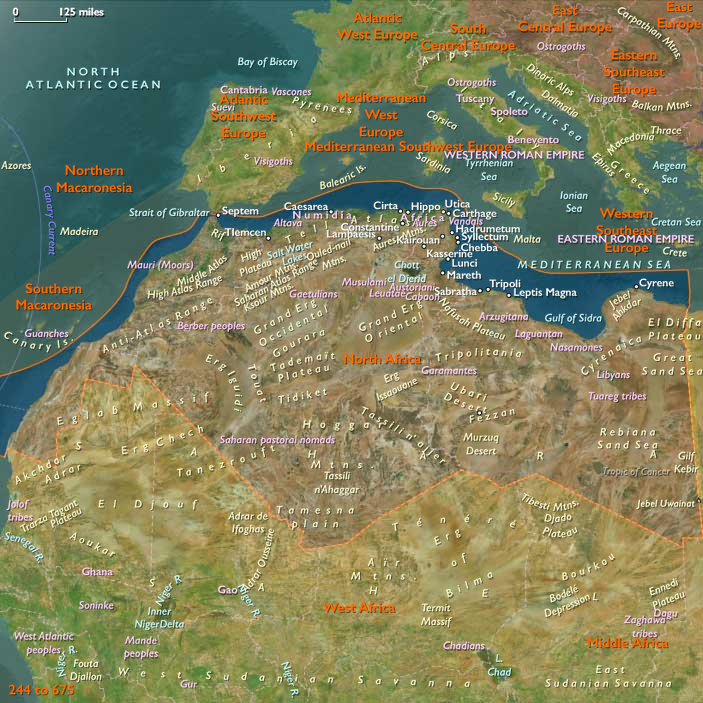
North Africa (544–555 CE) Byzantine Fortifications, Administrative…
544 CE to 555 CE
North Africa (544–555 CE)
Byzantine Fortifications, Administrative Struggles, and Persistent Berber Autonomy
Between 544 and 555 CE, Byzantine North Africa enters a period marked by sustained administrative efforts, ambitious fortification projects, and ongoing challenges from resilient local resistance, primarily by autonomous Berber tribes.
Under Emperor Justinian I, Byzantine authority attempts to solidify its presence through an extensive series of military fortifications along coastal regions and strategic inland locations. Prominent cities such as Carthage, Leptis Magna, and Caesarea (Cherchell) witness significant reinforcement of defenses, with strengthened walls, watchtowers, and fortified urban precincts designed to secure Byzantine political and economic interests. However, these fortifications emphasize the inherently precarious nature of Byzantine rule, which remains limited primarily to urban and coastal areas.
Despite these investments, imperial administration throughout the region remains deeply flawed, undermined by widespread official corruption, ineffective leadership, limited military capabilities, and general neglect from distant Constantinople. Byzantine governors impose heavy taxes to finance these military defenses and administrative expenses, generating discontent among urban populations and local elites, who resent their increasingly burdensome obligations.
Persistent opposition from the rural and interior regions, particularly among independent Berber tribes, continues to impede the extension of Byzantine authority beyond fortified coastal enclaves. Berber groups, accustomed to relative independence during prior Vandal rule and the early years of Byzantine reconquest, vigorously resist attempts at centralized control. Rural areas and interior territories remain largely autonomous, frequently rejecting Byzantine governance and asserting local tribal authority.
Culturally and religiously, Byzantine restoration further reinforces orthodox Christianity, solidifying its dominance and fully reversing the previous Vandal-imposed Arianism. Orthodox clergy and local Christian communities enjoy renewed support, benefiting from restored church properties, religious institutions, and theological prominence. Yet religious unity does little to resolve underlying socio-political tensions caused by heavy taxation, administrative corruption, and ineffective governance.
Economically, coastal urban centers sustain relative prosperity, benefiting from reintegrated trade networks in the Mediterranean. Carthage reasserts itself as the leading economic hub, though its prosperity contrasts starkly with the neglected, economically depressed interior regions, where traditional agriculture and pastoral economies remain disrupted by continual Berber raids and resistance.
By the end of 555 CE, North Africa remains a region of pronounced contrasts. While Byzantine fortifications and orthodox religious institutions reflect renewed imperial ambitions, weak administration and relentless Berber resistance significantly limit genuine territorial control. This era thus highlights the inherent fragility and complexity of Byzantine rule, setting the stage for enduring instability and persistent local autonomy in the decades that follow.
People
Groups
Topics
Regions
North Africa
View →Subregions