North Africa (556–567 CE) Weakened Byzantine Control,…
556 CE to 567 CE
North Africa (556–567 CE)
Weakened Byzantine Control, Internal Decay, and Rising Berber Independence
Between 556 and 567 CE, North Africa endures a prolonged period of administrative deterioration, growing economic disparity, and escalating frontier tensions that severely challenge Byzantine rule across the region.
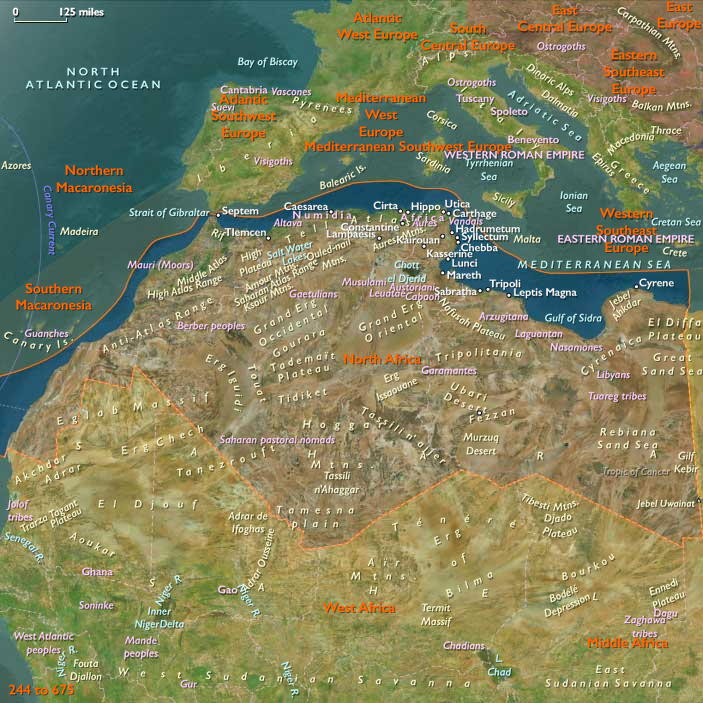
Following the ambitious but incomplete restoration under Emperor Justinian I, Byzantine governance struggles increasingly with internal inefficiencies, official corruption, and military weakness. Distant Constantinople shows limited interest in North African affairs, compounding the administrative neglect. This neglect results in the steady erosion of centralized control and authority, limiting effective Byzantine presence primarily to fortified coastal enclaves and major urban centers such as Carthage, Leptis Magna, and Caesarea (Cherchell).
Heavy taxation imposed by Byzantine governors to fund military fortifications and administrative expenditures further alienates local populations and urban elites, leading to growing dissatisfaction and economic hardship. Infrastructure in many urban and rural areas deteriorates notably, with maintenance of public works, water systems, and roads neglected due to poor governance and diversion of resources.
In contrast, autonomous Berber tribes thrive by capitalizing on weakened imperial authority. Berber groups aggressively assert control over extensive interior and mountainous territories, frequently launching raids into Byzantine-held rural settlements and disrupting critical trade routes. By this period, many rural communities prefer the protection of tribal chieftains to imperial administration, solidifying Berber control over significant portions of North Africa's interior.
Religiously and culturally, orthodox Christianity remains dominant and well-established in Byzantine-controlled urban regions. Yet, religious unity offers little to mitigate rising tensions stemming from socio-economic disparity and governmental neglect. Orthodox clergy, although officially supported, struggle with growing local resentment towards imperial officials, as dissatisfaction with governance undermines broader social cohesion.
Economically, the sharp divide between prosperous coastal urban centers and neglected, increasingly impoverished rural regions deepens significantly. Coastal cities such as Carthage maintain relative economic stability through Mediterranean trade, but the rural hinterlands suffer greatly from continual Berber incursions, agricultural disruption, and infrastructural neglect.
By the end of 567 CE, Byzantine North Africa faces a critical and escalating crisis. The empire's tenuous control, limited to fortified urban strongholds, contrasts sharply with extensive rural regions under independent Berber authority. Persistent internal decay, administrative neglect, and frontier instability foreshadow even greater disruptions, underscoring the growing fragility of Byzantine rule as the region approaches a period of further transformation.
People
Groups
Topics
Regions

North Africa
View →Subregions