
North Africa (189–46 BCE) Numidian Consolidation, …
Years: 189BCE - 46BCE
North Africa (189–46 BCE)
Numidian Consolidation, Carthaginian Recovery, Roman Expansion, Cyrenaic Stability, and Berber Integration
Numidia: Consolidation and Adaptation
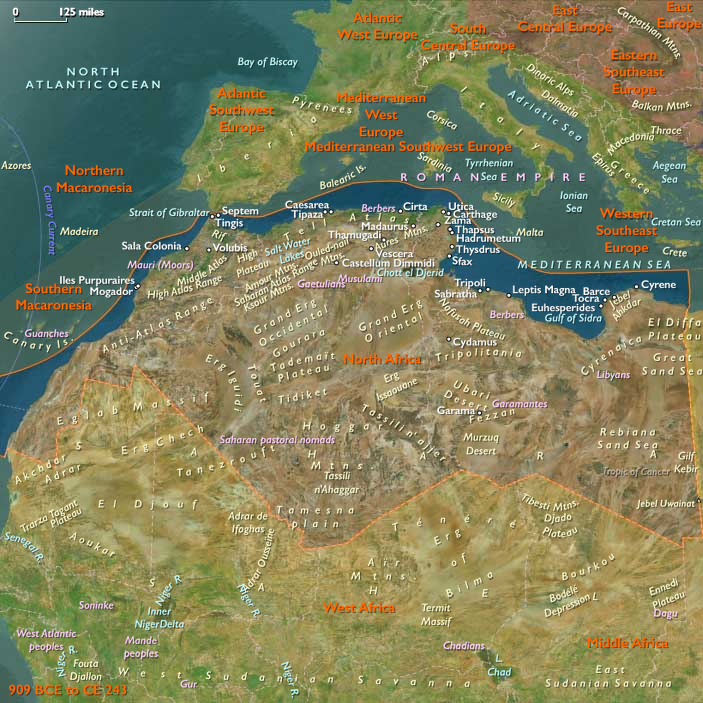
From 189 to 46 BCE, Numidia undergoes significant political and economic transformations. Under King Masinissa (189–148 BCE), the kingdom significantly consolidates territorial and political power, maintaining a critical alliance with Rome. Following Masinissa’s death, his successor Micipsa (148–118 BCE) sustains stability, although internal tensions around succession ultimately lead to the Jugurthine War (112–106 BCE), reducing Numidia’s autonomy under Rome.
Numidia adapts effectively under Roman oversight, maintaining agricultural productivity, commercial strength, and internal stability, successfully balancing local governance with imperial obligations.
Carthage: Economic Revival and Diplomatic Prudence
Between 189 and 146 BCE, Carthage experiences a cautious yet notable economic recovery, emphasizing agriculture, commerce, and manufacturing. Carefully managing diplomatic relations with Rome, Carthage remains influential economically and culturally. However, escalating tensions culminate in the devastating Third Punic War (149–146 BCE), leading to Carthage's complete destruction in 146 BCE and ending its independent existence.
Roman Provincial Expansion and Integration
Following Carthage’s destruction, Rome consolidates control over the province of Africa Proconsularis. From 146 to 46 BCE, Roman administration enhances regional stability through extensive investments in urban infrastructure, agriculture, trade networks, and provincial governance. Cities such as Utica prosper, firmly embedding North Africa within Rome’s broader Mediterranean economic and administrative framework.
Mauretania: Diplomatic Expansion and Economic Growth
From the era of King Bocchus I (c. 110–80 BCE) through subsequent leadership, Mauretania strategically enhances its diplomatic ties and economic integration with Rome. Benefiting substantially from Mediterranean trade routes and diplomatic cooperation, Mauretania experiences steady economic growth and regional influence, especially after siding with Rome in the Jugurthine War.
Cyrenaica: Economic Stability and Cultural Influence
Cyrenaica consistently prospers economically under stable Ptolemaic governance throughout this era. The Greek Pentapolis—Cyrene, Barce (Al Marj), Euhesperides (Benghazi), Teuchira (Tukrah), and Apollonia (Susah)—maintains robust economic activity, exporting grain, wine, wool, livestock, and especially the medicinal plant Silphium.
Cyrene continues as a distinguished cultural and intellectual hub, attracting scholars, philosophers, and medical experts, solidifying its significant cultural position within the Hellenistic world.
Berber Communities: Sustained Economic Integration and Cultural Continuity
Berber populations remain deeply integrated economically and culturally throughout North Africa. Coastal economic hubs, notably Oea (Tripoli), thrive through dynamic commercial interactions with Roman and Mediterranean markets, indirectly supporting inland Berber tribes.
Inland Berber communities maintain traditional governance and cultural practices, leveraging economic interactions with coastal centers to ensure sustained prosperity and stability. This mutual interdependence reinforces regional cohesion and cultural resilience.
Cultural Exchange and Religious Syncretism
Throughout the period, dynamic interactions among Berber, Roman, and Greek populations enrich regional traditions in pottery, textiles, metalwork, and broader artisanal crafts. Religious syncretism flourishes, seamlessly blending indigenous Berber traditions with Roman, Greek, and Phoenician religious customs, significantly enhancing the region’s rich cultural tapestry.
Foundations for Long-term Stability
By 46 BCE, North Africa has firmly established itself through Numidian adaptation, Roman provincial integration, Mauretanian diplomatic expansion, enduring Cyrenaic prosperity, and resilient Berber economic and cultural continuity. Collectively, these elements secure North Africa’s enduring importance within the evolving Mediterranean geopolitical framework.
People
Groups
- Berber people (also called Amazigh people or Imazighen, "free men", singular Amazigh)
- Carthage, Kingdom of
- Roman Republic
- Numidia, Kingdom of
- Cyrenaica, (Ptolemaic) Kingdom of
- Africa proconsularis (Roman province)
- Tripolitania (Roman province)
- Mauretania, Kingdom of
Topics
Commodoties
Subjects
Regions
Subregions
Related Events
Showing 4 events out of 4 total
Years: 189BCE - 46BCE
People
Groups
- Berber people (also called Amazigh people or Imazighen, "free men", singular Amazigh)
- Carthage, Kingdom of
- Roman Republic
- Numidia, Kingdom of
- Cyrenaica, (Ptolemaic) Kingdom of
- Africa proconsularis (Roman province)
- Tripolitania (Roman province)
- Mauretania, Kingdom of
Topics
Commodoties
Subjects
Regions
Subregions