
North Africa (736–747 CE) Berber Revolt, …
Years: 736 - 747
North Africa (736–747 CE)
Berber Revolt, Kharijite Uprisings, and Fragmentation of Umayyad Authority
Between 736 and 747 CE, North Africa experiences profound turmoil as indigenous Berber resentment erupts into widespread rebellion against the Umayyad Caliphate, known as the Berber Revolt (739–743 CE). This period marks a critical turning point, reshaping regional politics and paving the way for independent Berber dynasties.
The initial spark igniting widespread revolt occurs in 739 CE, driven by accumulated grievances including oppressive taxation, discriminatory practices, forced conscription, and the enslavement of Berber converts. This unrest quickly coalesces around the egalitarian ideals of the radical Islamic Kharijite sect, which advocates equality among all Muslims, irrespective of ethnic background, in stark contrast to Umayyad policies favoring Arab supremacy.
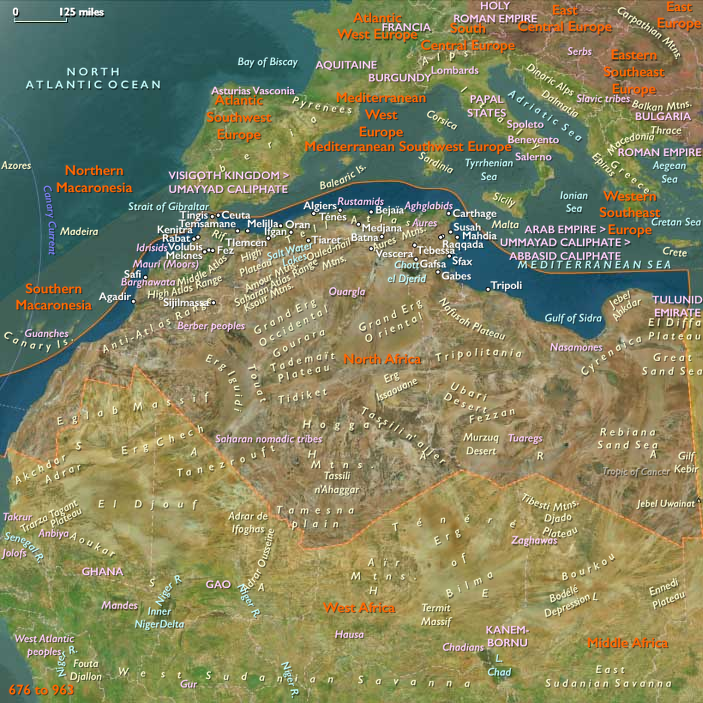
Berber groups across the Maghreb rise in unison, significantly challenging Umayyad control. Tribes from the mountainous Aurès, along with powerful confederations such as the Austoriani, Leutae, and the fiercely autonomous Laguatan, unite under Kharijite leadership, notably figures such as Maysara al-Matghari, whose forces gain rapid success.
Amid the chaos, the western coastal Barghawata confederation establishes itself as an independent entity, adopting a distinctive form of Islam deeply infused with local Berber traditions. Their unique religious identity underscores the fragmentation of religious authority during this period.
Simultaneously, oasis cities like Ouargla flourish economically despite regional instability, maintaining prosperous trade connections across Saharan routes controlled largely by influential Tuareg tribes. This economic autonomy bolsters local Berber power, further weakening central Umayyad authority.
The Berber Revolt severely destabilizes Umayyad dominance, forcing Arab forces to retreat to strongholds in Ifriqiya, primarily around Kairouan. Though the Umayyads eventually regain partial control by 743 CE, their grip on North Africa remains tenuous, significantly diminished in comparison to previous decades.
By 747 CE, North Africa is fundamentally transformed. The Berber Revolt, despite its eventual suppression, profoundly weakens centralized Umayyad governance, leading directly to the rise of independent Berber-ruled dynasties and deepening regional fragmentation. The era concludes with North Africa entering a new phase marked by vibrant local autonomy, diverse religious interpretations, and shifting political alliances.
People
Groups
- Arab people
- Berber people (also called Amazigh people or Imazighen, "free men", singular Amazigh)
- Numidians
- Tuaregs, or Touareg, people
- Laguatan (Libyan tribal confederation)
- Christianity, Chalcedonian
- Roman Empire, Eastern: Heraclian dynasty
- Islam
- Muslims, Sunni
- Muslims, Kharijite
- Umayyad Caliphate (Damascus)
- Muslims, Ibadi
- Ifriqiya, Ummayad
- Barghawata Confederacy (Masmuda Berber tribal confederacy)
Topics
Subjects
Regions
Subregions

Years: 736 - 747
People
Groups
- Arab people
- Berber people (also called Amazigh people or Imazighen, "free men", singular Amazigh)
- Numidians
- Tuaregs, or Touareg, people
- Laguatan (Libyan tribal confederation)
- Christianity, Chalcedonian
- Roman Empire, Eastern: Heraclian dynasty
- Islam
- Muslims, Sunni
- Muslims, Kharijite
- Umayyad Caliphate (Damascus)
- Muslims, Ibadi
- Ifriqiya, Ummayad
- Barghawata Confederacy (Masmuda Berber tribal confederacy)
Topics
Subjects
Regions
Subregions