Event
North Africa (1108–1251 CE): Almohad Unification, Mediterranean…
North Africa (1108–1251 CE): Almohad Unification, Mediterranean Competition, and the Birth of Successor States
Geographic and Environmental Context
Agricultural North Africa remained concentrated in Atlas and Tell valleys, coastal plains, irrigated basins, orchard districts, and favored uplands. Pastoralism filled the steppe and dry interior, while oasis agriculture and caravan mobility connected these populated northern environments with Saharan routes.
Political consolidation did not eliminate regional ecological distinctions. Indeed, the capacity of the emerging Almohad state depended upon moving resources among them.
The End of Almoravid Rule
At the opening of the age, the Almoravids still controlled Morocco and much of al-Andalus. Their empire tied Marrakesh to agricultural plains, Saharan networks, Atlantic and Mediterranean ports, and Iberian cities. Yet dissatisfaction with Almoravid political and religious authority helped generate a new reform movement among Masmuda communities of the High Atlas.
Ibn Tumart proclaimed a rigorous theology centered upon divine unity. After his death, Abd al-Muʾmin transformed the movement into a territorial empire.
Almohad Expansion
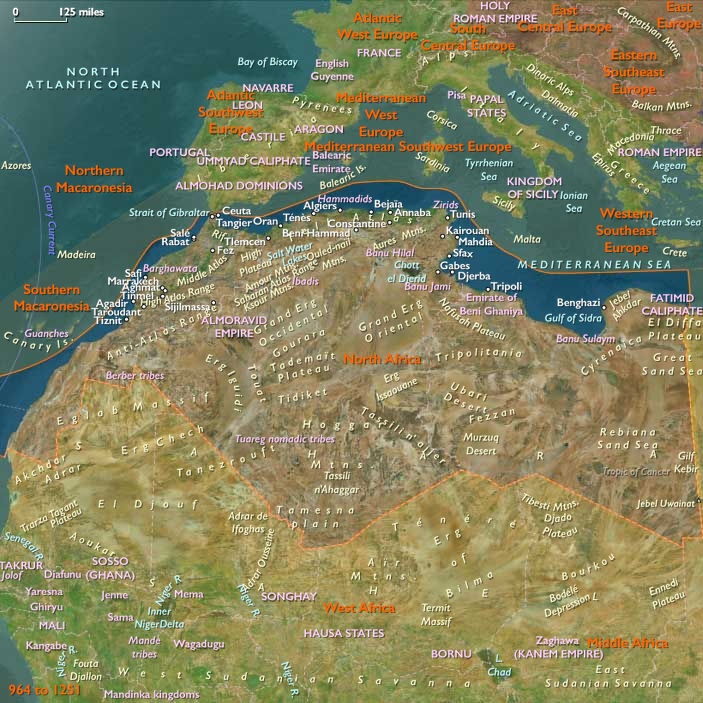
The Almohads captured Marrakesh in 1147, ending Almoravid rule there. Abd al-Muʾmin then expanded eastward through Algeria and eventually across Ifriqiya, producing the broadest Maghrebi political integration of the medieval epoch. Met scholarship describes the Almohads as the North African dynasty that succeeded the Almoravids and controlled Morocco while also building a major Iberian political system.
The central Maghreb was essential to this expansion. Hammadid authority ended as Almohad forces absorbed Algeria. In Ifriqiya, political weakness had allowed Norman Sicily to seize several coastal positions, including Mahdia. Almohad reconquest in the mid-twelfth century restored Muslim control and integrated the eastern Maghreb into the empire.
North Africa thereby experienced a rare moment in which Morocco, Algeria, Tunisia, and substantial parts of Libya belonged to one political system.
Imperial Infrastructure and Economy
Almohad unity depended on considerably more than military conquest. Taxation of agricultural production, customs duties, markets, roads, ports, military garrisons, provincial governors, and communication between major cities made imperial government possible.
Marrakesh remained the western center of power. Fez retained commercial and scholarly importance. Tlemcen occupied a strategic central position. Béjaïa linked mountainous Algeria to Mediterranean trade. Tunis gained increasing importance in Ifriqiya.
Mediterranean commerce connected North African ports with Iberia, Sicily, Genoa, Pisa, and other Christian and Islamic destinations. Shipping carried grain, olive oil, textiles, hides, wax, metals, ceramics, timber, animals, and people.
Trans-Saharan commerce remained equally important. Gold from western Africa flowed toward Moroccan and Algerian markets; North African textiles, salt, horses, manufactured goods, and religious scholarship traveled southward.
Agricultural and Pastoral Continuity
Imperial centralization did not remove local productive systems. Household cereal agriculture, irrigated garden cultivation, olives, orchard fruit, livestock, mountain terraces, fishing, and caravan transport continued.
The Hilalian presence in Ifriqiya and parts of Algeria contributed to an increasingly complex mosaic of settled cultivation and mobile pastoralism. Arab pastoral communities, Amazigh farmers and herders, oasis populations, and urban merchants interacted through markets rather than inhabiting wholly separate economic worlds.
Intellectual and Religious Life
Almohad religious policy initially challenged established Maliki institutions and advanced the dynasty’s own reformist ideology. Over time, however, the region again developed strong Maliki scholarship alongside Sufism.
The period also belonged to the exceptionally interconnected intellectual world of the western Mediterranean. Scholars, jurists, physicians, philosophers, artisans, and merchants moved between Maghrebi and Andalusi cities. Muslim, Jewish, and Christian communities participated unequally within these systems, and Almohad policy toward religious minorities could be considerably more coercive than under some preceding regimes.
Imperial Strain
The Almohad defeat at Las Navas de Tolosa in 1212 occurred in Iberia but had major implications for North African power. It accelerated the erosion of imperial prestige and compounded internal succession struggles.
As the empire weakened, regional political systems re-emerged. In Ifriqiya the Hafsids asserted independence from 1229. At Tlemcen the Zayyanids established a central-Maghrebi state. The Marinids, originating among Zenata communities, were expanding in Morocco and would ultimately replace Almohad rule there.
This succession was not a return to chaos. It represented the re-regionalization of an imperial economic structure whose cities, markets, roads, scholars, ports, and agricultural districts remained active.
Legacy of the Age
By 1251, Almohad imperial unity had largely ceased to function as the dominant political reality, although the dynasty survived in Morocco for several more years.
The age had nevertheless produced something historically important: a century in which much of the Maghreb was coordinated through a single imperial network, intensifying communication among Morocco, Algeria, Ifriqiya, the Sahara, Mediterranean ports, and al-Andalus.
The emerging Hafsid, Zayyanid, and Marinid states inherited that connectivity rather than beginning anew.

-
{# Image navigates to the detail page; the magnifying-glass chip is the only Fancybox lightbox trigger (kept a separate sibling — anchors can't nest). #}
 The Middle of The Earth
World
-
{# Image navigates to the detail page; the magnifying-glass chip is the only Fancybox lightbox trigger (kept a separate sibling — anchors can't nest). #}
 North Africa
Region
-
{# Image navigates to the detail page; the magnifying-glass chip is the only Fancybox lightbox trigger (kept a separate sibling — anchors can't nest). #}
 North Africa
Subregion