
North Polynesia (1396–1539 CE): Ahupuaʻa Landscapes, Interisland …
Years: 1396 - 1539
North Polynesia (1396–1539 CE): Ahupuaʻa Landscapes, Interisland Canoes, and Sacred Leeward Seas
Geographic & Environmental Context
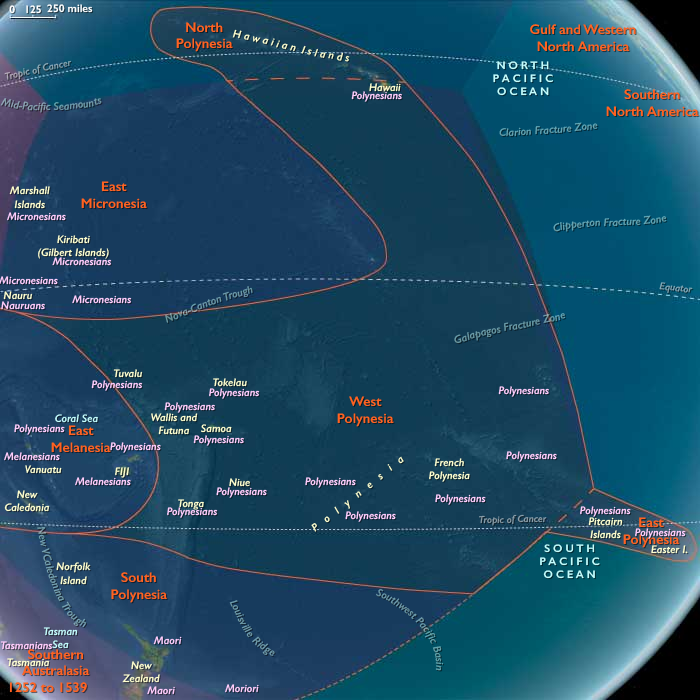
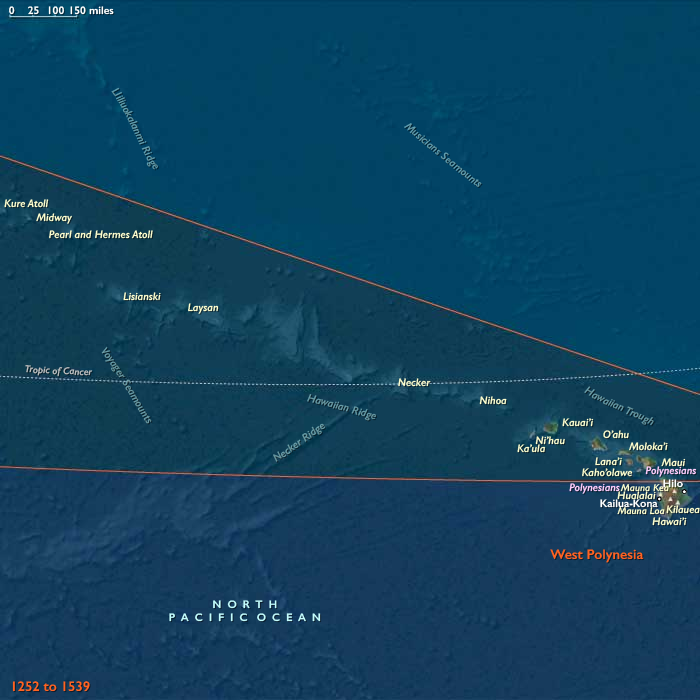
The subregion of North Polynesia includes the high Hawaiian Islands of Kaua‘i, Ni‘ihau, O‘ahu, Moloka‘i, Lāna‘i, Kaho‘olawe, and Maui; the chain of the Northwestern Hawaiian Islands from Nihoa to Kure; and Midway Atoll. Anchors span windward volcanic ranges with deep stream valleys (Kaua‘i, O‘ahu, Maui), leeward dry slopes and lava plains (Moloka‘i, Lāna‘i, Kaho‘olawe), salt pans and coastal flats (Ni‘ihau), and low coral atolls to the northwest hosting vast seabird rookeries and monk seal haul-outs. Reef-lined embayments, interisland channels, and the Kuroshio/NE trade-wind regime knit the archipelago into one oceanic world.
Climate & Environmental Shifts
The Little Ice Age introduced slightly cooler sea-surface temperatures and heightened interannual variability.
-
Windward slopes: orographic rains remained reliable, feeding perennial streams and valley wetlands.
-
Leeward zones: experienced longer dry spells; periodic Kona storms brought intense winter rains.
-
Northwestern atolls: exposed to winter swell and cyclones, yet sustained by productive upwelling. ENSO events modulated rainfall and hurricane risk, intermittently stressing dryland field systems and coastal fisheries.
Subsistence & Settlement
Island communities organized land and sea within ahupuaʻa—mauka-to-makai districts integrating upland forests, irrigated valleys, and reefs.
-
Irrigated kalo (taro) systems: loʻi terraces and ʻauwai canals filled stream valleys on O‘ahu (Kāne‘ohe, Nuʻuanu), Kaua‘i (Hanalei, Wainiha), Moloka‘i’s wet windward gulches, and east Maui.
-
Dryland field systems: leeward slopes on O‘ahu, Maui, Moloka‘i, Lāna‘i, and Kahoʻolawe supported intensive ʻuala (sweet potato), kō (sugarcane), and gourd complexes built with stone mulch, windbreaks, and contour alignments.
-
Coastal fisheries: nearshore netting and hook-and-line, reef gleaning, and stone-walled fishponds (loko iʻa) around O‘ahu and Moloka‘i provided steady protein and storage.
-
Niʻihau & the NWHI: Niʻihau specialized in salt and nearshore fishing; the Northwestern chain and Midway were uninhabited but visited episodically for birds, feathers, fish, and ritual purposes.
Technology & Material Culture
-
Agricultural engineering: terraced loʻi, earthen/stone dikes, and diversion ʻauwai; dryland alignments and mulch beds moderated heat and wind.
-
Maritime craft: double-hulled voyaging canoes (waʻa kaulua), outrigger fishing canoes, bone/pearl-shell fishhooks, sennit lashings, and sail rigs tuned to trades and channels.
-
Tools & textiles: basalt adzes, wooden digging sticks, fiber cordage; barkcloth (kapa), feather capes (ʻahu ʻula) and helmets (mahiole) for chiefly display.
-
Architecture & ritual: coastal and upland heiau (luakini war temples, agricultural heiau), house platforms, canoe sheds, and fishpond walls of fitted stone.
Movement & Interaction Corridors
-
Interisland canoe routes: linked valleys, fishpond districts, and forest bird-feather grounds; channels between O‘ahu–Moloka‘i–Lāna‘i–Maui formed a busy maritime hub.
-
Resource circuits: salt from Niʻihau, bird feathers from Nihoa/Mokumanamana, basalt and timber from selected valleys, and prized fish from pond complexes circulated through chiefly exchange.
-
Seasonal ranging: expeditions to the Northwestern Hawaiian Islands and Midway occurred for birding, fishing, and rites; these low isles functioned as waymarks and sacred limits of the archipelago.
Long-distance trans-Polynesian voyaging had largely waned by this age, but sophisticated wayfinding underpinned interisland travel and provisioning.
Cultural & Symbolic Expressions
Political life centered on aliʻi (chiefly) lineages under the kapu system that governed access to land, labor, and ritual.
-
Ritual cycle: offerings at heiau coordinated planting, fishing closures, and warfare; the Makahiki festival renewed abundance under the god Lono.
-
Landscape of meaning: ahupuaʻa altars at district boundaries, fishpond shrines, and upland forest taboos inscribed stewardship into space.
-
Arts: formal chant (oli), hula, and oratory framed genealogies and chiefly deeds; featherwork regalia and fine kapa signaled rank.
-
Northwestern isles: kupuna (ancestral) associations and bird-sending rites marked these remote atolls as spiritually potent, even without permanent settlement.
Environmental Adaptation & Resilience
-
Diversified agro-seascapes: coupling irrigated kalo with leeward ʻuala fields and loko iʻa buffered drought and storm.
-
Fisheries management: kapu closures by season or lunar phase protected spawning runs; fishponds converted pulses of juvenile fish into reliable stores.
-
Water & wind engineering: ʻauwai maintenance, terrace repairs, windbreaks, and stone mulches stabilized yields; upland replanting and forest kapu protected springs.
-
Risk-spreading mobility: interisland canoeing redistributed food and labor after crop failures or storms; expeditions to bird-rich NWHI supplemented protein and ornament demand.
Technology & Power Shifts (Conflict Dynamics)
Chiefly competition waxed and waned among island polities (O‘ahu, Maui, Kaua‘i, Moloka‘i), with alliances, marriage ties, and warfare legitimized through heiau luakini rites. Control of fishpond districts, irrigated valleys, and leeward field systems conferred power. Ritual specialists enforced kapu on land and sea; victory and redistribution feasts reinforced allegiance. No external powers intruded during this age.
Transition
By 1539 CE, North Polynesia was a tightly integrated ahupuaʻa commonwealth—hydraulic valleys feeding ponded coasts, dryland mosaics supplying staples, and interisland canoes knitting the system together. The Northwestern Hawaiian Islands and Midway remained unpeopled sanctuaries and waymarks, visited but not settled. Chiefly rivalries, ritual governance, and careful ecological management sustained abundance on the eve of a wider Pacific world that, in later centuries, would test these island balances.
Groups
Commodoties
Subjects
Regions
Subregions
Years: 1396 - 1539
Groups
Commodoties
Subjects
Regions
Subregions