
Northeast Asia (1396–1539 CE): Ice Margins, Salmon …
Years: 1396 - 1539
Northeast Asia (1396–1539 CE): Ice Margins, Salmon Corridors, and River–Sea Worlds
Geography & Environmental Context
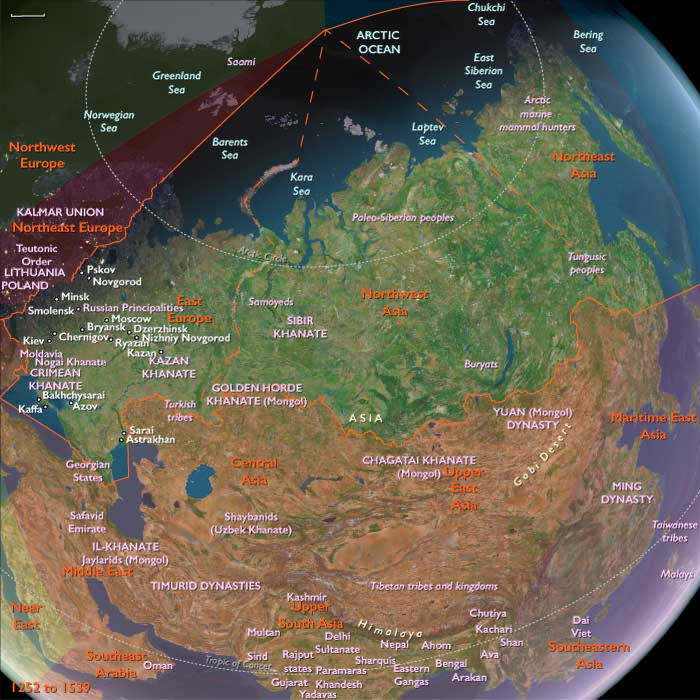
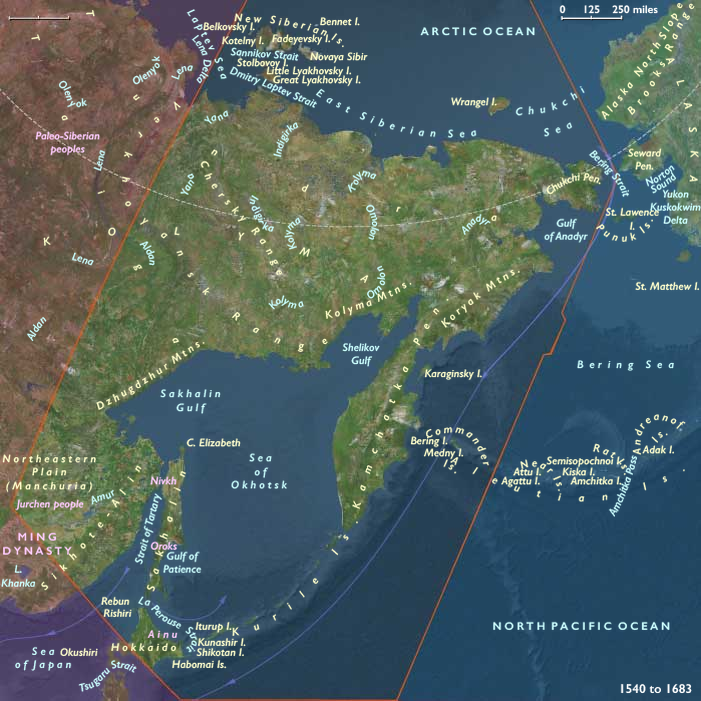
Northeast Asia comprises the Lena–Indigirka–Kolyma basins and New Siberian Islands; the Chukchi Peninsula, Wrangel Island, and the Anadyr basin; the Sea of Okhotsk rim from Magadan to Okhotsk with the Uda–Amur–Ussuri lowlands (including extreme northeastern Heilongjiang); the Sikhote–Alin and Primorye uplands (upper half); Sakhalin and the lower Amur mouth; and Hokkaidō (except its southwestern corner). Anchors: permafrosted taiga–tundra north of the tree line; ice-prone Bering and Okhotsk coasts; salmon rivers descending the Sikhote–Alin; and oak–birch forests across Hokkaidō.
Climate & Environmental Shifts
The early Little Ice Age brought longer winters, deeper sea ice in the Bering/Okhotsk seas, and shorter growing seasons on Hokkaidō. River freeze-up extended overland mobility but squeezed spring runs and travel windows. Storm belts intensified along the Anadyr and Okhotsk coasts; interior permafrost thickened, stabilizing winter “roads” while complicating warm-season portage.
Subsistence & Settlement
-
High Arctic & Chukchi–Anadyr: Marine hunting (whale, walrus, seal) on the coasts; inland reindeer hunting and small-scale herding among Chukchi, Even, and Yukaghir groups.
-
Lena–Indigirka–Kolyma taiga: Evenki/Even/Yukaghir mixed economies of fishing, ungulate hunting, trapping; seasonal camps arrayed along river terraces.
-
Amur–Ussuri–Sakhalin: Daur, Nanai (Hezhe), Udege, and Nivkh villages centered on salmon, sturgeon, millet/legumes, with stilted storehouses and smokehouses.
-
Hokkaidō (Ezo): Ainu coastal and river settlements focused on salmon, deer, bear, and marine harvests; small fields of hardy crops supplemented stored fish and acorns.
Technology & Material Culture
Composite bows; toggling harpoons; sinew-backed arrows; winter dog sleds and skis; birch-bark/plank boats for open water. Fish weirs, wicker traps, drying racks, and oil rendering were ubiquitous. In the Amur–Hokkaidō arc, iron knives and pots circulated via interregional trade; Ainu ritual implements—ikupasuy (prayer sticks) and inau (wood-shaved offerings)—figured prominently. Ornaments in bone/antler, carved wooden dishes, and lacquer imports at contact nodes signaled status.
Movement & Interaction Corridors
-
Frozen rivers as highways: Winter travel stitched together the Lena–Aldan–Indigirka–Kolyma systems and the Anadyr corridor.
-
Amur trunk: Salmon villages mediated taiga–coast exchange and linked southward toward Manchuria.
-
Okhotsk littoral & Sakhalin straits: Nivkh pilots ferried goods seasonally.
-
Hokkaidō coast: Canoe routes tied Ishikari–Tokachi–Nemuro; crossings reached the southern Kurils. Long-distance ties with Wajin (Japanese) were episodic and indirect in this era.
Cultural & Symbolic Expressions
Shamanic cosmologies (drum rites, trance, helping spirits) guided Evenki, Yukaghir, Chukchi, and Nivkh ritual life. Among the Ainu, seasonal rites culminated in the bear-sending ceremony, iomante, returning the bear’s spirit to the divine realm. Place-spirits sacralized salmon riffles, seal rookeries, and mountain passes. Carved masks, beadwork, tattooing (in parts of Hokkaidō), and story-singing preserved lineages and territorial memory.
Environmental Adaptation & Resilience
Caching (smoked salmon, rendered oils, dried meat), multi-year net/weir regimes, and rotational hunting grounds buffered variability. Reindeer and dog traction extended mobility; settlement duality (winter riverine nodes / summer dispersed camps) spread risk. Along the Amur, raised granaries and flood-aware siting reduced losses. On Hokkaidō, acorn processing and herring pulses complemented salmon cycles.
Transition
By 1539, Northeast Asia remained an indigenous archipelago of river routes and sea-ice margins. Trade threads brought limited iron and prestige goods into Amur–Hokkaidō circuits, but political intrusion from agrarian empires was still distant. The ecological template—ice roads, salmon corridors, and taiga hunting—set the stage for later encounters with state powers pressing in from the west and south.
Groups
- Nivkh people
- Buddhism
- Ainu people
- Mohe people
- Okhotsk culture
- Satsumon culture
- Jurchens
- Liao Dynasty, or Khitan Empire
- Jin Dynasty (Chin Empire), Jurchen
- Jin Dynasty (Chin Empire), Jurchen
- Jin Dynasty (Chin Empire), Jurchen
Commodoties
- Fish and game
- Hides and feathers
- Gem materials
- Glass
- Domestic animals
- Grains and produce
- Strategic metals
Subjects
Regions
Subregions
Related Events
Showing 10 events out of 78 total
Years: 1396 - 1539
Groups
- Nivkh people
- Buddhism
- Ainu people
- Mohe people
- Okhotsk culture
- Satsumon culture
- Jurchens
- Liao Dynasty, or Khitan Empire
- Jin Dynasty (Chin Empire), Jurchen
- Jin Dynasty (Chin Empire), Jurchen
- Jin Dynasty (Chin Empire), Jurchen
Commodoties
- Fish and game
- Hides and feathers
- Gem materials
- Glass
- Domestic animals
- Grains and produce
- Strategic metals
Subjects
Regions
Subregions