
Northeastern Eurasia (1396–1539 CE): Little Ice Age …
Years: 1396 - 1539
Northeastern Eurasia (1396–1539 CE): Little Ice Age Rim — Ice Roads, Salmon Corridors, and Steppe–Forest Frontiers
Geographic & Environmental Context
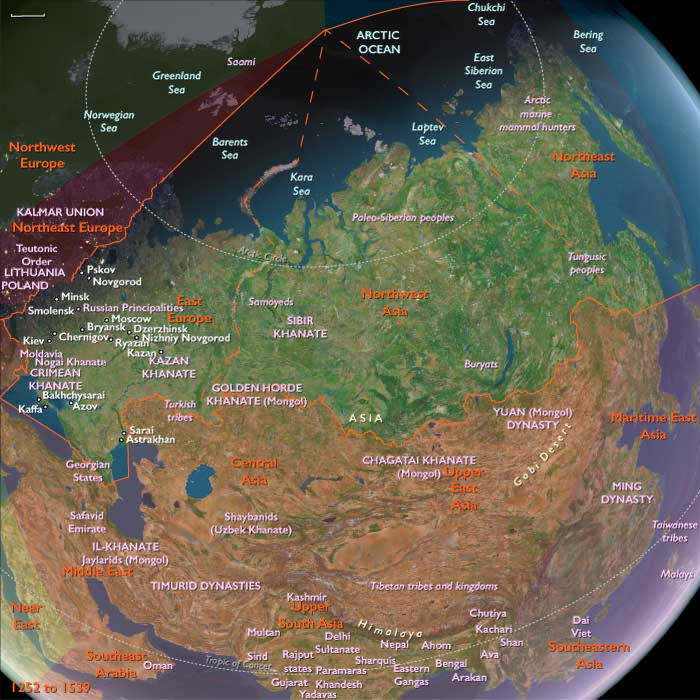
Northeastern Eurasia was not one land but three adjoining worlds stitched together by rivers, coasts, and winter ice:
-
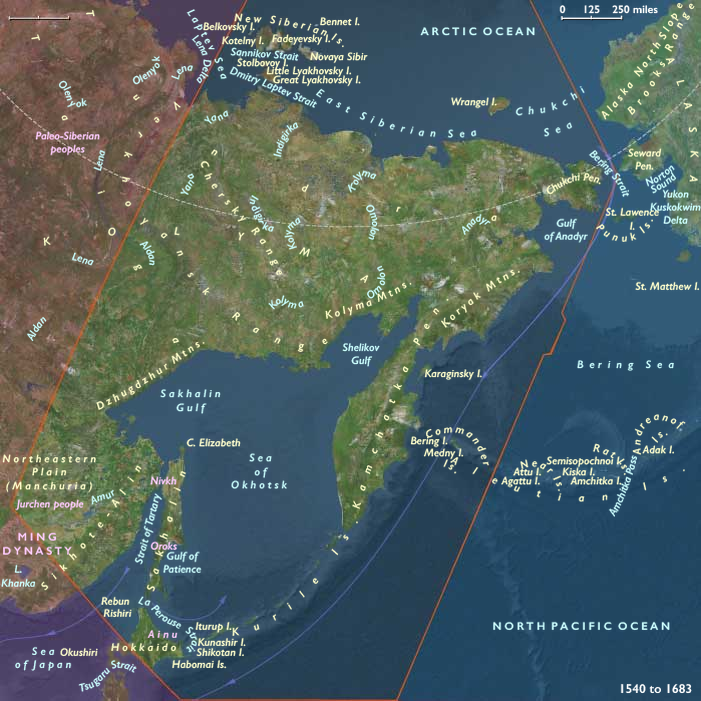
Northeast Asia — the Lena–Indigirka–Kolyma taiga–tundra, the Chukchi–Anadyr coast and Wrangel, the Sea of Okhotsk rim with the Amur–Ussuri lowlands, Sakhalin, and (Ezo) Hokkaidō.
-
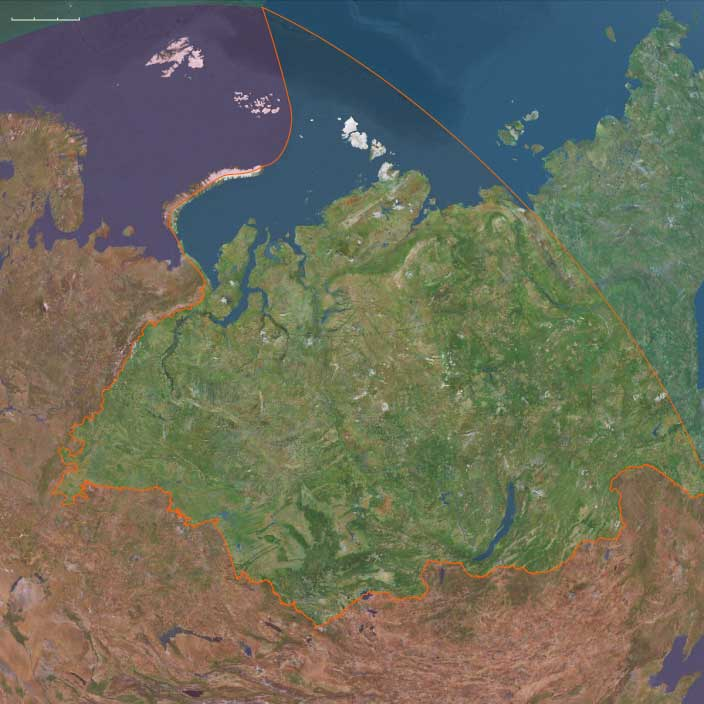
Northwest Asia — western/central Siberia from the Urals to the Altai, spanning Ob–Irtysh–Yenisei basins, taiga belts, and steppe margins.
-
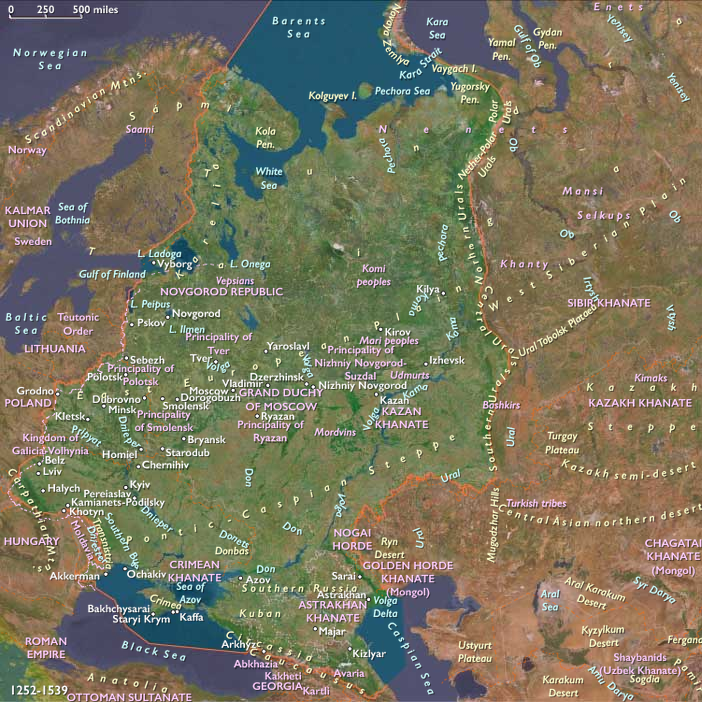
East Europe — the Baltic–Dvina/Vistula watersheds through the Dnieper–Don–Oka–Volga to the Ural forelands, where forest, forest-steppe, and the Pontic steppe overlapped.
These worlds were more tightly coupled to their external neighbors (the Pacific, Central Asia, the Black/Baltic Seas) than to each other—precisely the pattern The Twelve Worlds expects.
Climate & Environmental Shifts (Little Ice Age)
Longer winters, deeper sea ice, and shorter growing seasons defined the rim:
-
Bering/Okhotsk: thicker seasonal pack ice and stormier belts along Anadyr/Okhotsk; river freeze-up lengthened overland mobility but narrowed spring fish windows.
-
Siberian interior: permafrost pushed south; river ice lingered into late spring; summer flood pulses swelled the Ob–Irtysh–Yenisei.
-
East European steppe rim: drought–flood oscillations heightened vulnerability to Crimean and Nogai raids.
Households hedged risk with storage (smoked fish/meat, oils), multi-site settlement (winter river nodes / summer dispersed camps), and diversified ecologies (coast–river–upland rotations).
Lifeways & Polities
Northeast Asia
-
Subsistence: Coastal whale–walrus–seal hunting (Chukchi, maritime Even), inland reindeer hunting/herding(Chukchi, Even/Evenki, Yukaghir); salmon–sturgeon civilizations along the Amur–Ussuri–Sakhalin (Daur, Nanai/Hezhe, Udege, Nivkh); Ainu river–coast salmon/deer/bear regimes in Hokkaidō with hardy field plots and acorn processing.
-
Society: Village storehouses, fish weirs, smokehouses; dogsleds, skis, birch-bark/plank boats. Iron knives/pots moved in via interregional barter; lacquer/imports appeared at contact nodes.
-
Politics: No intrusive agrarian states; authority nested in clans, ritual specialists, and river alliances.
Northwest Asia
-
Subsistence: Turkic/Mongol herders on steppe margins; Ob-Ugric, Samoyedic, Yeniseian hunters/fishers in taiga–tundra; mixed agro-pastoralism in Altai valleys; Nenets reindeer management on the Arctic fringe.
-
Power: The Siberian Khanate (Irtysh–Tyumen) levied furs/slaves; Kazan and Nogai raided and mediated caravan trade; no Muscovite crossing of the Urals yet—that comes next epoch.
East Europe
-
Economy: Forest honey/wax/furs; black-earth grain; saltworks and iron; Baltic grain via Vistula–Gdańsk.
-
Power shifts: Muscovy rose (annexed Novgorod 1478, Pskov 1510, ended Horde tribute 1480); Lithuania-Rus’ reached its zenith then bled in wars with Muscovy (loss of Smolensk 1514); Crimea (Ottoman 1475)dominated the Black Sea littoral; Ducal Prussia 1525 stabilized Poland’s Baltic flank.
Economy & Exchange
-
Northeast Asia: Salmon, oils, skins, and dried fish moved along riverine/ice corridors; Nivkh pilots ferried goods across Sakhalin straits; Ainu exchanged furs/fish for iron and prestige items via gray-zone ties to Wajin outposts.
-
Northwest Asia: Fur frontiers flowed south to Kazan/Bukhara; textiles, grain, and iron went north; caravan trails spanned steppe corridors; river canoes threaded the Ob/Yenisei.
-
East Europe: Hanse/Baltic pulled forest goods west; Oka–Volga bound Muscovy’s service state; Dnieper constrained by Crimean–Ottoman control; early Cossack prototypes appeared in lower marshlands.
Technology & Material Culture
-
Arctic–Subarctic: toggling harpoons, sinew-backed bows, dog traction, skis, raised granaries; birch-bark craft and plank boats; fish weirs and wicker traps.
-
Steppe–Taiga: yurts/felt tents; sledges and ski-shoes; birchbark containers; small-scale smithing; fur robes and ritual regalia (drums, antler headdresses).
-
East Europe: gunpowder siege tools enter; brick/stone kremlins (Italian-engineered walls/cathedrals in Moscow); chancery codes—Sudebnik (1497) in Muscovy, Lithuanian Statute (1529); Ruthenian printing (Skaryna, 1517–25).
Movement & Interaction Corridors
-
Ice roads & frozen rivers: winter highways across Lena–Aldan–Indigirka–Kolyma and Anadyr; long-haul sled caravans between steppe and forest.
-
Amur trunk: salmon polities brokered taiga–coast exchange and linked south toward Manchuria.
-
Okhotsk littoral & straits: seasonal ferrying by Nivkh pilots; canoe arcs along Hokkaidō to the southern Kurils.
-
Steppe corridors: khanate caravans drew furs/slaves into the Kazan–Bukhara zone; raiding and tribute overlapped with trade.
-
East European rivers: Vistula to the Baltic; Oka–Volga for Muscovite assembly and frontier watches; Carpathian passes for salt/wine/cattle.
Cultural & Symbolic Expressions
-
Shamanic cosmologies (Evenki, Yukaghir, Chukchi, Nivkh): drum rites, trance, helping spirits; place-spirits sacralized salmon riffles, rookeries, and passes.
-
Ainu ritual life: iomante (bear-sending), carved prayer sticks (ikupasuy), shaved-wood inau offerings, tattooing in parts of Hokkaidō.
-
Turkic epics and Islamic court culture in steppe towns; forest peoples’ clan dances, antler offerings, and river shrines.
-
Orthodox East Europe: icon schools (Rublev’s legacy), monastic federations (Trinity–Sergius), “Third Rome” idioms after Ivan III–Sophia Palaiologina marriage; Ruthenian confraternities sustained schools/charities.
Environmental Adaptation & Resilience
-
Caching & rotation: multi-year fish weirs, rotational traplines, and stored oils/fats buffered scarcity.
-
Mobility: reindeer and dog traction extended winter range; dual-site settlement (winter rivers / summer camps) spread risk; steppe herders shifted pastures with snowpack and drought.
-
Siting: raised granaries and flood-savvy village plans along Amur; fortified monasteries and watch-lines in East Europe; clan reciprocity smoothed shocks across ecotones.
Subregional Signatures (in one glance)
-
Northeast Asia: ice margins + salmon corridors—indigenous river–sea civilizations with limited iron inflows, no imperial intrusion.
-
Northwest Asia: khanates + forest worlds—fur tribute and caravan war/peace systems, Siberian Khanate ascendant, Muscovy not yet over the Urals.
-
East Europe: gathering of states—Muscovy’s consolidation; Lithuania-Rus’ codification and contraction; Crimean–Ottoman Black Sea dominance; Baltic grain arteries.
Each subregion aligned as much with its far neighbors (Pacific fisheries, Central Asian caravans, Ottoman Black Sea) as with one another—confirming The Twelve Worlds argument that regions are envelopes; subregions are the living units.
Transition by 1539
The template was set for the next century’s upheavals:
-
Northeast Asia remained an indigenous archipelago of ice roads and salmon states, soon to face southern and western state pressures.
-
Northwest Asia balanced khanate tribute and forest autonomy; Muscovy stood just beyond the Urals, poised for the Siberian push.
-
East Europe entered confessional and imperial realignments with a centralized Muscovy, embattled Lithuania-Rus’, and an Ottoman-Crimean Black Sea.
Across the rim, ice, river, and steppe still governed movement—but by the mid-sixteenth century the age of states would ride those same corridors.
Groups
- Nivkh people
- Buddhism
- Ainu people
- Mohe people
- Okhotsk culture
- Satsumon culture
- Jurchens
- Liao Dynasty, or Khitan Empire
- Jin Dynasty (Chin Empire), Jurchen
- Jin Dynasty (Chin Empire), Jurchen
- Jin Dynasty (Chin Empire), Jurchen
Commodoties
- Fish and game
- Hides and feathers
- Gem materials
- Glass
- Domestic animals
- Grains and produce
- Strategic metals
Subjects
Regions
Subregions
Related Events
Showing 10 events out of 78 total
Years: 1396 - 1539
Groups
- Nivkh people
- Buddhism
- Ainu people
- Mohe people
- Okhotsk culture
- Satsumon culture
- Jurchens
- Liao Dynasty, or Khitan Empire
- Jin Dynasty (Chin Empire), Jurchen
- Jin Dynasty (Chin Empire), Jurchen
- Jin Dynasty (Chin Empire), Jurchen
Commodoties
- Fish and game
- Hides and feathers
- Gem materials
- Glass
- Domestic animals
- Grains and produce
- Strategic metals
Subjects
Regions
Subregions