
Northeastern North America (1396–1539 CE) Woodland …
Years: 1396 - 1539
Northeastern North America (1396–1539 CE)
Woodland Societies and First Atlantic Glimpses
Geography & Environmental Context
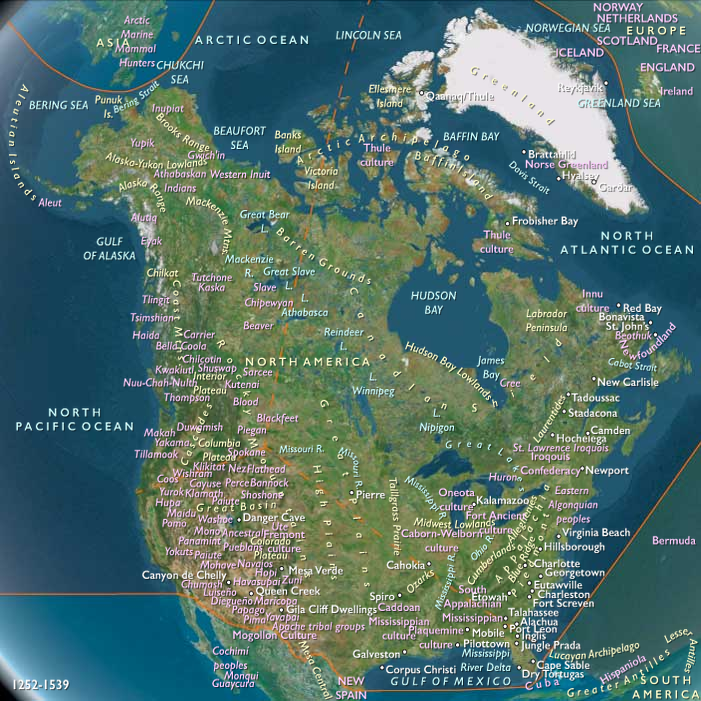
Extending from Florida to Greenland, including the Great Lakes, St. Lawrence, and Appalachians, this subregion united temperate forests, prairie margins, and Arctic tundra. Fertile valleys contrasted with shield lakes and frozen fjords.
Climate & Environmental Shifts
The onset of the Little Ice Age brought severe winters and short summers. Ice covered the Great Lakes longer; Greenland’s sea-ice thickened; coastal storms re-sculpted barrier islands. Despite hardship, forest and marine productivity sustained populous societies.
Subsistence & Settlement
-
Eastern Woodlands: Iroquoian and Algonquian communities farmed maize, beans, and squash, hunted deer and elk, and fished rivers. Palisaded longhouse towns and council fires structured governance.
-
Great Lakes & Midwest: Semi-sedentary villages traded copper, flint, and shell; earth lodges dotted floodplains.
-
Canadian Shield & Subarctic: Mobile Algonquian hunters followed moose and caribou, fished, and harvested wild rice.
-
Greenland: Inuit Thule peoples expanded dog-sled and umiak networks after Norse settlements vanished.
-
Bermuda: Still uninhabited, a sanctuary for seabirds and turtles.
Technology & Material Culture
Birchbark canoes, snowshoes, bows, pottery, and woven mats defined everyday life. Trade moved Lake Superior copper, coastal shells, and obsidian. Inuit innovations—toggle harpoons, tailored skins—embodied Arctic mastery.
Movement & Interaction Corridors
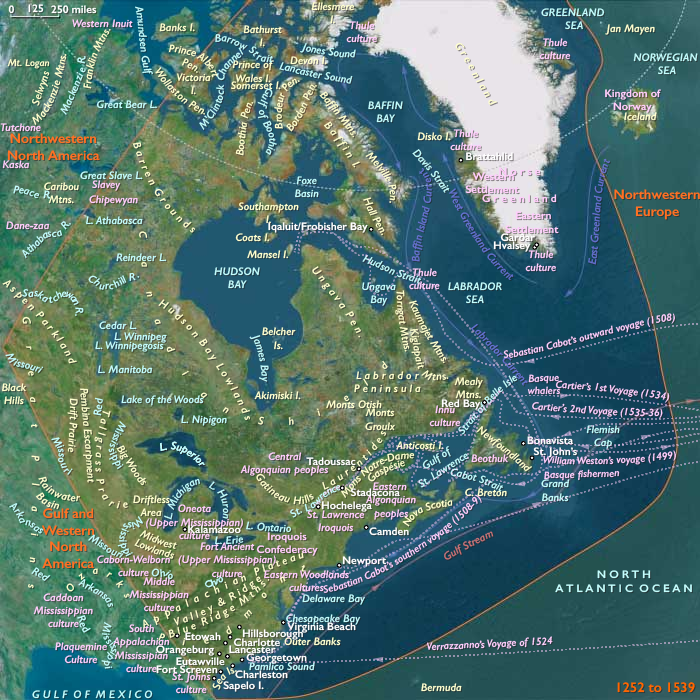
Rivers and lakes—the St. Lawrence, Great Lakes, Mississippi—served as highways for diplomacy and exchange. Coastal Algonquians navigated dugouts along estuaries. Inuit traversed sea-ice between Greenland, Labrador, and Baffin Island.
By the early 1500s, Portuguese, Breton, and Basque fishers visited Newfoundland and Labrador, exploiting cod and whales yet leaving no colonies.
Cultural & Symbolic Expressions
Clan councils and wampum belts recorded law and memory. Woodland cosmologies centered on spirits of animals, rivers, and crops; shamans mediated their power. Inuit song, carving, and dance honored sea-mammal spirits and hunters’ skill.
Environmental Adaptation & Resilience
Crop rotation and storage cushioned Iroquoian villages against frost. Hunters and fishers shifted territories with game cycles. Inuit extended whaling zones under thicker ice, while cod fisheries fed Atlantic coasts.
Transition
By 1539 CE, the region remained overwhelmingly Indigenous. Woodland and Arctic cultures thrived independently, though transatlantic sails on the horizon foreshadowed a coming transformation.
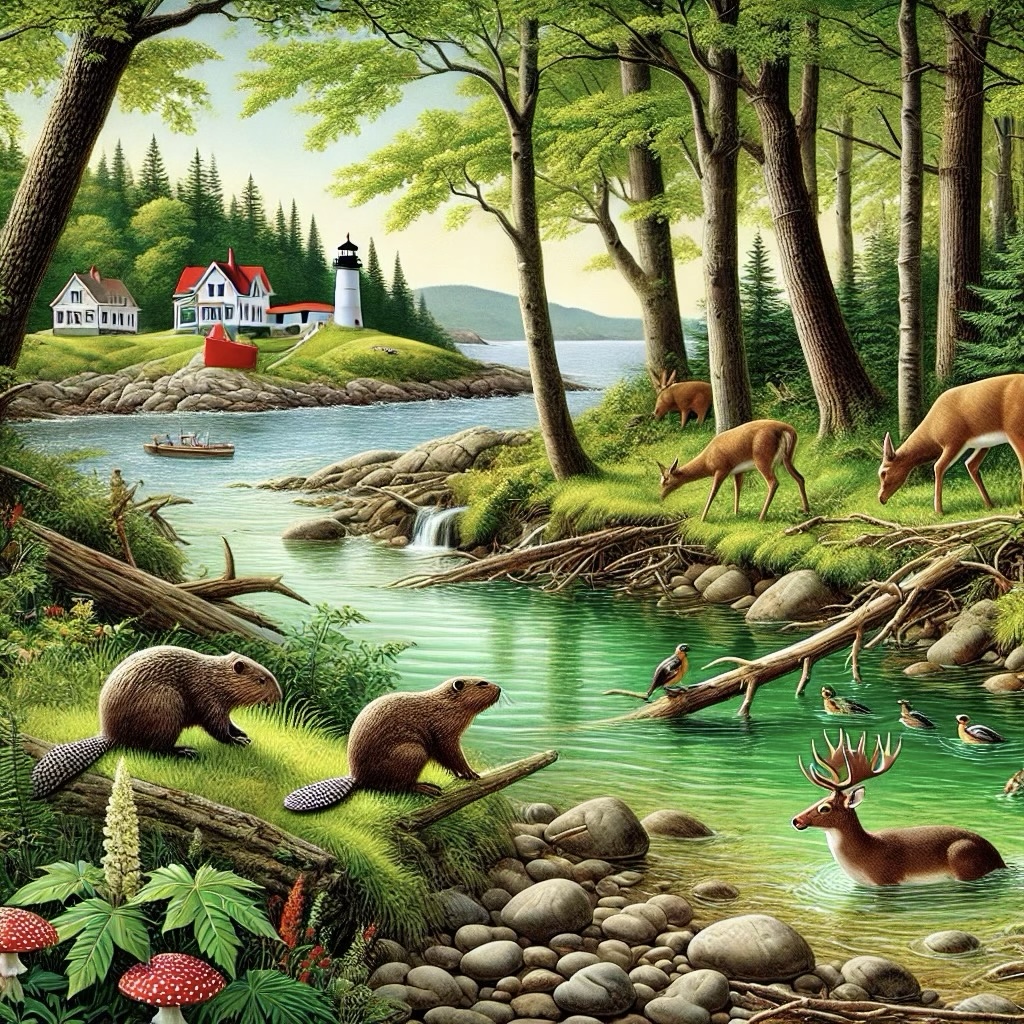
Northeastern North America (with civilization) ©2024-25 Electric Prism, Inc. All rights reserved.
Groups
- Mound Builders
- Dorset culture
- Mississippian culture
- Caddoan Mississippian culture
- Iroquois (Haudenosaunee, also known as the League of Peace and Power, Five Nations, or Six Nations)
- Penobscot people (Amerind tribe)
- Tunlit (Dorset culture)
- Greenland, Norwegian Crown Colony of
- Mi'kmaq people (Amerind tribe)
- Ho-Chunk (Amerind tribe)
- Thule people
- Cahokia Mounds
Topics
Commodoties
- Fish and game
- Gem materials
- Colorants
- Domestic animals
- Grains and produce
- Ceramics
- Strategic metals
- Tobacco
Subjects
- Commerce
- Environment
- Decorative arts
- Exploration
- Government
- Custom and Law
- Technology
- Human Migration
Regions
Subregions
Years: 1396 - 1539
Northeastern North America (with civilization) ©2024-25 Electric Prism, Inc. All rights reserved.
Groups
- Mound Builders
- Dorset culture
- Mississippian culture
- Caddoan Mississippian culture
- Iroquois (Haudenosaunee, also known as the League of Peace and Power, Five Nations, or Six Nations)
- Penobscot people (Amerind tribe)
- Tunlit (Dorset culture)
- Greenland, Norwegian Crown Colony of
- Mi'kmaq people (Amerind tribe)
- Ho-Chunk (Amerind tribe)
- Thule people
- Cahokia Mounds
Topics
Commodoties
- Fish and game
- Gem materials
- Colorants
- Domestic animals
- Grains and produce
- Ceramics
- Strategic metals
- Tobacco
Subjects
- Commerce
- Environment
- Decorative arts
- Exploration
- Government
- Custom and Law
- Technology
- Human Migration
Regions
Subregions