
Northeastern North America (1432 to 1433 …
Years: 1432 - 1443
Northeastern North America
(1432 to 1433 CE): Late Mississippian Cultures and Indigenous Continuity
Between 1432 and 1433 CE, Northeastern North America remained a landscape primarily shaped by indigenous cultures, characterized by stable yet increasingly complex social and political developments, especially within Late Mississippian societies. Though this brief era appears quiet in the historical record, significant cultural continuities, interactions, and gradual shifts in settlement patterns continued to set the stage for later transformative periods.
Late Mississippian Societies and Ceremonial Centers
Decline of Mississippian Chiefdoms
By the early 15th century, many Mississippian ceremonial centers experienced noticeable population reductions and decreased mound-building activity, indicative of social and environmental pressures. Centers such as Cahokia—once the largest urban center north of Mexico—had already been abandoned around 1400. However, smaller Mississippian-influenced settlements, characterized by fortified villages and modest mound complexes, persisted throughout the Mississippi, Ohio, and Tennessee valleys.
Continuity in Southern Appalachia and Etowah
In regions such as present-day Georgia and the southern Appalachians, the Mississippian-influenced Etowah Mounds remained important cultural and political centers during this period. Although mound construction and associated ceremonialism had waned somewhat by the early 1400s, these sites maintained significant social roles as regional political and ceremonial hubs.
Indigenous Societies in Transition
Pre-Iroquoian Communities and Regional Networks
In what is now New York State and the southern Great Lakes region, pre-Haudenosaunee (Iroquoian) populations continued living in dispersed settlements composed primarily of longhouses, practicing maize agriculture combined with hunting and gathering. Social networks and trading relationships connecting these northern communities to southern Mississippian-influenced groups remained active, reflecting sustained interregional interaction.
Algonquian-speaking Groups in the Northeast
In the northeastern woodlands, numerous Algonquian-speaking communities such as the ancestors of the Mi'kmaq, Maliseet, Abenaki, and coastal peoples in present-day New England continued their seasonal cycles of fishing, hunting, and gathering. These societies maintained stable settlement patterns with distinct cultural traditions centered around coastal and riverine resources.
Thule-Inuit Presence and Adaptation in Greenland and Labrador
Thule-Inuit Adaptation
The Thule culture (ancestors of modern Inuit) remained well established in Greenland and Labrador. The Thule sustained their specialized maritime-based subsistence, hunting marine mammals such as whales, seals, and walrus. They continued to inhabit semi-subterranean winter houses constructed of whalebones, stone, and turf, reflecting their adaptation to harsh Arctic conditions.
Continued Absence of Norse Contact and Isolation of Greenland Settlements
Isolation of Norse Greenland
The Norse settlements on Greenland had entered a period of prolonged isolation, largely cut off from regular European contact due to increasingly severe climatic conditions associated with the onset of the Little Ice Age. The last reliably documented event among Norse Greenlanders was a marriage recorded at Hvalsey Church in 1408. By 1432–1433, Norse Greenland communities continued declining in population and vitality, increasingly vulnerable to environmental stressors.
Indigenous Environmental Management and Resource Use
Adaptive Strategies and Subsistence
Throughout the Northeast, indigenous communities maintained sustainable environmental management practices, including controlled burns for land clearing, fishing weirs, and sustainable hunting practices. These strategies were well-suited to the mixed forested environments and riverine ecosystems prevalent in the region, enabling long-term resource stability.
Cultural Continuity and Artistic Traditions
Artistic Traditions and Material Culture
Indigenous communities sustained vibrant artistic traditions. Pottery decorated with intricate geometric patterns, ceremonial effigy pipes, elaborate shell gorgets, and beads crafted from bone, shell, and copper remained prominent. These artifacts reinforced cultural identities and social cohesion during this stable yet transitional period.
Oral Traditions and Cultural Memory
Strong oral traditions maintained cultural continuity, preserving histories, cosmologies, and communal identities. Indigenous societies across the region relied heavily on oral narratives to communicate social norms, historical knowledge, and ceremonial protocols, laying the foundation for cultural resilience in future centuries.
Legacy of the Era (1432–1433 CE)
Though brief and outwardly quiet, the period 1432–1433 CE represented continued stability and subtle transformation within indigenous societies across Northeastern North America. Late Mississippian cultural traditions persisted despite shifting settlement patterns, while indigenous groups such as the proto-Iroquoians and Algonquians sustained rich cultural lifeways, laying essential foundations for subsequent geopolitical realignments. The Thule-Inuit maintained their adaptation in harsh Arctic environments, and the isolated Norse communities in Greenland continued toward eventual abandonment. Collectively, these developments, while subtle, significantly influenced the subsequent trajectory of cultural, social, and political landscapes across Northeastern North America.
Groups
- Mound Builders
- Dorset culture
- Caddoan Mississippian culture
- Mississippian culture
- Iroquois (Haudenosaunee, also known as the League of Peace and Power, Five Nations, or Six Nations)
- Tunlit (Dorset culture)
- Thule people
- Penobscot people (Amerind tribe)
- Ho-Chunk (Amerind tribe)
- Mi'kmaq people (Amerind tribe)
- Mohawk people (Amerind tribe)
- Wyandot, or Wendat, or Huron people (Amerind tribe)
- Osage Nation (Amerind tribe)
- Oneida people (Amerind tribe)
- Susquehannock (Amerind tribe)
- Catawba people (Amerind tribe)
- Quapaw, or Arkansas (Amerind tribe)
- Omaha (Amerind tribe)
- Kaw, or Kanza, people (Amerind tribe)
- Caddo (Amerind tribe)
- Tuscarora (Amerind tribe)
- Ponca (Amerind tribe)
- Yuchi (Amerind tribe)
- Seneca (Amerind tribe)
- Cherokee, or Tsalagi (Amerind tribe)
- Cayuga people(Amerind tribe)
- Onondaga people (Amerind tribe)
Topics
Commodoties
- Fish and game
- Gem materials
- Colorants
- Domestic animals
- Grains and produce
- Ceramics
- Strategic metals
- Tobacco
Subjects
- Commerce
- Environment
- Decorative arts
- Exploration
- Government
- Custom and Law
- Technology
- Human Migration
Regions
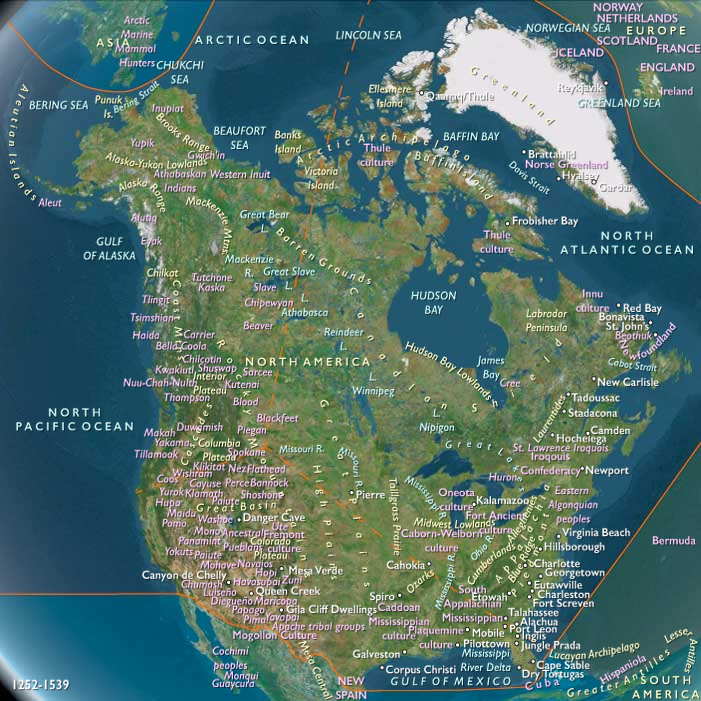
Subregions
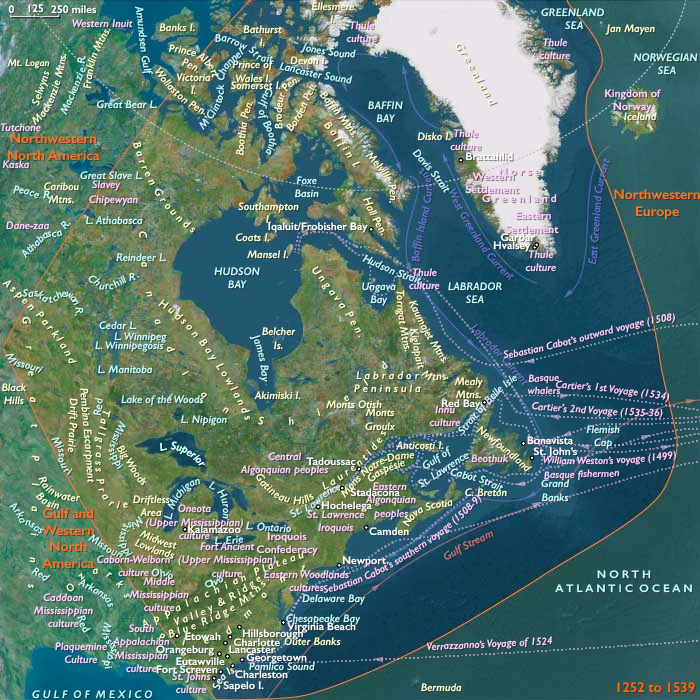
Years: 1432 - 1443
Groups
- Mound Builders
- Dorset culture
- Caddoan Mississippian culture
- Mississippian culture
- Iroquois (Haudenosaunee, also known as the League of Peace and Power, Five Nations, or Six Nations)
- Tunlit (Dorset culture)
- Thule people
- Penobscot people (Amerind tribe)
- Ho-Chunk (Amerind tribe)
- Mi'kmaq people (Amerind tribe)
- Mohawk people (Amerind tribe)
- Wyandot, or Wendat, or Huron people (Amerind tribe)
- Osage Nation (Amerind tribe)
- Oneida people (Amerind tribe)
- Susquehannock (Amerind tribe)
- Catawba people (Amerind tribe)
- Quapaw, or Arkansas (Amerind tribe)
- Omaha (Amerind tribe)
- Kaw, or Kanza, people (Amerind tribe)
- Caddo (Amerind tribe)
- Tuscarora (Amerind tribe)
- Ponca (Amerind tribe)
- Yuchi (Amerind tribe)
- Seneca (Amerind tribe)
- Cherokee, or Tsalagi (Amerind tribe)
- Cayuga people(Amerind tribe)
- Onondaga people (Amerind tribe)
Topics
Commodoties
- Fish and game
- Gem materials
- Colorants
- Domestic animals
- Grains and produce
- Ceramics
- Strategic metals
- Tobacco
Subjects
- Commerce
- Environment
- Decorative arts
- Exploration
- Government
- Custom and Law
- Technology
- Human Migration
Regions
Subregions