
Northeastern North America (1444 to 1445 …
Years: 1444 - 1455
Northeastern North America
(1444 to 1445 CE): Indigenous Continuity, Arctic Stability, and the Final Decline of Norse Greenland
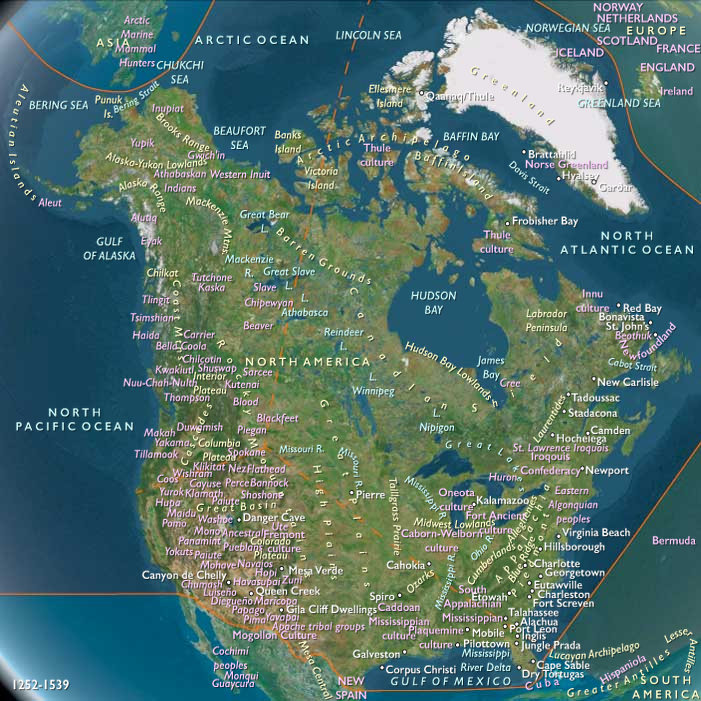
From 1444 to 1445 CE, Northeastern North America experienced steady indigenous political stability, cultural resilience, and environmental adaptations. The Haudenosaunee Confederacy solidified its regional unity, Mississippian chiefdoms persisted through localized adaptations, and Thule Inuit societies thrived in Arctic territories. Concurrently, the Norse settlements in Greenland, after centuries of prosperity, finally disappeared, marking the definitive end of medieval Norse colonization in the Americas.
Final Disappearance of Norse Greenland
Historical Background of Greenland’s Colonization
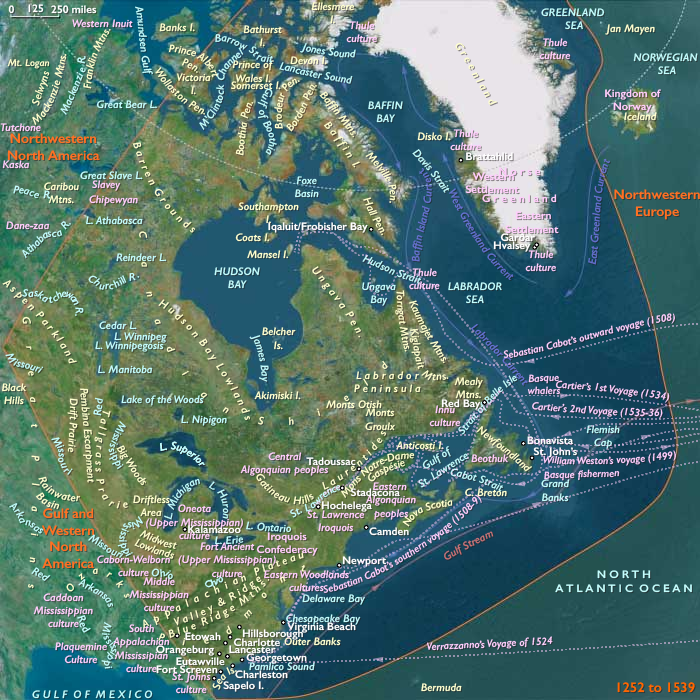
Greenland's west coast had been colonized by Icelanders and Norwegians beginning in 986 CE, initially establishing two principal settlements in fjords near the island’s southwestern tip—most notably at Brattahlíð. These settlements prospered for several centuries, sharing Greenland first with the late Dorset culture (occupying northern and western regions), and subsequently with the Thule Inuit who arrived from the north around the thirteenth century.
Political Changes and Isolation
By the thirteenth century, Norse Greenlanders had accepted Norwegian overlordship. In 1380, Norway entered a personal union with Denmark, and from 1397, Greenland became part of the wider Scandinavian political structure known as the Kalmar Union. Despite these broader European affiliations, Greenland became increasingly isolated economically, socially, and politically in the late fourteenth and early fifteenth centuries, ultimately contributing to its demise.
Climatic and Environmental Conditions
Greenland’s environment had fluctuated dramatically over centuries, significantly influencing settlement viability. Analysis of ice-core samples and clam-shell growth data indicate that from roughly 800 to 1300 CE, the regions around Greenland’s southern fjords experienced milder climates several degrees Celsius warmer than typically seen in the North Atlantic. During this warmer era—often referred to as the Medieval Warm Period—trees, herbaceous plants, and livestock thrived, and Norse Greenlanders even successfully farmed barley crops as far north as the 70th parallel.
However, around the onset of the Little Ice Age (circa 1300 CE), Greenland’s climate dramatically cooled. Ice cores indicate Greenland experienced frequent and severe temperature fluctuations over the past hundred thousand years, emphasizing the region’s vulnerability to climatic shifts. In response to deteriorating conditions, Norse Greenlanders increasingly relied on marine resources, eventually suffering severe nutritional stress, soil erosion from intensive agriculture, deforestation, and potential armed conflicts or competition with Inuit populations.
Final Decline and Disappearance
By the mid-fifteenth century, the once-thriving Norse settlements, such as Brattahlíð, had disappeared completely. Although historical records cease after the marriage recorded at Hvalsey Church in 1408, archaeological evidence confirms that by 1444–1445 CE, Norse Greenland was effectively abandoned. Similar conditions had previously occurred in Iceland, as documented in the Icelandic Book of Settlements, which recorded famines so severe that the old and helpless were cast from cliffs. Greenland’s fate appears similarly harsh, brought about by isolation, climate deterioration, economic collapse following the reduced demand for walrus ivory, and strained relationships with indigenous peoples.
Haudenosaunee Confederacy: Continued Strengthening
Internal Stability and Regional Influence
During these years, the recently established Haudenosaunee Confederacy—attributed by tradition to Hiawatha and the holy man Deganawidah—further solidified political unity among the Mohawk, Oneida, Onondaga, Cayuga, and Seneca nations. This consolidation reduced internal conflict, allowing effective management of resources and diplomacy with neighboring tribes.
Linguistic and Cultural Identity
Distinctive Northern (Mohawk, Oneida, Onondaga, Cayuga, Seneca, Tuscarora, Susquehannock, Huron) and Southern (Cherokee) Iroquoian language branches remained clear, highlighting cultural and societal structures emphasizing matrilineal descent and influential roles for women.
Mississippian Chiefdoms: Persistent Localized Stability
Adaptation and Ceremonial Continuity
Localized Mississippian chiefdoms continued adapting to environmental pressures and resource competition, maintaining fortified towns such as Etowah (Georgia) and Moundville (Alabama). These communities, despite smaller scales and reduced monumental ceremonialism, remained resilient through localized rituals, social cohesion, and stable agricultural practices.
Continued Agricultural Prosperity
Agriculture—predominantly maize cultivation supplemented by beans, squash, hunting, and gathering—ensured food security and community sustainability. Communities adapted effectively to environmental fluctuations and local resource pressures.
Dhegiha Communities: Continued Stability and Prosperity
Sustained Agricultural and Social Structures
West of the Mississippi River, Dhegiha-speaking peoples—the ancestors of modern-day Quapaw, Omaha, Ponca, Osage, and Kaw—remained stable and prosperous. Village-based economies centered around maize agriculture, hunting, and gathering ensured consistent resilience, supported by strong social and kinship networks.
Thule Inuit: Arctic Dominance and Ecological Adaptation
Consolidation in Arctic Environments
By 1445 CE, the Thule Inuit dominated Arctic Canada and Greenland. Their sophisticated subsistence methods—sled dogs, toggling harpoons, and slate knives—allowed thriving settlements in challenging ecological conditions.
Post-Norse Adaptations
Following the final disappearance of Norse Greenlanders, Thule Inuit populations occupied previously Norse-held territories, adapting seamlessly to environmental conditions and utilizing resources left by the departed European settlers.
Coastal and Riverine Indigenous Communities
Subsistence and Cultural Continuity
Indigenous communities along northeastern coasts and inland waterways continued robust subsistence economies through fishing, hunting, trapping, and gathering. Sophisticated techniques—nets, weirs, fish traps—secured food supplies and reinforced regional stability.
Artistic and Ceremonial Persistence
Communities maintained localized artistic traditions, crafting ceremonial pottery, shell gorgets, polished stone tools, and ornate tobacco pipes. Though monumental ceremonialism had declined, localized practices continued to define community identity and cohesion.
Legacy of the Era (1444–1445 CE)
This era notably marks the final disappearance of Norse Greenland, ending nearly five centuries of medieval European settlement in the Americas prior to Columbus. Simultaneously, indigenous societies across Northeastern North America—Haudenosaunee Confederacy, Mississippian chiefdoms, Dhegiha communities, and Arctic Thule Inuit—continued to demonstrate resilience, stability, and adaptation. These indigenous societies maintained vibrant, sustainable cultures poised to engage with new external influences in subsequent centuries, laying critical cultural and political foundations for future historical developments.
Groups
- Mound Builders
- Mississippian culture
- Caddoan Mississippian culture
- Iroquois (Haudenosaunee, also known as the League of Peace and Power, Five Nations, or Six Nations)
- Thule people
- Penobscot people (Amerind tribe)
- Ho-Chunk (Amerind tribe)
- Mi'kmaq people (Amerind tribe)
- Mohawk people (Amerind tribe)
- Wyandot, or Wendat, or Huron people (Amerind tribe)
- Osage Nation (Amerind tribe)
- Oneida people (Amerind tribe)
- Susquehannock (Amerind tribe)
- Catawba people (Amerind tribe)
- Quapaw, or Arkansas (Amerind tribe)
- Omaha (Amerind tribe)
- Kaw, or Kanza, people (Amerind tribe)
- Caddo (Amerind tribe)
- Tuscarora (Amerind tribe)
- Ponca (Amerind tribe)
- Yuchi (Amerind tribe)
- Seneca (Amerind tribe)
- Cherokee, or Tsalagi (Amerind tribe)
- Cayuga people(Amerind tribe)
- Onondaga people (Amerind tribe)
Topics
Commodoties
- Fish and game
- Gem materials
- Colorants
- Domestic animals
- Grains and produce
- Ceramics
- Strategic metals
- Tobacco
Subjects
- Commerce
- Environment
- Decorative arts
- Exploration
- Government
- Custom and Law
- Technology
- Human Migration
Regions
Subregions
Years: 1444 - 1455
Groups
- Mound Builders
- Mississippian culture
- Caddoan Mississippian culture
- Iroquois (Haudenosaunee, also known as the League of Peace and Power, Five Nations, or Six Nations)
- Thule people
- Penobscot people (Amerind tribe)
- Ho-Chunk (Amerind tribe)
- Mi'kmaq people (Amerind tribe)
- Mohawk people (Amerind tribe)
- Wyandot, or Wendat, or Huron people (Amerind tribe)
- Osage Nation (Amerind tribe)
- Oneida people (Amerind tribe)
- Susquehannock (Amerind tribe)
- Catawba people (Amerind tribe)
- Quapaw, or Arkansas (Amerind tribe)
- Omaha (Amerind tribe)
- Kaw, or Kanza, people (Amerind tribe)
- Caddo (Amerind tribe)
- Tuscarora (Amerind tribe)
- Ponca (Amerind tribe)
- Yuchi (Amerind tribe)
- Seneca (Amerind tribe)
- Cherokee, or Tsalagi (Amerind tribe)
- Cayuga people(Amerind tribe)
- Onondaga people (Amerind tribe)
Topics
Commodoties
- Fish and game
- Gem materials
- Colorants
- Domestic animals
- Grains and produce
- Ceramics
- Strategic metals
- Tobacco
Subjects
- Commerce
- Environment
- Decorative arts
- Exploration
- Government
- Custom and Law
- Technology
- Human Migration
Regions
Subregions