
Northeastern North America (1480 to 1491 …
Years: 1480 - 1491
Northeastern North America
(1480 to 1491 CE): Indigenous Stability on the Eve of European Exploration
From 1480 to 1491 CE, Northeastern North America continued to witness stable indigenous societies, consolidated political structures, and effective environmental adaptations. The Haudenosaunee Confederacy maintained its regional dominance and internal unity, while Mississippian-derived chiefdoms retained localized cultural identities. Dhegiha peoples sustained prosperous village-based economies west of the Mississippi, and Thule Inuit fully established themselves in Arctic territories. On the cusp of sustained European exploration, these indigenous communities presented robust cultural landscapes poised to engage with emerging external influences.
Haudenosaunee Confederacy: Regional Dominance and Internal Stability
Political Cohesion and Influence
By the close of the fifteenth century, the Haudenosaunee Confederacy—comprising the Mohawk, Oneida, Onondaga, Cayuga, and Seneca nations—had deeply entrenched governance structures and political cohesion. Established according to tradition earlier in the century by the legendary figures Hiawatha and Deganawidah, the Confederacy effectively minimized internal conflict, coordinated diplomatic relations, and secured territorial integrity, positioning itself as the dominant political entity within the northeastern forests.
Cultural Continuity and Matrilineal Structures
Distinct linguistic divisions remained prominent, reinforcing the separation between the Northern Iroquoian (Mohawk, Oneida, Onondaga, Cayuga, Seneca, Tuscarora, Susquehannock, and Huron) and Southern Iroquoian (Cherokee) branches. Matrilineal kinship systems continued to underpin societal structures, with influential roles reserved for women in clan leadership and governance, setting the Haudenosaunee apart culturally from neighboring indigenous groups.
Mississippian Chiefdoms: Continued Localized Stability
Persistent Community Adaptations
Localized chiefdoms, exemplified by settlements at Etowah in Georgia and Moundville in Alabama, maintained stable and fortified communities. Though large-scale ceremonial mound-building had significantly declined, smaller ceremonial centers continued practicing rituals emphasizing local identity, community cohesion, and spiritual traditions.
Agricultural Sustainability
Mississippian-derived communities remained agriculturally prosperous through continued reliance on maize cultivation, supplemented by beans, squash, hunting, and gathering. These subsistence practices allowed effective adaptation to environmental changes, providing food security and community resilience.
Dhegiha Communities: Westward Stability and Prosperity
Agricultural and Social Resilience
West of the Mississippi River, the Dhegiha-speaking peoples—ancestors of modern-day Quapaw, Omaha, Ponca, Osage, and Kaw—continued their stable agricultural economies. Secure village-based communities, supported by maize agriculture, seasonal hunting, and gathering practices, enabled ongoing prosperity, reinforced by strong social cohesion and kinship structures.
Thule Inuit: Firm Arctic Establishment
Continued Adaptation and Dominance
Throughout Arctic Canada and Greenland, the Thule Inuit had definitively established themselves as dominant inhabitants, having fully replaced earlier Dorset peoples and effectively adapted to the ecological vacuum left by Norse Greenlanders. Their sophisticated hunting technologies—sled dogs, toggling harpoons, slate knives—and marine mammal subsistence strategies ensured continued community stability in harsh climates.
Post-Norse Resource Integration
Following the Norse abandonment earlier in the century, Thule Inuit adapted seamlessly to altered Arctic landscapes, occasionally incorporating abandoned Norse structures and artifacts into their settlements and resource use. This practical integration reinforced their environmental resilience and cultural stability.
Coastal and Riverine Communities: Ongoing Resilience
Stable Subsistence Practices
Indigenous societies along northeastern Atlantic coasts and inland waterways maintained stable economies through continued fishing, trapping, hunting, and gathering. Sophisticated fishing technologies—nets, weirs, and traps—provided secure and sustainable food supplies, allowing robust territorial integrity and population stability.
Cultural and Artistic Continuity
Persistent localized artistic production included ceremonial pottery, finely crafted shell gorgets, polished stone tools, and elaborate tobacco pipes. Although monumental ceremonialism was limited, smaller-scale ritual practices reinforced community identities and cultural cohesion, ensuring continuity of traditions.
Ecological Context: Lessons from Norse Greenland
Climate Variability and Indigenous Resilience
Historical lessons from the Norse Greenland collapse highlighted the critical importance of adaptability to climatic fluctuations. Ice-core data from Greenland emphasized significant climate variability, particularly during the transition from the warmer Medieval Warm Period (ca. 800–1300 CE) to the cooling phase of the Little Ice Age. Indigenous societies, unlike their Norse counterparts, successfully adapted to these ecological conditions through flexible subsistence strategies, resource diversification, and community-based decision-making, thereby ensuring long-term sustainability.
Indigenous Landscapes on the Eve of European Exploration
Stability and Preparedness
As the fifteenth century approached its conclusion, Northeastern North America's indigenous societies exhibited remarkable stability and adaptability. Haudenosaunee political dominance, Mississippian localized chiefdoms, prosperous Dhegiha settlements, and resilient Thule Inuit communities each thrived within their distinct ecological niches.
Anticipation of External Contacts
By 1491 CE, these indigenous groups stood on the precipice of sustained contact with European explorers and colonizers, with the imminent arrival of voyages led by individuals like John Cabot (1497) soon to fundamentally alter the region’s historical trajectory. Nevertheless, indigenous societies had demonstrated centuries of adaptive expertise, political sophistication, and cultural resilience, positioning them to confront and negotiate these forthcoming encounters.
Legacy of the Era (1480–1491 CE)
The years 1480 to 1491 CE represent the final era of indigenous stability, internal consolidation, and cultural resilience in Northeastern North America prior to significant European intervention. Indigenous societies—Haudenosaunee, Mississippian-derived chiefdoms, Dhegiha peoples, and Thule Inuit—maintained robust traditions, ecological adaptations, and political unity, setting a strong foundation for the complex intercultural dynamics that would emerge in the approaching age of European exploration and colonization.
People
Groups
- Mound Builders
- Mississippian culture
- Caddoan Mississippian culture
- Iroquois (Haudenosaunee, also known as the League of Peace and Power, Five Nations, or Six Nations)
- Thule people
- Penobscot people (Amerind tribe)
- Ho-Chunk (Amerind tribe)
- Mi'kmaq people (Amerind tribe)
- Mohawk people (Amerind tribe)
- Wyandot, or Wendat, or Huron people (Amerind tribe)
- Osage Nation (Amerind tribe)
- Oneida people (Amerind tribe)
- Susquehannock (Amerind tribe)
- Catawba people (Amerind tribe)
- Quapaw, or Arkansas (Amerind tribe)
- Omaha (Amerind tribe)
- Kaw, or Kanza, people (Amerind tribe)
- Caddo (Amerind tribe)
- Tuscarora (Amerind tribe)
- Ponca (Amerind tribe)
- Yuchi (Amerind tribe)
- Seneca (Amerind tribe)
- Cherokee, or Tsalagi (Amerind tribe)
- Cayuga people(Amerind tribe)
- Onondaga people (Amerind tribe)
Topics
Commodoties
- Fish and game
- Gem materials
- Colorants
- Domestic animals
- Grains and produce
- Ceramics
- Strategic metals
- Tobacco
Subjects
- Commerce
- Environment
- Decorative arts
- Exploration
- Government
- Custom and Law
- Technology
- Human Migration
Regions
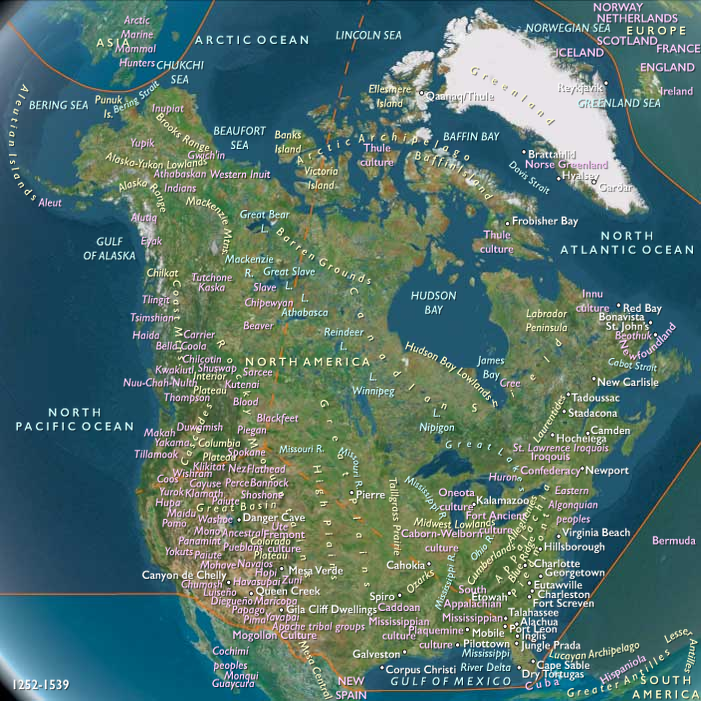
Subregions
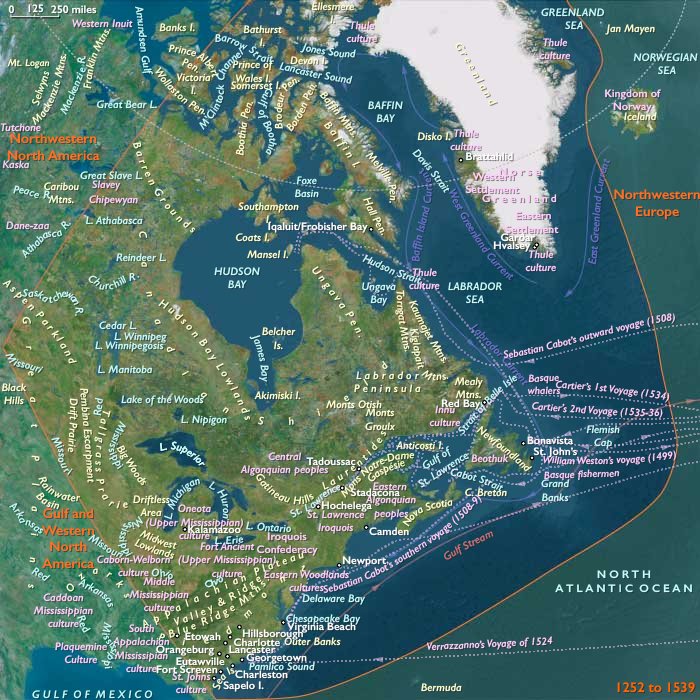
Years: 1480 - 1491
People
Groups
- Mound Builders
- Mississippian culture
- Caddoan Mississippian culture
- Iroquois (Haudenosaunee, also known as the League of Peace and Power, Five Nations, or Six Nations)
- Thule people
- Penobscot people (Amerind tribe)
- Ho-Chunk (Amerind tribe)
- Mi'kmaq people (Amerind tribe)
- Mohawk people (Amerind tribe)
- Wyandot, or Wendat, or Huron people (Amerind tribe)
- Osage Nation (Amerind tribe)
- Oneida people (Amerind tribe)
- Susquehannock (Amerind tribe)
- Catawba people (Amerind tribe)
- Quapaw, or Arkansas (Amerind tribe)
- Omaha (Amerind tribe)
- Kaw, or Kanza, people (Amerind tribe)
- Caddo (Amerind tribe)
- Tuscarora (Amerind tribe)
- Ponca (Amerind tribe)
- Yuchi (Amerind tribe)
- Seneca (Amerind tribe)
- Cherokee, or Tsalagi (Amerind tribe)
- Cayuga people(Amerind tribe)
- Onondaga people (Amerind tribe)
Topics
Commodoties
- Fish and game
- Gem materials
- Colorants
- Domestic animals
- Grains and produce
- Ceramics
- Strategic metals
- Tobacco
Subjects
- Commerce
- Environment
- Decorative arts
- Exploration
- Government
- Custom and Law
- Technology
- Human Migration
Regions
Subregions