
Northeastern North America (1492 to 1503 …
Years: 1492 - 1503
Northeastern North America
(1492 to 1503 CE): European Exploration and Indigenous Continuity
The era from 1492 to 1503 CE marks a pivotal transition in the history of Northeastern North America, as indigenous communities sustained stable cultural and political structures while European voyages dramatically reshaped the future of the continent. Although the earliest direct impacts of European contact were initially confined to coastal areas, the explorations of Christopher Columbus in the Caribbean and the subsequent expeditions of John Cabot to North American shores initiated profound, far-reaching consequences for the region.
Early European Exploration: Columbus and Cabot
Christopher Columbus’s Voyages (1492–1503)
Christopher Columbus’s first voyage in 1492 to the Caribbean initiated an era of extensive European exploration and colonization in the Americas. While Columbus himself did not reach Northeastern North America, his journeys catalyzed the rapid intensification of European interest in trans-Atlantic exploration, leading to subsequent voyages that directly impacted indigenous communities throughout the continent.
John Cabot’s Voyages (1497–1498)
The Genoese mariner Giovanni Caboto—known in English as John Cabot—sailed from Bristol, England, reaching the northeastern shores of North America in 1497, likely landing somewhere in present-day Newfoundland or possibly Nova Scotia. Cabot’s voyages, sponsored by King Henry VII of England, represented the earliest confirmed European exploration of Northeastern North America since the Norse abandonment of Greenland, reintroducing direct European contact after nearly five centuries.
Cabot’s explorations significantly influenced European maritime interest in the abundant fisheries off the Grand Banks, fostering a period of seasonal European fishing expeditions along the northeastern Atlantic coast, laying foundations for future settlements.
Haudenosaunee Confederacy: Continued Stability and Strength
Political Cohesion and Regional Influence
During this period, the Haudenosaunee Confederacy—comprising the Mohawk, Oneida, Onondaga, Cayuga, and Seneca—continued its internal consolidation, successfully navigating regional diplomatic relations with neighboring Algonquian and Siouan peoples. The internal strength of the Confederacy, founded according to tradition earlier in the fifteenth century by legendary leaders Hiawatha and Deganawidah, positioned it to confront future pressures posed by European contact and territorial incursions.
Cultural and Social Resilience
The Haudenosaunee maintained distinctive matrilineal kinship structures, with women retaining critical roles in governance, clan leadership, and cultural preservation. Ceremonial practices, particularly associated with the annual festivals and rituals of the Longhouse tradition, persisted robustly, reinforcing community identity and unity.
Mississippian Chiefdoms: Localized Stability Amid New Pressures
Persistent Community Structures
Smaller Mississippian-descended chiefdoms, notably at settlements such as Etowah (Georgia) and Moundville(Alabama), continued stable community life through localized ceremonial practices and fortified settlements. Though diminished in monumental scale, these chiefdoms retained stable, community-oriented structures deeply rooted in agricultural subsistence.
Agricultural Sustainability
Mississippian communities continued to sustain themselves effectively through maize cultivation, supplemented by beans, squash, hunting, and gathering. This stable agricultural foundation provided community resilience, allowing effective adaptation to emerging pressures of environmental variability and future European influences.
Dhegiha Communities: Ongoing Stability in the West
Agricultural Prosperity and Social Resilience
West of the Mississippi River, Dhegiha-speaking communities—ancestors of the Quapaw, Omaha, Ponca, Osage, and Kaw—remained economically prosperous and culturally cohesive. Village-based maize agriculture, seasonal hunting, and gathering ensured long-term stability and social cohesion, positioning these communities to withstand external pressures encountered in subsequent centuries.
Thule Inuit: Continued Dominance in the Arctic
Arctic Adaptation and Consolidation
In Arctic Canada and Greenland, the Thule Inuit maintained unchallenged dominance. Their sophisticated hunting and maritime subsistence techniques—sled dogs, toggling harpoons, slate knives—allowed stable communities to flourish despite the severe climatic conditions. Thule Inuit populations occupied former Norse settlements, adapting these sites and resources into their subsistence strategies.
Coastal and Riverine Indigenous Communities: Resilient Adaptations
Continued Subsistence Practices
Indigenous communities along the northeastern Atlantic coast and inland waterways remained economically stable, relying on sophisticated fishing, trapping, hunting, and gathering practices. Coastal groups were among the first to experience direct impacts from Cabot’s voyages, encountering seasonal European fishing fleets increasingly active on the Grand Banks and along the Newfoundland coast.
Artistic and Cultural Traditions
Localized artistic and ceremonial traditions persisted, evident through continued craftsmanship in pottery, shell gorgets, polished stone tools, and ornate tobacco pipes. Community ceremonies and rituals remained integral, reinforcing cultural cohesion in the face of emerging European contact.
Initial European-Indigenous Encounters: Seasonal Contact
European Fishing Expeditions and Early Trade
The immediate aftermath of John Cabot’s voyages saw limited but significant European-indigenous contact along Northeastern North America’s coast. European fishing fleets, particularly Basque, Portuguese, French, and English vessels, began seasonal expeditions to the rich cod fisheries off the Newfoundland coast. These encounters, initially commercial and intermittent, began to introduce European trade goods into indigenous exchange networks, initiating gradual but profound changes in regional economies and social structures.
Environmental Context: Indigenous Resilience and European Vulnerability
Climate Variability and European Adaptation Challenges
The late fifteenth century’s climatic conditions, influenced by the Little Ice Age, continued to demonstrate significant variability. European explorers and fishermen initially struggled to adapt to the harsh North Atlantic climate, while indigenous groups, with centuries of ecological adaptation, maintained stable and resilient subsistence strategies.
Legacy of the Era (1492–1503 CE)
The era of 1492 to 1503 CE marks the critical intersection between established indigenous stability and the onset of sustained European exploration and colonization in Northeastern North America. Indigenous societies, including the Haudenosaunee Confederacy, Mississippian chiefdoms, Dhegiha-speaking communities, and Thule Inuit, maintained robust cultural traditions, stable economies, and effective political structures as European maritime presence steadily increased. The arrival of John Cabot in 1497 foreshadowed the profound transformations to come, heralding a new historical epoch characterized by complex intercultural dynamics, significant demographic shifts, and fundamental alterations to indigenous lifeways.
People
Groups
- Mound Builders
- Mississippian culture
- Caddoan Mississippian culture
- Iroquois (Haudenosaunee, also known as the League of Peace and Power, Five Nations, or Six Nations)
- Thule people
- Penobscot people (Amerind tribe)
- Ho-Chunk (Amerind tribe)
- Mi'kmaq people (Amerind tribe)
- Osage Nation (Amerind tribe)
- Mohawk people (Amerind tribe)
- Wyandot, or Wendat, or Huron people (Amerind tribe)
- England, (Tudor) Kingdom of
- Oneida people (Amerind tribe)
- Susquehannock (Amerind tribe)
- Cherokee, or Tsalagi (Amerind tribe)
- Quapaw, or Arkansas (Amerind tribe)
- Omaha (Amerind tribe)
- Kaw, or Kanza, people (Amerind tribe)
- Caddo (Amerind tribe)
- Tuscarora (Amerind tribe)
- Ponca (Amerind tribe)
- Yuchi (Amerind tribe)
- Catawba people (Amerind tribe)
- Seneca (Amerind tribe)
- Cayuga people(Amerind tribe)
- Onondaga people (Amerind tribe)
Topics
Commodoties
- Fish and game
- Gem materials
- Colorants
- Domestic animals
- Grains and produce
- Ceramics
- Strategic metals
- Tobacco
Subjects
- Commerce
- Environment
- Decorative arts
- Exploration
- Government
- Custom and Law
- Technology
- Human Migration
Regions
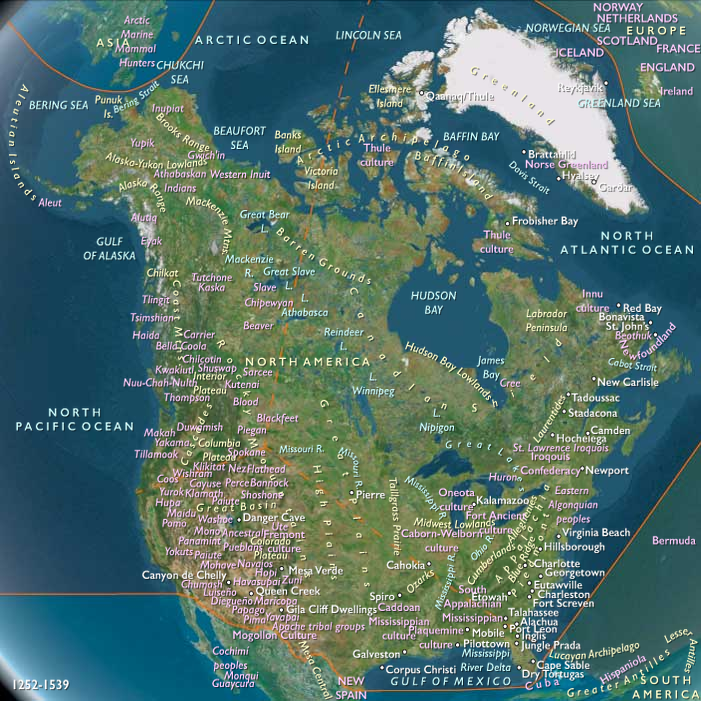
Subregions
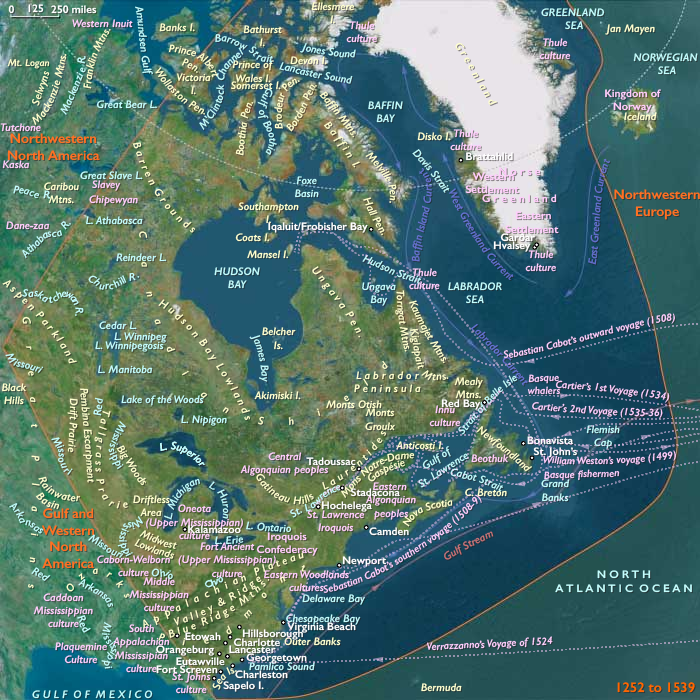
Related Events
Showing 10 events out of 40412 total
Years: 1492 - 1503
People
Groups
- Mound Builders
- Mississippian culture
- Caddoan Mississippian culture
- Iroquois (Haudenosaunee, also known as the League of Peace and Power, Five Nations, or Six Nations)
- Thule people
- Penobscot people (Amerind tribe)
- Ho-Chunk (Amerind tribe)
- Mi'kmaq people (Amerind tribe)
- Osage Nation (Amerind tribe)
- Mohawk people (Amerind tribe)
- Wyandot, or Wendat, or Huron people (Amerind tribe)
- England, (Tudor) Kingdom of
- Oneida people (Amerind tribe)
- Susquehannock (Amerind tribe)
- Cherokee, or Tsalagi (Amerind tribe)
- Quapaw, or Arkansas (Amerind tribe)
- Omaha (Amerind tribe)
- Kaw, or Kanza, people (Amerind tribe)
- Caddo (Amerind tribe)
- Tuscarora (Amerind tribe)
- Ponca (Amerind tribe)
- Yuchi (Amerind tribe)
- Catawba people (Amerind tribe)
- Seneca (Amerind tribe)
- Cayuga people(Amerind tribe)
- Onondaga people (Amerind tribe)
Topics
Commodoties
- Fish and game
- Gem materials
- Colorants
- Domestic animals
- Grains and produce
- Ceramics
- Strategic metals
- Tobacco
Subjects
- Commerce
- Environment
- Decorative arts
- Exploration
- Government
- Custom and Law
- Technology
- Human Migration
Regions
Subregions