Northern West Indies (4,365–2,638 BCE) Late Holocene…
4365 BCE to 2638 BCE
Northern West Indies (4,365–2,638 BCE) Late Holocene — Ceramic Migrations on the Horizon
Geographic and Environmental Context
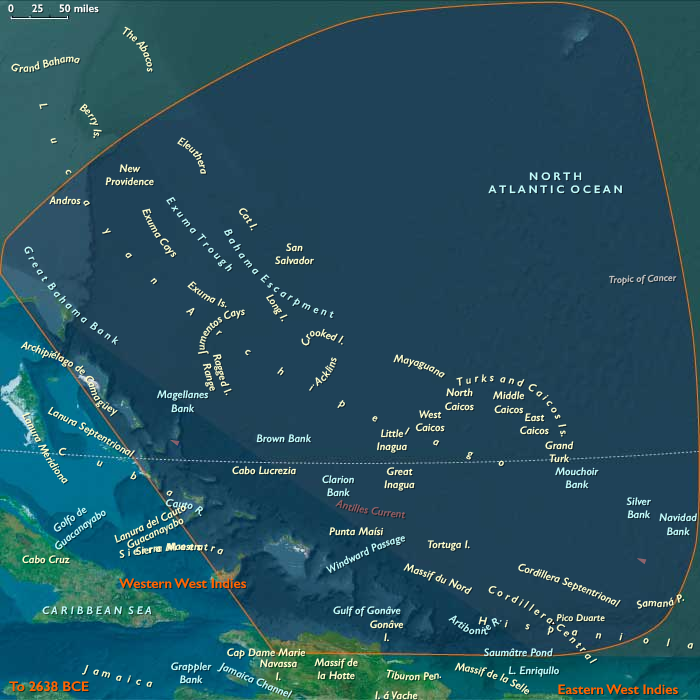
Northern West Indies includes the Outer Bahamas (Lucayan archipelago), the Turks & Caicos Islands, and northern Hispaniola — northern Haiti (Cap-Haïtien, Massif du Nord) and the Cibao/north coast of the Dominican Republic (Santiago de los Caballeros, Puerto Plata).
Anchors: Andros–Abaco–Eleuthera–San Salvador–Exuma banks, Turks & Caicos banks and passes, Cap-Haïtien–Massif du Nord, Cibao–Puerto Plata–Santiago river valleys and coastal shelves.
-
Stable banks and passes; fertile Cibao river-fans.
Climate & Environmental Shifts
-
Slightly increased storminess; reefs resilient.
Subsistence & Settlement
-
Archaic lifeways continued; Saladoid ceramic farmers from Orinoco prepared regional advances (first in south/east Antilles).
Technology & Material Culture
-
Preceramic tools persisted on the north coast; incipient ceramics approached Hispaniola late in this span.
Movement & Interaction Corridors
-
Canoe lanes through Virgin Islands/Leewards began to touch Greater Antilles.
Cultural & Symbolic Expressions
-
Ancestor rites deepened at shell middens.
Environmental Adaptation & Resilience
-
Riverine refugia + lagoon stores buffered cyclone years.
Transition
By 2,638 BCE, ceramic horticulturalism was approaching northern Hispaniola.
Images

Northern West Indies in the Late Holocene
Commodities
Subjects
Regions
West Indies
View →Subregions