
Northwest Europe (1048–1059 CE): Strengthening Monarchies, Rising…
1048 CE to 1059 CE
Northwest Europe (1048–1059 CE): Strengthening Monarchies, Rising Tensions, and Cultural Revivals
England: Consolidation Under Edward the Confessor
From 1048–1059, Edward the Confessor (r. 1042–1066) solidified his reign in England. Edward's rule emphasized religious devotion, administrative efficiency, and relative stability after decades of political turbulence. Deeply influenced by his Norman upbringing, Edward increasingly brought Norman advisers, clergy, and customs into the English court, laying foundations for future Anglo-Norman integration. His patronage notably led to the rebuilding of Westminster Abbey, commenced around 1045 and continuing throughout this period, reflecting his personal piety and reinforcing England’s connections with European monastic reforms.
Edward’s reliance on Norman courtiers gradually provoked resentment among Anglo-Saxon nobility, notably Earl Godwin of Wessex and his sons. In 1051, these tensions erupted dramatically when Edward briefly exiled the Godwin family after disputes involving Norman influence. Yet, by 1052, Edward was compelled to reinstate Godwin, underscoring the English nobility's continued power and setting the stage for subsequent political rivalries.
Scotland: Stability Under Macbeth
In Scotland, the reign of Macbeth (1040–1057) brought sustained internal stability and strengthened royal authority. Macbeth’s governance contrasted sharply with the turbulent conditions under Duncan I, establishing a period of prosperity. His reign saw strengthened diplomatic and religious ties with Rome, highlighted by his pilgrimage to the city in 1050, reflecting Scotland’s growing integration into wider European networks.
However, Macbeth’s position faced increasing challenge from Malcolm Canmore (Malcolm III), son of the defeated Duncan I. Supported by English allies, Malcolm initiated persistent incursions against Macbeth, significantly weakening the latter’s hold over Scotland. In 1057, these hostilities culminated at the Battle of Lumphanan, where Macbeth was slain, leading to Malcolm’s eventual accession and ushering in a transformative new era for Scottish governance.
Ireland: Continued Fragmentation and Rivalries
Ireland remained politically fragmented between 1048 and 1059, with no central authority emerging. Prominent regional kingdoms in Munster, Leinster, Connacht, and Ulster continued vying for dominance. Rivalries remained intense, frequently erupting into regional conflicts. Despite political fragmentation, Ireland’s ecclesiastical life thrived, exemplified by increased contacts with continental Europe, significantly contributing to religious and cultural renewal.
Norway and Denmark: Magnus the Good and Harald Hardrada
The Norwegian throne underwent significant transitions in this period. Magnus the Good had ruled Norway and Denmark jointly until his sudden death in 1047, prompting political realignments. In Norway, Magnus was succeeded by the ambitious Harald Sigurdsson (Harald Hardrada), whose vigorous reign began in 1047, strengthening Norway’s international stature.
Harald, known for military prowess and administrative skill, expanded Norway’s influence through robust military campaigns. His rule notably improved royal control, standardized coinage, and enhanced trade. Harald’s assertive foreign policy brought Norway into direct competition with Denmark, now ruled by Sweyn II Estridsson (from 1047), setting the stage for renewed Danish-Norwegian conflicts.
In Denmark, Sweyn II Estridsson focused on internal consolidation and church reform. His reign brought ecclesiastical renewal as he sought greater alignment with papal authority, strengthening Denmark’s ecclesiastical infrastructure, developments influential in subsequent periods.
Iceland and Norse Atlantic Communities: Cultural Flourishing
Between 1048–1059, Icelandic society flourished, characterized by remarkable literary output, including early sagas and genealogical works. The Althing maintained stable governance, promoting prosperous trade and cultural connections with Norway, Scotland, and Ireland. Christianity further entrenched itself, stimulating rich intellectual life, manuscript production, and cultural exchange.
The Norse Atlantic settlements—including the Faroe Islands, Orkney, and Shetland—experienced similar prosperity. Particularly, Orkney emerged as an important maritime center under influential earls, sustaining vibrant trade and cultural interactions across Northwest Europe.
Religious and Intellectual Renewal
This era saw increased ecclesiastical and cultural exchanges between Northwest Europe and continental centers. Reformist movements emphasizing clerical discipline, monastic purity, and papal authority gained prominence across England, Scotland, and Denmark. In England, Edward the Confessor’s rebuilding of Westminster Abbey exemplified growing continental religious influence, integrating English ecclesiastical life into wider European reform movements.
The legacy of Saint Olaf Haraldsson remained influential, strengthening popular devotion across Scandinavia and Northwest Europe. The Olaf cult reinforced regional Christian identity, intensifying pilgrimage activity and ecclesiastical connectivity between Norway, Denmark, Iceland, and England.
Legacy of the Era
By 1059 CE, Northwest Europe experienced significant consolidation and cultural flourishing amid lingering political rivalries. England, under Edward the Confessor, enjoyed internal peace despite growing Norman influence and tensions among nobility. Scotland transitioned from Macbeth’s stable reign to Malcolm III’s ascendancy, reshaping its political landscape. In Scandinavia, Harald Hardrada’s assertive rule revitalized Norway’s international standing, while Sweyn Estridsson’s Denmark witnessed ecclesiastical reforms and internal stability. Iceland and the Norse settlements continued economic prosperity and vibrant cultural life, enriching the region’s cultural heritage.
Thus, this period laid critical foundations—political, cultural, and ecclesiastical—that decisively shaped Northwest Europe’s evolving medieval trajectory.
People
Groups
Regions
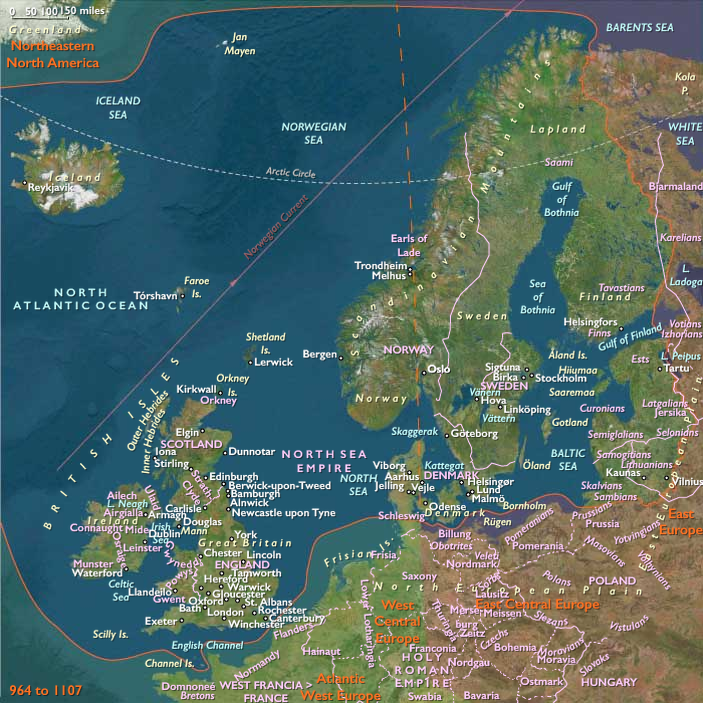
North Europe
View →Subregions
