
Northwest Europe (1120–1131 CE): Dynastic Challenges and…
1120 CE to 1131 CE
Northwest Europe (1120–1131 CE): Dynastic Challenges and Ecclesiastical Expansion
England: Tragedy and Succession Crisis
The period from 1120 to 1131 began tragically for England with the White Ship disaster (1120), in which William Adelin, the sole legitimate heir to King Henry I, drowned along with many prominent nobles. This catastrophe plunged England into a succession crisis, prompting Henry I to secure oaths from his barons acknowledging his daughter Matilda as his heir. Despite Henry's efforts, tensions simmered beneath the surface as the nobility remained skeptical of Matilda's potential rule, setting the stage for future conflicts.
Scotland: Norman Integration and Feudal Reforms
Alexander I (r. 1107–1124) continued his reign until his death in 1124, succeeded by his brother, David I (r. 1124–1153). David deepened Scotland's Norman integration by reorganizing his kingdom along Norman lines, introducing feudalism through immigrant French and Anglo-French knights, and establishing burghs to boost trade and urbanization. He implemented ideals of Gregorian Reform and encouraged significant monastic growth, founding monasteries such as Kelso Abbey (1128) and Holyrood Abbey (1128). David's reign notably advanced Scotland's feudal structure, strengthened central authority, and significantly influenced Scottish development.
Ireland: Persistent Fragmentation and Norse Influence
Ireland remained politically fragmented, characterized by continuous rivalries among native kingdoms. Nonetheless, the Norse-Gaelic towns—especially Dublin, Waterford, and Limerick—persisted as bustling trade hubs, reinforcing Ireland’s economic ties across the Irish Sea. These coastal settlements became vital points of cultural and commercial exchange, despite Ireland's ongoing internal conflicts.
Denmark and Norway: Internal Stability and Succession Turmoil
In Denmark, King Niels (r. 1104–1134) sustained internal peace and ecclesiastical patronage, supporting the expansion of monasticism and church infrastructure. His reign witnessed continuing stability and prosperity.
Norway, under Sigurd I Jorsalfar (r. 1103–1130), enjoyed prestige from his earlier crusading achievements. However, Sigurd’s death in 1130 sparked a turbulent succession conflict, igniting a period of civil wars and instability. Rival kings and pretenders fought a series of conflicts that would persist until 1240, profoundly shaping Norway’s medieval political landscape.
Iceland and the North Atlantic: Cultural Preservation
In Iceland, the Althing continued to uphold traditional laws and governance. Icelandic and North Atlantic communities sustained their rich literary and cultural traditions, preserving Norse history and sagas. These cultural activities provided stability and a strong sense of identity amid wider European transformations.
Religious and Cultural Developments
Ecclesiastical growth characterized the era, with numerous monastic foundations established throughout Northwest Europe, particularly in Scotland under David I. The increasing influence of the church facilitated cultural exchange and helped embed Northwest Europe more deeply into continental European religious and intellectual networks.
Legacy of the Era
By 1131 CE, Northwest Europe faced significant dynastic challenges, most notably England's looming succession crisis following the White Ship disaster and Norway’s succession turmoil after Sigurd’s death. Conversely, Scotland saw continued consolidation, feudal reforms, and ecclesiastical growth under David I. Ireland maintained economic strength despite political divisions, and Denmark preserved internal stability. Iceland and its North Atlantic neighbors retained cultural vibrancy, highlighting this era as one of dynamic contrasts, shaping the region’s medieval trajectory profoundly.
People
Groups
Regions
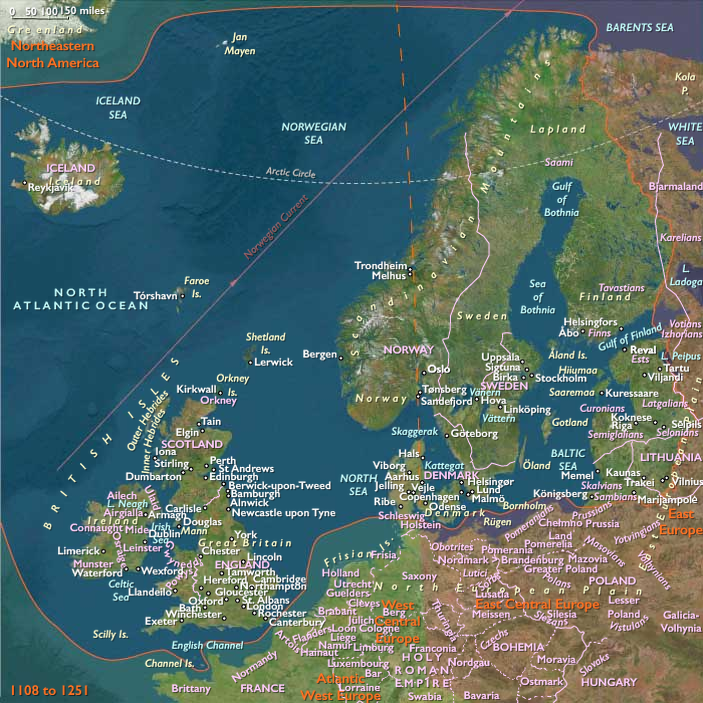
North Europe
View →Subregions
