
Northwest Europe (1341–1198 BCE): Flourishing Late Bronze…
1341 BCE to 1198 BCE
Northwest Europe (1341–1198 BCE): Flourishing Late Bronze Age Cultures and Regional Integration
Metallurgical Mastery and Craftsmanship
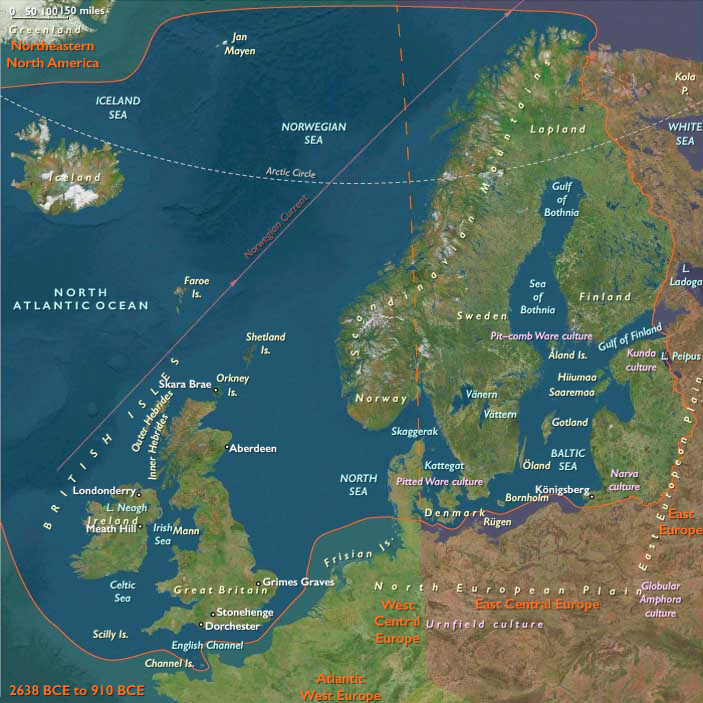
From 1341 to 1198 BCE, Bronze Age communities throughout Northwest Europe—including the British Isles, western regions of Denmark and Norway, the Channel Islands, and the northern archipelagos of Orkney and Shetland—achieved remarkable expertise in bronze metallurgy. Sophisticated metalworking techniques produced superior tools, intricate jewelry, and high-quality weapons, greatly enhancing regional economies and reinforcing societal structures.
Further Social Stratification
Social stratification became deeply entrenched during this period, with elite groups prominently distinguished by rich burials containing elaborate bronze objects, finely crafted jewelry, and ceremonial artifacts. Such burials provided clear evidence of increasingly rigid social hierarchies and the sustained authority of powerful ruling classes.
Enduring Ritual and Monumental Traditions
Ceremonial sites like Stonehenge and Avebury in Britain retained their cultural centrality. Although significant new monumental projects ceased, these sites continued as important focal points for ritual activities, celestial alignments, and communal gatherings, preserving their roles as cornerstones of cultural and religious identity.
Continued Importance of Irish Ceremonial Centers
In Ireland, passage tomb complexes in the Boyne River Valley—such as Newgrange, Knowth, and Dowth—maintained their significance as key ceremonial and communal sites. While large-scale construction had ceased, these monuments continued to anchor spiritual traditions, collective memory, and social cohesion.
Agricultural Advances and Population Expansion
Enhanced bronze tools, including advanced plowing and harvesting implements, supported increasingly efficient agricultural practices. Prosperous agricultural regions like Scotland’s Aberdeen lowlands and Northern Ireland’s area around present-day Londonderry (Derry) experienced continued demographic growth and stable settlements, bolstering regional economic resilience.
Intensified Maritime Exchange and Economic Prosperity
Maritime trade reached unprecedented levels of connectivity, integrating coastal and inland communities across Denmark, Norway, the British Isles, and further afield. The extensive trade network facilitated the movement of bronze artifacts, amber, pottery, textiles, and exotic goods, enhancing economic wealth and fostering a richly interconnected cultural landscape.
Technological Consolidation of Bronze
Bronze fully dominated the technological landscape, firmly establishing itself as the preferred material for everyday tools, agricultural implements, weapons, and ritual objects. This widespread adoption marked a significant and irreversible technological shift that shaped all facets of societal life.
Stability and Community Dynamics in Orkney and Shetland
In the Orkney Islands, ceremonial landscapes such as the Ring of Brodgar and the Stones of Stenness remained culturally active, with communities upholding traditional ritual practices. Similarly, the Shetland Islands actively participated in maritime networks, maintaining economic prosperity and cultural continuity despite geographic isolation.
Continued Isolation: Iceland and the Faroe Islands
Throughout this period, the islands of Iceland and the Faroe Islands continued to remain uninhabited due to their harsh environmental conditions. Icelandic volcanic events persisted as significant chronological benchmarks for archaeological studies of the broader Northwest European region.
Legacy of the Age
By 1198 BCE, Northwest European Bronze Age societies had reached their zenith of cultural integration and technological sophistication. Stable agricultural communities, thriving trade networks, pronounced social stratification, and advanced metallurgy characterized this era, leaving enduring legacies that profoundly influenced subsequent cultural and historical developments across the region.
Groups
Topics
Commodities
Subjects
Regions
North Europe
View →Subregions
