
Northwest Europe (1696–1707): Dynastic Consolidation, Maritime Rivalries,…
1696 CE to 1707 CE
Northwest Europe (1696–1707): Dynastic Consolidation, Maritime Rivalries, and Economic Transitions
Centralization and Power in Denmark-Norway
The Danish-Norwegian monarchy under King Frederick IV continued the evolution toward centralized administration initiated by previous rulers. After decades of intermittent function, the Danish diet—an assembly representing Danish nobility, clergy, and urban bourgeoisie—was effectively suspended and faded from political relevance for nearly two centuries. Power was increasingly consolidated in Copenhagen, where Frederick IV’s administration adopted a more hierarchical structure with the king serving as the focal point of governance. This bureaucratic reshaping streamlined administration but also concentrated power, strengthening royal authority and weakening traditional aristocratic checks on monarchy.
England: Maritime Supremacy and Economic Deregulation
England’s maritime power continued to expand following the Battle of Solebay (1672), consolidating naval supremacy over Dutch rivals. The wealth generated by overseas trade, especially from India, enriched merchants and officials associated with the East India Company. Officers and former employees returned home with considerable fortunes, establishing extensive estates, lucrative businesses, and gaining significant political influence.
The East India Company's growing economic and political clout nurtured a powerful lobby within the English Parliament, which increasingly debated the monopolistic privileges enjoyed by the company. Pressure from ambitious merchants and entrepreneurs—dubbed Interlopers by company advocates—culminated in a critical deregulating act passed in 1694, effectively annulling the nearly century-old monopoly. By 1696, this legislative change allowed any English firm not explicitly prohibited by Parliament to engage in trade with India, marking a significant economic shift that intensified commercial competition and profoundly altered English trade dynamics in Asia.
Further complicating the trade landscape, Parliament established a new "parallel" entity in 1698, officially titled the English Company Trading to the East Indies. This new enterprise was floated under a substantial state-backed indemnity of £2 million. However, powerful stockholders from the old East India Company rapidly subscribed to the new entity, investing £315,000, quickly positioning themselves to dominate both companies. As a result, the two rival companies wrestled fiercely with one another for a dominant share of trade, both domestically and within their Indian spheres of influence. This struggle exacerbated competition and tension, reflecting England’s broader transformation from monopolistic privilege toward open but contentious commercial rivalry.
Scotland: Economic Strain and the Darien Disaster
During this era, Scotland undertook an ambitious but ultimately disastrous attempt to establish a colony in Panama—the infamous Darien Scheme (1698–1700). Intended to open a profitable trade route between the Atlantic and Pacific Oceans, the scheme consumed vast amounts of Scottish capital. Poorly planned, inadequately provisioned, and undermined by tropical diseases and Spanish hostility, the colony collapsed spectacularly, wiping out substantial national wealth. The economic catastrophe resulting from Darien significantly intensified pressures leading toward the eventual union of Scotland and England.
Maritime Commerce and Rivalries
Maritime rivalries shaped the era. Following the loss of its dominance in North Sea trade, the Dutch Republic began losing ground to England’s burgeoning naval supremacy. Although Amsterdam remained an important center of trade, London increasingly emerged as the leading global financial and maritime hub, facilitating the British Isles’ ascent as a principal European economic power.
Cultural and Intellectual Developments
The era also witnessed cultural and intellectual advances, notably in England and Denmark. The scientific culture exemplified by the Royal Society continued to encourage empirical inquiry. Notable intellectuals such as Isaac Newton, who became Master of the Royal Mint in 1699, embodied the fusion of scientific inquiry and statecraft. In Denmark, Frederick IV encouraged intellectual and cultural patronage as part of his broader effort to modernize and centralize governance.
Ireland: Continued Repression and Economic Stagnation
In Ireland, the aftermath of the Williamite War (1688–1691) entrenched a harsh Protestant ascendancy, disenfranchising the Catholic majority through punitive legislation known as the Penal Laws. Economic stagnation deepened as these restrictive policies hindered trade and manufacturing, significantly curtailing the island’s economic potential during this period.
Iceland and North Atlantic Islands: Subsistence and Isolation
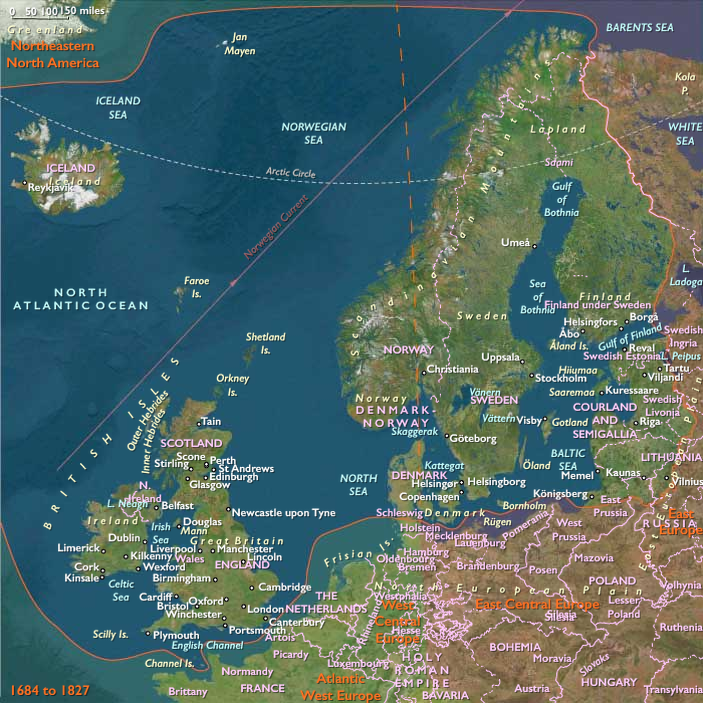
Farther northwest, Iceland and the North Atlantic islands (including the Faroes, Shetland, and Orkney) continued to endure relative isolation. Economically peripheral and politically marginal, their economies relied largely on subsistence agriculture, fishing, and sheep-herding. Danish authority remained nominal yet distant, with limited direct intervention, though administrative centralization in Copenhagen hinted at future efforts to integrate these remote territories more firmly into the kingdom.
The era 1696–1707 thus marked significant transitions across Northwest Europe. From intensified maritime rivalry and economic deregulation in England—highlighted by the fierce competition between the two East India Companies—to centralization in Denmark-Norway, economic devastation in Scotland, continued repression in Ireland, and isolation in Iceland and adjacent islands, these developments collectively shaped a region moving toward more centralized political structures, economic competition, and increasingly interconnected global commerce.
Groups
Topics
Commodities
Subjects
Regions
North Europe
View →Subregions
