
Northwest Europe (1744–1755): Jacobite Rebellion, Colonial Rivalries, …
Years: 1744 - 1755
Northwest Europe (1744–1755): Jacobite Rebellion, Colonial Rivalries, and Industrial Advances
The Jacobite Rebellion of 1745
In 1745, long-simmering Jacobite discontent flared into open rebellion. Charles Edward Stuart—the Young Pretender—landed in the Scottish Highlands and rallied clans to his cause, aiming to restore the Stuart dynasty. After early victories at Prestonpans and the occupation of Edinburgh, his forces crossed into England. Yet by 1746, the rebellion was crushed at the Battle of Culloden, where British troops under the Duke of Cumberland delivered a decisive and brutal defeat. The aftermath ushered in harsh reprisals: Highland culture was suppressed, Jacobite leaders were executed or exiled, and the clan system was systematically dismantled, extinguishing a centuries-old social order.
Britain and France: Intensifying Colonial Rivalry
The mid-1740s to early 1750s saw escalating Anglo-French competition over overseas territories, particularly in North America, the Caribbean, and India. These conflicts, part of a broader imperial rivalry, included frequent naval skirmishes and proxy wars that destabilized the colonial frontier. These tensions were a prelude to the global conflict that would become the Seven Years’ War (1756–1763).
The British government, wary of the financial strain of sustained conflict, turned again to its most powerful trading institution. In 1742, Parliament had extended the United East India Company's exclusive license until 1783 in exchange for a £1 million loan. This extension ensured continued revenues from Indian trade and reinforced the company's central role in supporting the British imperial and fiscal apparatus.
The 1750 Gaol Fever Outbreak
In May 1750, another devastating outbreak of gaol fever (typhus) struck the heart of London’s legal establishment. Originating in the filthy confines of Newgate Prison, the disease spread into the adjacent Old Bailey courtroom during the Lent assizes. Among the dead were Sir Samuel Pennant, the Lord Mayor of London, and a large number of court officers and jurors. This tragedy highlighted the appalling conditions of British prisons and the permeability of disease between carceral and civic spaces, reigniting calls for penal reform—though substantive change would remain slow.
The Hellfire Club and Elite Dissent
In this era of formal Enlightenment and state consolidation, a more shadowy aspect of elite culture flourished. Around 1749, Sir Francis Dashwood revived the Hellfire Club, more formally known as the Order of the Friars of St. Francis of Wycombe. Its rumored rituals—held at Medmenham Abbey—and its motto, Fais ce que tu voudras ("Do what thou wilt"), shocked polite society. Though shrouded in secrecy, the club attracted powerful political figures and prominent members of the aristocracy. Earlier iterations had been founded as early as 1719 by Philip, Duke of Wharton, and continued to proliferate, especially in Ireland. These clubs embodied a paradox of the period: outward rationalism masking inner libertinism among the ruling class.
John Harrison and the Mechanization of Precision
Meanwhile, John Harrison advanced his efforts to resolve the longitude problem. His H2 and H3 marine chronometers—refined in the 1740s and early 1750s—incorporated mechanisms designed to resist the distortions of humidity, temperature, and ship movement. Harrison’s work represented the forefront of mechanical innovation, challenging long-standing astronomical approaches and offering Britain a competitive navigational advantage. Though official recognition remained elusive, his chronometers laid the groundwork for reliable sea navigation, vital in an era of intensifying global trade and naval warfare.
William Champion and Zinc Metallurgy
In the realm of industry, William Champion revolutionized British metallurgy with the first commercial-scale zinc production. Building on methods similar to those long practiced at the Zawar mines in India, Champion adapted the process to Bristol’s industrial infrastructure. His innovation involved solving a complex thermodynamic problem: zinc vaporizes at 907°C, but requires reduction at 1000°C, necessitating a sealed furnace with a vapor condensation mechanism. Although no direct transmission of knowledge from India can yet be demonstrated, Champion’s success reflected a growing capacity for independent scientific problem-solving and the dawn of modern chemical engineering in Northwest Europe.
Denmark-Norway: Quiet Reform and Commercial Development
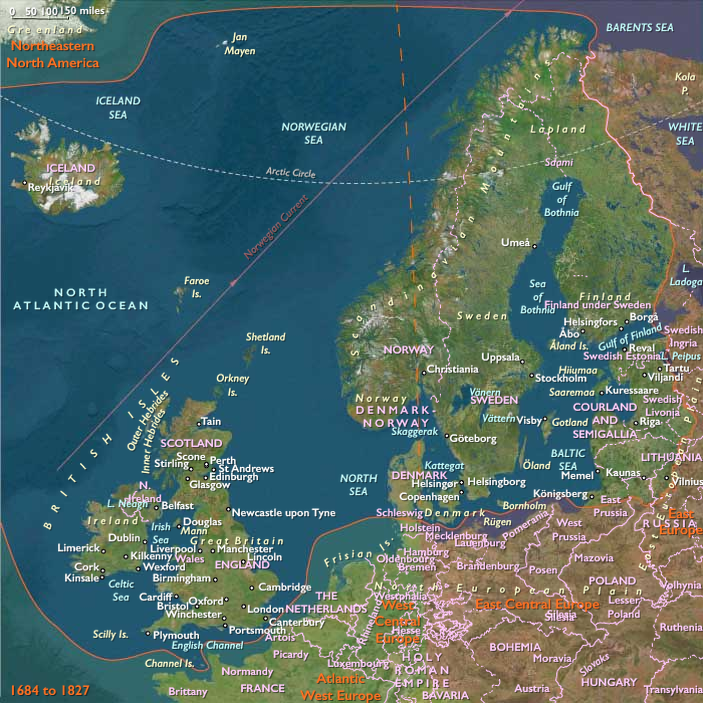
In Denmark-Norway, Frederick V continued the cautious modernization of his dual monarchy. While not a major actor in the Anglo-French rivalry, Denmark-Norway pursued regional economic consolidation. Copenhagen’s shipyards and merchants grew in importance, while gradual administrative reforms continued. However, the North Atlantic dependencies—Iceland, the Faroe Islands, Shetland, and Orkney—remained on the periphery, economically dependent on fishing and trade in wool and dried cod, and largely untouched by the era’s industrial innovations.
Ireland: Repression and Emigration
The penal codes remained harshly enforced in Ireland, marginalizing the Catholic majority and restricting political and economic participation. Rural poverty deepened, especially in western counties, driving a new wave of emigration to North America. Though Dublin and Belfast retained pockets of commercial vitality and Enlightenment culture, the broader island remained socially polarized and economically stagnant.
Intellectual and Cultural Milestones
The literary and intellectual culture of Northwest Europe continued to flourish. In 1755, Samuel Johnson published his Dictionary of the English Language, an extraordinary achievement that standardized English spelling and grammar. Simultaneously, elite social spaces—from libraries and salons to reading chairs and secret societies—supported a wide range of intellectual expression, from moral philosophy to occult experimentation. The period’s cultural life reflected the tensions between Enlightenment order and aristocratic indulgence.
Between 1744 and 1755, Northwest Europe experienced profound shifts: the last Jacobite rebellion was extinguished, Britain and France entered increasingly violent imperial rivalry, and transformative scientific and industrial advances began reshaping the region's technological capabilities. From the disease-ridden prisons of London to the smelting furnaces of Bristol, from secret libertine societies to precision marine chronometers, the age was marked by paradox—order and disorder, discipline and decadence—on the cusp of global conflict and industrial revolution.
People
- Charles Edward Stuart
- Francis Dashwood, 15th Baron le Despencer
- Frederick V of Denmark
- George II of Great Britain
- John Harrison
- Prince William, Duke of Cumberland
- Samuel Johnson
- William Champion
Groups
- Gaels
- Irish people
- Scottish people
- Christians, Roman Catholic
- English people
- Scotland, Kingdom of
- Iceland (Danish dependency)
- Anglicans (Episcopal Church of England)
- Denmark-Norway, Kingdom of
- Ireland, (English) Kingdom of
- Presbyterians
- France, (Bourbon) Kingdom of
- East India Company, British (The Company of Merchants of London Trading into the East Indies)
- Britain, Kingdom of Great
- British Empire
Topics
- Middle Subatlantic Period
- Colonization of the Americas, British
- Colonization of Asia, British
- Jacobite Rebellion of 1745-46 (”The Forty-five”)
- Prestonpans, Battle of
- Culloden, Battle of
Commodoties
Subjects
- Commerce
- Writing
- Public health
- Decorative arts
- Conflict
- Mayhem
- Faith
- Government
- Custom and Law
- Human Migration
- Horology
Regions
Subregions

Years: 1744 - 1755
People
- Charles Edward Stuart
- Francis Dashwood, 15th Baron le Despencer
- Frederick V of Denmark
- George II of Great Britain
- John Harrison
- Prince William, Duke of Cumberland
- Samuel Johnson
- William Champion
Groups
- Gaels
- Irish people
- Scottish people
- Christians, Roman Catholic
- English people
- Scotland, Kingdom of
- Iceland (Danish dependency)
- Anglicans (Episcopal Church of England)
- Denmark-Norway, Kingdom of
- Ireland, (English) Kingdom of
- Presbyterians
- France, (Bourbon) Kingdom of
- East India Company, British (The Company of Merchants of London Trading into the East Indies)
- Britain, Kingdom of Great
- British Empire
Topics
- Middle Subatlantic Period
- Colonization of the Americas, British
- Colonization of Asia, British
- Jacobite Rebellion of 1745-46 (”The Forty-five”)
- Prestonpans, Battle of
- Culloden, Battle of
Commodoties
Subjects
- Commerce
- Writing
- Public health
- Decorative arts
- Conflict
- Mayhem
- Faith
- Government
- Custom and Law
- Human Migration
- Horology
Regions
Subregions