
Event
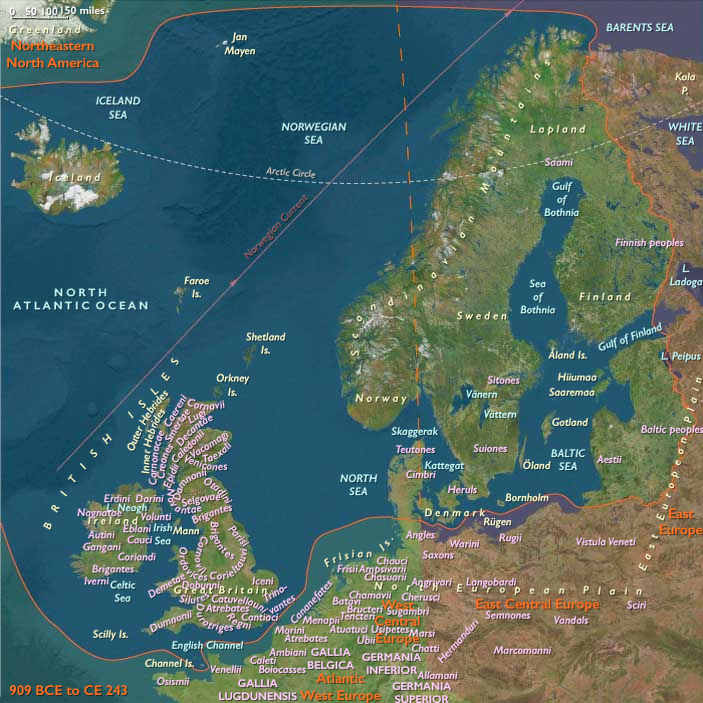
Northwest Europe (477 BCE–243 CE): Classical Antiquity…
Northwest Europe (477 BCE–243 CE): Classical Antiquity — Continental Exchange, Roman Britain, and Regional Diversity
Environmental Continuity
Throughout Classical Antiquity, the enduring Atlantic environment continued to shape Northwest European history. Fertile lowlands supported expanding agriculture, while uplands, peatlands, fjords, estuaries, and rocky coasts encouraged mixed economies based upon pastoralism, fishing, woodland resources, and maritime exchange.
The sea remained the principal transportation network linking Ireland, Britain, western Scandinavia, Gaul, and the wider North Sea world.
Expanding Exchange Networks
During the centuries before Roman conquest, maritime trade intensified across the Channel and North Sea. Continental artistic traditions, imported luxury goods, and technological innovations circulated through coastal exchange, while southern Britain developed increasingly complex regional polities centered upon hillforts and later oppida.
Tin from Cornwall, iron, salt, livestock, textiles, hides, and agricultural products became increasingly integrated into broader European commercial systems.
Roman Transformation of Britain
The Roman conquest beginning in 43 CE fundamentally reorganized southern Britain without transforming the entire subregion. Roads, forts, towns, villas, and military frontiers introduced new administrative structures and expanded long-distance commerce. Londinium, Camulodunum, and Eboracum emerged as important administrative and commercial centers integrated into imperial networks.
Roman influence remained strongest in southern and eastern Britain. Wales, northern Britain, and upland districts experienced more limited incorporation, while Ireland, western Norway, western Denmark, Orkney, and Shetland continued developing beyond imperial authority.
Cultural Adaptation
Roman administration did not replace indigenous society but became layered upon existing agricultural landscapes. Native farmsteads, enclosed fields, and regional traditions persisted alongside villas, military installations, and urban settlements. Religious life similarly combined local deities with Roman cults, producing a distinctive Romano-British cultural synthesis.
Outside Roman Britain, Iron Age political traditions continued evolving independently, maintaining strong maritime connections with neighboring regions.
Legacy of the Period
By 243 CE, Northwest Europe contained both one of Rome's most northwestern provinces and extensive independent Atlantic societies beyond imperial rule. Roman infrastructure transformed much of Britain, but environmental diversity, maritime connectivity, and enduring regional traditions ensured that the subregion remained politically and culturally heterogeneous.
-
{# Image navigates to the detail page; the magnifying-glass chip is the only Fancybox lightbox trigger (kept a separate sibling — anchors can't nest). #}
 The North Atlantic Lands
World
-
{# Image navigates to the detail page; the magnifying-glass chip is the only Fancybox lightbox trigger (kept a separate sibling — anchors can't nest). #}
 North Europe
Region
-
{# Image navigates to the detail page; the magnifying-glass chip is the only Fancybox lightbox trigger (kept a separate sibling — anchors can't nest). #}
 Northwest Europe
Subregion
