
Oil, discovered in commercial quantities at Al-Hasa…
1942 CE
Oil, discovered in commercial quantities at Al-Hasa near the shores of the Persian Gulf in 1938, begins to be exploited energetically after 1941 by the concessionaire, Standard Oil of California. (The Al-Hasa oilfield will prove to be one of the largest in the world.)
After Saudi Arabia declares its neutrality during the Second World War, Britain and the United States subsidize the kingdom.
Groups
Subjects
Regions

The Near and Middle East
View →Subregions
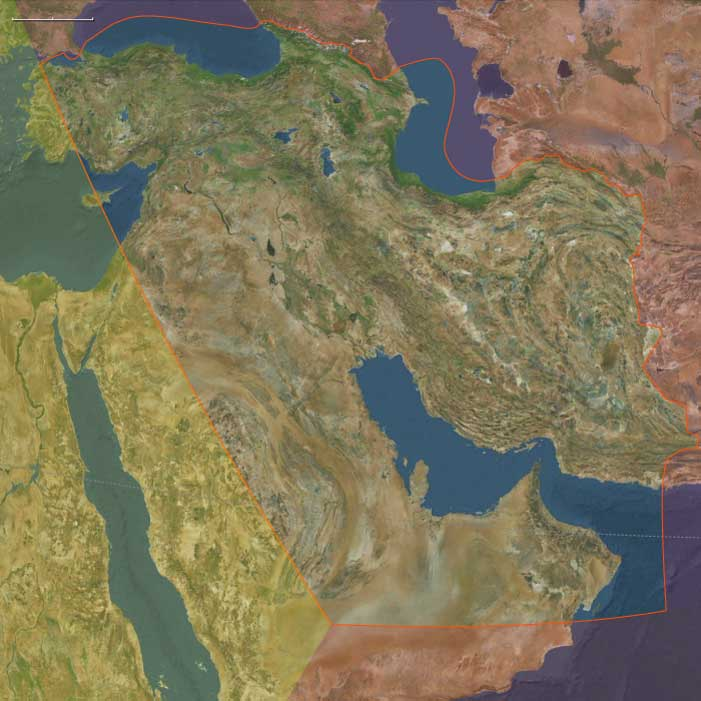
Middle East
View →Related Events
No active filters.
Showing 10 events out of 5535 total
Japan conquers most of the islands of the western Pacific in 1942.
The US Navy halts Japan’s advance at the battles of Midway and the Coral Sea; US troops fight the Japanese at New Guinea and Guadalcanal.
The US offensive in the Central Pacific begins at the Gilbert Islands.
Task forces assault Tarawa and Makin islands in November 1942, clearing Makin of enemy troops within four days.
Five thousand US Marines land on Tarawa to face 5,000 veteran jungle-fighters that an uncoordinated air assault had failed to weaken.
The ferocious fighting ends on November 23 with only 17 Japanese and 129 Korean workers remaining alive to be taken prisoner.
After the February 15, 1942 fall of Singapore to the Japanese forces, 20,000 Australian troops become prisoners of war.
In late February, US General Douglas MacArthur obeys President Roosevelt’s order to escape the beleaguered Philippines and proceed to Australia.
Fearing Japanese invasion, Curtin insists upon the return of troops from the Middle East to defend Australia and assist General MacArthur’s Australian-based Allied forces on their Pacific Island drive to Japan.
Thailand allies with Japan in the War of Greater East Asia begun by the Japanese, declaring war on the US and Great Britain in January 1942.
In these countries, Free Thai movements organize to liberate Thailand from Japanese control.
The Japanese methodically deploy ground forces and air power to destroy the Allies Dutch East Indies positions, then cripple an Allied fleet in a sequence of Java Sea battles.
The Japanese complete their conquest of Malaya with the February 15, 1942 capture of Singapore, the key to British and Dutch defenses in East and Southeast Asia.
By late February, combat deaths, dysentery, malaria and a mere trickle of supplies reduce the Bataan troop’s strength to the extent that Roosevelt orders MacArthur to escape to Australia and assume supreme command of the Allied forces in the southwestern Pacific.
He doses so, stating “I shall return.” The Dutch islands surrender in March 1942.
The British, pushed northward in Burma by the Japanese, evacuate Rangoon on March 7, 1942.
In mid-March, Jiang Jeishei sends his newly-appointed chief of staff, US Lieutenant General Joseph W. Stilwell, to command the Fifth and Sixth Chinese armies in Burma.
Tarrying too long in southern Burma, Stilwell’s forces are cut off from the Burma Road in April.
Japanese general Yamashita accepts the Lieutenant General Jonathan M. Wainwright’s April 9 surrender of 36,000 US troops on the Philippines Bataan Peninsula.
Most of the men not killed on the “Death March” to internment camps die in the camps.
3,500 troops remain and retreat to join the defenders of Corregidor, a fortified island.
An anti-fascist guerrilla movement, led mainly by a coalition of Filipino socialists and communists known by their acronym, HUKS, resists the occupying Japanese forces.
Stilwell’s forces cover the British retreat into India, then retreat themselves in a hardship-ridden journey to India and China.
US Lieutenant Colonel James Doolittle, having spent months preparing a group of enthusiastic volunteers for the mission, departs from the deck of the carrier Hornet on the morning of April 18, 1942 with a force of 16 North American B-25 medium-range bombers.
Flying below radar level towards the Japanese mainland islands, they bomb industrial targets at treetop level, then head for China, leaving behind an astonished Japanese public, who had been assured that their islands were invulnerable to attack.
A US spotter plane over the Coral Sea spots a great gathering of Japanese war vessels, stationed there to secure Japanese control of New Guinea and the Solomons and thus sever the US supply lanes to Australia.
US planes launched from American carriers met the Japanese armada’s fighters in the May 4—8 Battle of the Coral Sea, in which more than 25 Japanese ships were sunk or disabled and its heavy carriers damaged.
For the first time in naval history, surface ships exchanged not a single shot in the battle.
The defenders of Corregidor surrender on May 6, 1942.
By mid-May 1942, the Japanese bring nearly all of Burma under their control and inherit the heavy equipment abandoned by the retreating British.
The Burma Road is closed to the Allies.
The Japanese strategists of the Naval General Staff plan a secret strike on the US-held island of Midway, regarded by the Americans as the sentry for Hawaii.
The approach of the assembled task force of 200 ships and 600 planes, the largest naval operation in history, is anticipated by US intelligence, which continues to break key Japanese codes and ciphers.
A US patrol plane spots the task force as it approaches Midway on the afternon of June 3, 1942.
When 100 Japanese planes depart their carriers the following day and head for Midway, a strong US force of torpedo planes and fighters rises from the carriers Enterprise, Hornet, and Yorktown to sink four Japanese carriers.
Admiral Yamamoto Isoroku turns back the invasion force, which US planes harry and damage as the armada retires.
Over the next four days, the US planes sink two heavy cruisers, severely damage three destroyers and destroy 322 planes.
The Americans lose the carrier Yorktown, a destroyer, and 147 aircraft.
By July 4, 1942, the Flying Tigers have destroyed 297 Japanese planes and killed 500 enemy soldiers.
The Japanese, in preparation for an invasion of Australia, begin construction of an airbase on Guadalcanal in the southern Solomons in early July 1942.
Japan sets up a puppet Burmese government in August 1942.
On August 7, 1942, a well-equipped US task force appears off the Solomons and bombards the Japanese installations, then lands US Marines on Guadalcanal and its satellite islands.
After the Marines establisha beachhead the next day and seize the half-completed airfield, the Americans face intense Japanese resistance launched from their powerful air and naval base at Rabaul on New Britain Island’s eastern tip, just east of New Guinea.
In autumn 1943, MacArthur begins to move his combined American and Australian forces northward up New Guinea in a plan to cross over to New Britain and outflank Rabaul from the west while American forces on the Solomons side begin their island-hopping northward drive towards Japan, hoping to neutralize the Japanese stronghold on Rabaul by air attacks and outflank it on the east, thus avoiding altogether a costly frontal assault.
In December 1942, thousands of Chinese implement Stillwell’s suggestion to construct a new Burma Road, the Ledo Road, from Ledo in India to the old Burma Road beyond Mytkyina.
After Germany's invasion of Russia in June 1941, there had been popular support for an alliance with Germany, which seems to offer prospects of realizing old Pan-Turkish aims.
Turkey, while having signed a nonaggression pact with Germany, clings to neutrality.
The army in 1939 had been rapidly expanded, and defense expenditures have risen to more than half the budget.
Substantial deficits have been incurred, imposing a severe economic strain, which is aggravated by shortages of raw materials.
One means chosen by the government to raise money is a capital levy, introduced in 1942, arranged to fall with punitive force upon the non-Muslim communities and upon the Dönmes (Jewish converts to Islam).
Heydrich, at Hitler’s insistence, chairs the Nazi’s Wannsee Conference on the Final Solution of the Jewish Question in January, 1942.
Zhukov’s Soviet troops, having maintained steady pressure on the Germans throughout winter, push the invaders back to 40 miles (64 kilometers) from Moscow.
In March 1942, mass killing of Jews begins at Auschwitz, chosen as the main extermination center.
Great numbers of Poles, Russians, Gypsies and others are also executed en masse.
In spring 1942, Hitler decides to mount a summer offensive on the Soviet’s southern front to deprive them of their oil fields in the Caucasus and force their surrender.
The RAF begins air attacks on the cities of Germany’s Ruhr Valley industrial center.
A 1,000 bomber RAF air raid in May 1942 destroys much of the Rhineland city of Cologne.
The Germans advance across southern Russian in June and complete their conquest of the Crimea with the capture of Sevastopol in early July.
In summer 1942, the US Army Air Corps, bolstered by newly-produced warplanes, joins the RAF in Allied operations against Germany.
US B-17 Flying Fortresses and B-24 Liberators carry out daylight precision bombing raids on industrial targets; the British bomb the German cities at night.
Although the German Luftwaffe, not nearly as effective as it was during the Battle of Britain, is unable to successfully defend the nation against the raids, neither tactic succeeds in inflicting great damage.
After entering the Caucasus in August, German general Friedrich Paulus leads his Sixth Army in a march toward Stalingrad, the greatest city on the Volga and the key to defending the German occupation of the Caucasus.
As German troops reach the Volga near Stalingrad on August 23, the Luftwaffe begins aerial bombing of the city with incendiaries and high explosives, inflicting 40,000 Russian casualties within a few hours.
Stalin orders his namesake city held, and rushes fresh reserves to the city.
Hiter, in an ill-timed display of bad judgement, diverts his panzer forces to the south instead of sending the tanks in to capture the city.
By the time he recalls the tanks two weeks later, the opportunity to roll over Stalingrad is gone.
German troops enter Stalingrad in mid-September 1942 and fight the Russian defenders in house-to-house combat.
By October, the Germans have captured Stalingrad’s southern and central portions and are pushing hard against the fiercely-defended industrial sectors to the north.
Hand-to-hand combat, in sewers, cellars, and factories, is the norm.
As casualties mount among Stalingrad’s trapped defenders, General Zhukov gathers reserves around the city.
On November 19, 1942, Zhukov and generals A. M. Vasilevsky and N. N. Voronov launch their planned attack on the invaders and by late November succeed in trapping the Sixth Army in the half-demolished city.
Hitler, furious at the revesal, refuses Paulus’s desperate entreaties to allow a retreat.
Gandhi’s “Quit India” campaign results in his 1942 imprisonment for obstructing the war effort.
Interpol chief Heydrich is assassinated in Czechloslavakia in late 1942.
In all territories occupied by any Balkan state since the fighting began, the Nazis insist upon carrying out the "final solution." In the two technically independent states of Romania .
.
.
.
.
.
and Bulgaria, however, local governments refuse to apply these measures in areas that they had controlled before expansion.
On November 24, 1941, Heydrich had established a walled ghetto, or concentration camp, Terezin, a garrison town in northern Bohemia.
As Theresienstadt, it soon becomes the home of Jews from Prague and other parts of German-occupied Bohemia and Moravia.
In 1942 the Nazis expel 7,000 Czechs who live in Terezín, then isolate the Jewish community in a closed environment.
The Nazis intend the camp to house elderly, privileged, and prominent Jews and Jewish war veterans from Germany, Austria, the Czech lands, and western Europe.
As the home of some of the most prominent Czech, Austrian, and German artists, writers, scientists, jurists, diplomats, musicians, and scholars, Theresienstadt has a rich cultural life.
Food is scarce, however, and conditions grow harsh.
In 1942, 15,891 people die, more than half the average daily population of Theresienstadt at the time.
To the south of the ghetto, the Germans build a crematorium capable of handling almost 200 bodies a day.