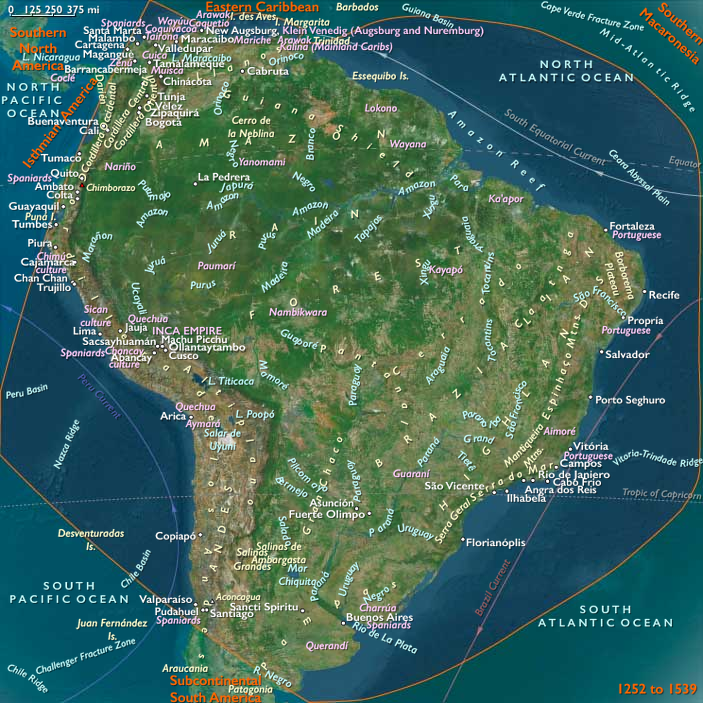
The Inca Empire has reached its maximum…
1492 CE to 1503 CE
Such powerful states as the coastal Chimu Kingdom are defeated and incorporated into the empire, although the Chimus speak a language, Yunga, that is entirely distinct from the Incas' Quechua.
The limits of the central Andean culture area are reached in present-day Chile and Argentina, as well as in the Amazon forests, where the Incas encounter serious resistance, and these territories are never thoroughly subjugated.
At the outset, the Incas share with most of their ethnic neighbors the same basic technology: weaving, pottery, metallurgy, architecture, construction engineering, and irrigation agriculture.
During their period of dominance, little is added to this inventory of skills, other than the size of the population they rule and the degree and efficiency of control they attain.
The latter, however, constitute a rather remarkable accomplishment, particularly because it is achieved without benefit of either the wheel or a formal system of writing.
Instead of writing, the Incas use the intricate and highly accurate quipu (knot-tying) system of record-keeping.
Imperial achievements are the more extraordinary considering the relative brevity of the period during which the empire is built (perhaps four generations) and the formidable geographic obstacles of the Andean landscape.
Viewed from the present-day perspective of Peruvian underdevelopment, one cannot help but admire a system that managed to bring under cultivation four times the amount of arable land cultivated today.
Achievements such as these will cause some twentieth-century Peruvian scholars of the indigenous peoples, known as indigenistas (indigenists), such as Hildebrando Castro Pozo and Luis Eduardo Valcarcel, to idealize the Inca past and to overlook the hierarchical nature and totalitarian mechanisms of social and political control erected during their Incan heyday.
To other intellectuals, however, from Jose Carlos Mariategui to Luis Guillermo Lumbreras, the path to development ion Peru has continued to call for some sort of return to the country's pre-Columbian past of communal values, autochthonous technology, and genius for production and organization.
Locations
Commodities
Subjects
Regions
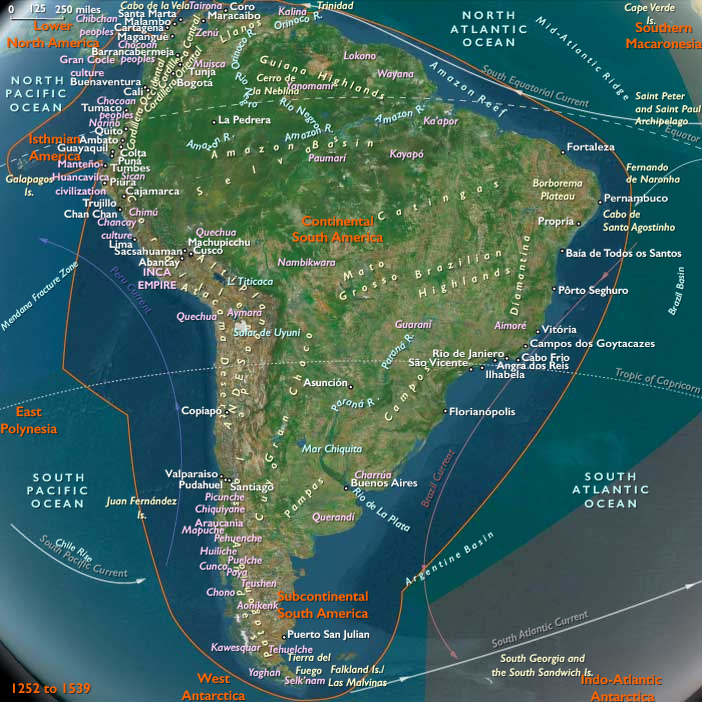
South America
View →Subregions